


If Oil Prices Don't Fall, the Global Economy Can Only Head Toward "Slow Growth + High Inflation"
Sustained high oil prices are pushing the global economy toward a "slow growth + high inflation" pattern. Morgan Stanley warns that prolonged high oil prices will have deep economic impacts, leading to stagflationary characteristics. Research indicates that the persistence of oil prices will subject businesses to long-term cost shocks, eventually passing the pressure to the pricing end. Although headline inflation data may improve, inflation risks remain tilted to the upside. High energy costs will weigh on consumption and corporate profit margins, affecting economic activity
Sustained high oil prices are pushing the global economy toward a disturbing macroeconomic landscape: the coexistence of slowing growth and stubborn inflation. Morgan Stanley warns that the true risk lies not in a single sharp oil price shock, but in the deep-seated impact of high oil prices being maintained over the long term and failing to recede.
According to Zhuifeng Trading Desk, a research team led by Morgan Stanley's Chief Global Economist Seth B Carpenter pointed out in their latest report that even if geopolitical tensions around the Strait of Hormuz do not escalate further, partial restrictions on crude oil supply could be maintained for a considerable time, keeping oil prices burdened by a geopolitical premium.
In this scenario, the global economy faces not a transient price shock, but a sustained elevation of energy costs—its macroeconomic impact will be far more complex than any oil price shock in history and will possess clear stagflationary characteristics.
The direction of this shock is stagflationary, causing monetary and fiscal policies to diverge significantly and producing starkly different impacts on various economies. For investors, this means that interest rate cut expectations need to be repriced, and the divergence in policy paths across countries will become a key variable in asset allocation.
Inflation Risks Underestimated: Second-Round Effects More Persistent Than Historically
Morgan Stanley notes that the fundamental difference in this oil price shock compared to previous ones lies in the "persistence" of prices rather than the "peak." In past oil price shocks, prices often retreated rapidly after rising, naturally compressing the duration of inflation transmission.
However, if oil prices stay high for a long period and lack mean reversion, businesses will face a protracted cost shock. Their ability to absorb costs by compressing profit margins will gradually be exhausted, eventually forcing them to pass the pressure to the pricing end.
This means that even if the year-on-year increase in energy prices narrows mathematically over time, the second-round effects—the transmission of energy costs to the prices of a broader range of goods and services—will be more stubborn than historical experience suggests. Therefore, even if headline inflation data appears to improve on the surface, inflation risks remain tilted to the upside.
Meanwhile, growth is slowing but will not collapse. Sustained high energy costs act as an implicit tax on consumption and corporate profit margins, weighing on economic activity in both developed and emerging markets. This drag effect takes time to fully manifest, but its impact cannot be ignored. The Global Recession this scenario could lead to would mean the disinflationary shock from slowing growth is insufficient to offset the upward push of second-round effects—thus forming a stagflationary pattern.
Central Bank Policy Divergence: Fed on Hold, ECB Leaning Toward Hikes
Facing stagflationary pressures, the policy orientations of major central banks have shown clear divergence, which will be the core variable affecting the global interest rate market.
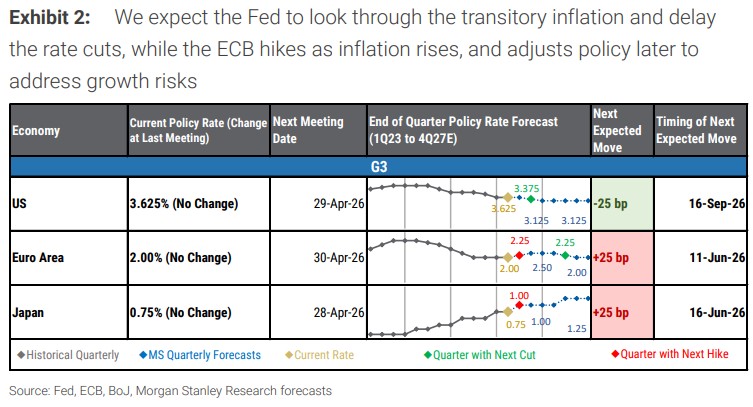
Central banks more sensitive to inflation expectations—especially the European Central Bank and the Bank of England—tend toward further tightening in the current environment. According to their latest forecasts, the ECB's next move is a 25 basis point rate hike, with the timing expected in June 2026; the Bank of Japan is likewise expected to hike rates by 25 basis points in June 2026.
In contrast, the Federal Reserve's situation is more complex. The Fed will choose to pause rather than cut rates, and this pause may last for a considerable time. Its baseline forecast shows that the window for the Fed's next 25 basis point rate cut is September 2026, provided that inflation expectations do not significantly drift. If inflation expectations show upward signals, the Fed may even maintain its restrictive policy stance until 2027.
Responses from emerging market central banks are more dispersed, highly dependent on individual countries' fiscal conditions and external vulnerabilities, making it difficult to form a unified policy direction.
Fiscal Policy: The Double-Edged Sword of Energy Subsidies Exacerbates Global Divergence
At the fiscal policy level, how governments respond will profoundly influence inflation trends and further exacerbate the divergence in the global macro landscape.
Many governments are leaning toward broad price suppression measures, including cutting fuel taxes, setting price caps, or implementing universal subsidies, shifting the cost burden from residents to public or quasi-public balance sheets. While these measures provide a short-term buffer, they distort price signals, support demand, and potentially keep inflation high over the long term—especially when these measures are difficult to sustain due to fiscal space constraints.
For energy-importing emerging markets with limited fiscal space, broad subsidies could harm external account balances and policy credibility; meanwhile, energy exporters benefit from improved terms of trade, with some countries gaining additional fiscal revenue. This divergence is the deep-seated reason why emerging market central bank policies are highly differentiated and difficult to coordinate.
In contrast, countries taking more targeted support measures—focusing on vulnerable households or specific industries while allowing energy prices to be more fully passed through—will see consumers under greater pressure in the short term, but will have lower fiscal costs and more controllable inflation shocks, at the cost of greater downside risk to growth. Given current high debt levels, rising financing costs, and the re-tightening of fiscal rules, the likelihood of large-scale fiscal intervention is limited unless recession risks rise significantly.
The above insightful content is from Zhuifeng Trading Desk.
For more detailed interpretations, including real-time analysis and front-line research, please join the [ **Zhuifeng Trading Desk ▪ Annual Membership**]

Risk Warning and Disclaimer
The market carries risks, and investment requires caution. This article does not constitute personal investment advice, nor does it take into account the specific investment objectives, financial situations, or needs of individual users. Users should consider whether any opinions, views, or conclusions in this article are appropriate for their particular circumstances. Investing based on this is at your own risk.