


AI Disrupting China's Online Gaming? JPMorgan: Market Is Ignoring the Real Moat
Under China's unique game licensing system, AI is not a disruptor to existing major operators but an amplifier of their competitive advantages. Licensing barriers block the impact of massive new games, allowing large companies to steadily enjoy the huge benefits of AI in cost reduction, efficiency improvement, and revitalizing existing user bases. JPMorgan believes the recent valuation compression experienced by companies like Tencent and NetEase is a market misjudgment
AI is reshaping the competitive landscape of the global gaming industry, but JPMorgan believes the market is making a directional error when applying this logic to major Chinese game operators.
According to "Zhuifeng Trading Desk," JPMorgan released a research report on April 8 stating that the recent downward revision of valuations for leading Chinese game operators like Tencent and NetEase reflects a misreading of applying the global AI disruption narrative indiscriminately to the Chinese market.
Under China's unique game licensing and regulatory system, AI is not a disruptor to existing major operators but an amplifier of their competitive advantages.
The licensing system sets a hard cap on the number of games that can be legally monetized. The vast number of new games spawned by AI lowering production thresholds cannot bypass this regulatory bottleneck to reach consumers. Major operators like Tencent and NetEase, who already hold licenses, will disproportionately benefit from the efficiency gains brought by AI.
GDC 2026: AI Implementation Has Moved from "Possible" to "Reality"
The 2026 Game Developers Conference (GDC 2026), held in San Francisco this March, served as the most comprehensive public window to observe the actual deployment of AI in the gaming industry to date.
Compared to previous years, a significant change at this year's conference was that the vast majority of AI-related sessions showcased production systems that are already in use and generating measurable value, rather than technical outlooks still in the conceptual stage. Of the hundreds of sessions at GDC, nearly half were related to AI, and the consensus has shifted from "whether to use AI" to "how to use AI effectively."
Chinese companies were particularly noteworthy at this GDC. Tencent alone participated in over 20 sessions, covering AI-driven rendering, asset generation, anti-cheat systems, and player experience tools, comprehensively demonstrating the deep integration of AI across its entire production and operational stack.
Industry insiders noted that in the AI track, Chinese developers' sessions accounted for a significant proportion in showcasing cutting-edge technologies.
The Licensing System: Transforming AI from a Threat into a Moat
AI's impact on the Chinese game market is structurally fundamentally different from its impact on open markets in Europe and America; the key variable is the game licensing system.
In the European and American PC and console markets, any developer can freely publish games on platforms like Steam. AI-driven mass production directly leads to a surge in content supply, increased competition, and pressure on profit margins.
However, in China, every game that can be legally monetized requires an ISBN license issued by the National Press and Publication Administration. This approval process imposes a hard limit on the number of games that can enter the market within a specific period.
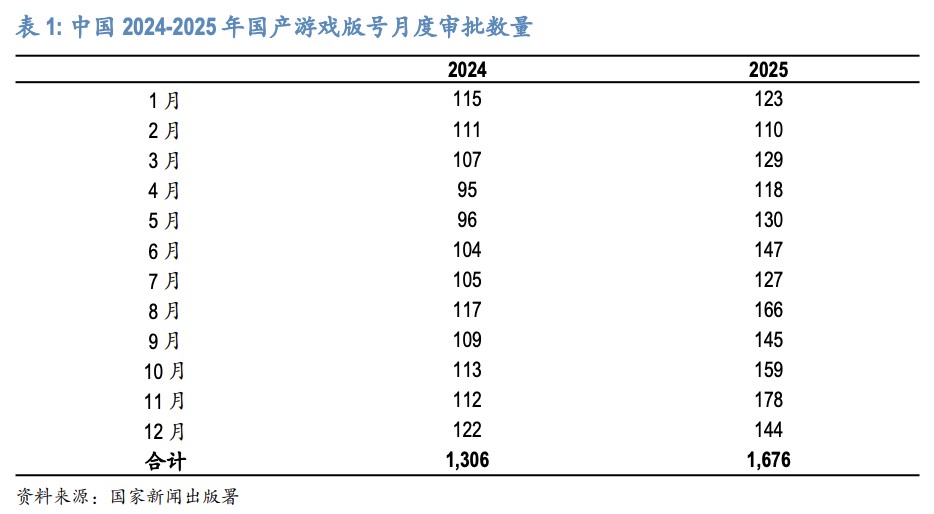
Data shows that the total number of domestic game licenses approved in 2025 was approximately 1,676, a year-on-year increase of about 19%. However, the growth rate of submitted games is still far faster than the approval capacity. With AI further reducing production costs, more games will reach a submit-worthy quality, potentially widening the approval gap.
The complexity of intellectual property and content compliance review introduced by AI-generated assets may actually slow down the approval process rather than accelerate it.
Tencent has publicly stated that its AI model training is fully based on its own commercially validated assets and employs a "data closed-loop" strategy. This approach directly circumvents the compliance risks most likely to be scrutinized by regulators. Smaller studios relying on public or open-source training data may face greater regulatory friction.
Four Mechanisms: How AI Strengthens Tencent's and NetEase's Competitive Position
AI will consolidate the advantages of major operators through four mutually reinforcing mechanisms.
First, the return on AI investment has a non-linear relationship with player scale. Operators can continuously refresh and expand existing approved games using AI without needing to apply for new licenses for new games. Remaking a game with a cumulative player base of 200 million generates an order of magnitude more incremental revenue per dollar of AI investment than remaking a game with 5 million players.
Tencent's battle royale game's new AI companion system has attracted over 100 million users, with concurrent users exceeding 10 million, transforming users who previously avoided multiplayer games into active paying users. This serves as the most direct validation of this logic.
Second, orchestration capabilities constitute a more durable moat than a single model. The true competitive barrier lies in the organizational capability to orchestrate dozens of AI components into a production-level pipeline—this is an organizational capability, not a technical one, and spreads much slower than any single model.
NetEase's hybrid super-resolution pipeline also exemplifies this characteristic: routing each texture surface to the optimal upscaling method via custom classifiers is a system-level design that requires deep domain knowledge to build.
Third, the UGC platform model is expected to channel AI content democratization internally into existing ecosystems. Several Chinese games with high daily active users have launched or expanded user-generated content platforms. The key is that UGC content created within existing approved games does not require a separate license. This means AI-driven content creation democratization will nourish existing player ecosystems rather than incubating independent competitors.
Fourth, operational AI forms a self-reinforcing advantage. AI-driven anti-cheat, personalized monetization, and player retention models all improve with the expansion of data volume. Operators with tens of millions of concurrent users generate training signals for these systems far superior to their peers with only hundreds of thousands of users, thereby creating a positive flywheel of "larger player base—better AI models—better player experience—attracting more players."
Valuation Judgment: Current Downgrades Reflect an Incorrect Narrative
The recent valuation compression experienced by companies like Tencent and NetEase stems from the market's misjudgment in indiscriminately applying the "AI disrupts existing vendors" narrative, which holds true in open markets, to a market where the structural landscape points in the opposite direction.
For Tencent, its closed-loop data strategy, AI orchestration capabilities across its entire production stack, dominant market share in key game genres, and its B2B path to monetize AI infrastructure externally through Tencent Cloud gaming solutions collectively make it the clearest beneficiary of China's AI gaming transformation, with its technological moat continuously widening.
For NetEase, its AI capabilities rely more on a combination of open-source and third-party tools rather than proprietary fundamental research, making the production-side advantages relatively more replicable. AI moat width is less than Tencent's. However, NetEase's deep IP reserves, agile game design, and operational scale still place it in an advantageous position within a competitive environment constrained by license supply.
Once the market narrative shifts from "AI disrupts existing vendors" to "AI strengthens existing vendors in a supply-constrained market," the valuations of Tencent's and NetEase's gaming businesses still have significant room for improvement.
