


Can Microsoft 'Buy the Dip' Now?
After plummeting 34% from its historical high, Microsoft's stock appears to be bottoming out. Bernstein analysts point out that AI hardware investments typically take six months to convert into revenue, and this critical inflection point is now approaching, with Azure growth rates expected to accelerate over the next two quarters. Additionally, defensive attributes and direct monetization capabilities provide support for Microsoft's stock price
After months of deep correction, Microsoft stock is attracting renewed scrutiny from Wall Street. Some analysts believe that as AI capital expenditures begin to convert into revenue, current valuations may represent a reasonable buying window—yet simultaneously, strategic missteps in data center expansion are continuing to pressure cloud business growth.
Recently, Bernstein analyst Mark Moerdler released a research report for clients stating that Microsoft Azure's revenue growth rate is expected to accelerate over the next two quarters, citing that it typically takes about six months from hardware procurement to generating revenue, and this conversion inflection point is now nearing. He believes that current stock prices present a reasonable entry opportunity for new investors.
At the same time, Piper Sandler analyst Billy Fitzsimmons also stated in last week's research report that despite strong market concerns regarding capital expenditures, Microsoft remains one of the most defensive companies in the software sector, with its Azure cloud infrastructure directly benefiting from AI demand serving as core support.
Additionally, as previously reported by Wallstreetcn, Microsoft slowed down data center construction last year and is now beginning to catch up. To make up for the gap, Microsoft has recently shifted to off-grid data center solutions relying on natural gas self-generation, signing multiple large-scale agreements in Texas and West Virginia with a total planned capacity exceeding 4.75 gigawatts.
Stock rebounds from lows but remains deeply in the red for the year
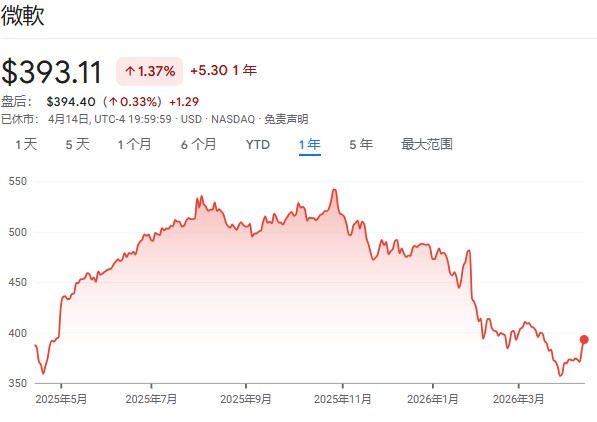
Microsoft's stock has faced significant pressure this year. From a historical closing high of $542.07 on October 28 last year to an annual low of $356.77 reached on March 27 this year, the cumulative decline was 34.2%.
However, recent signs of stabilization have emerged. The stock rose 3.6% on Monday and another 2.3% on Tuesday, rebounding approximately 10.2% since the March 27 low. Mark Moerdler described this trend as a characteristic "oscillation along the bottom" and believes that while there remains uncertainty regarding when AI spending will translate into actual revenue, current valuations offer entry value for new investors.
From a broader macro perspective, Microsoft's stock has still fallen 18.7% year-to-date, performing slightly better than the iShares Expanded Tech-Software Sector ETF (IGV) in which it resides—the latter having declined 24.8% this year. That ETF just touched its lowest closing price since November 2023 last Friday, indicating that the confirmation of the bottom for the entire software sector occurred about three weeks later than for Microsoft itself.
Capital Expenditure Conversion Logic: The Critical Six-Month Inflection Point
The core concern among investors lies in the fact that Microsoft's massive AI infrastructure investments have yet to reflect in Azure's revenue growth. Mark Moerdler provided an explanatory framework for this in his research report.
He pointed out that there are several reasonable reasons why capital expenditures have not been timely reflected in Azure growth: Microsoft likely allocated a significant portion of its computing power to training its own models and supporting first-party applications like Office and Copilot. These investments do not directly translate into external cloud service revenue in the short term.
The key lies in the time window. Moerdler stated, it typically takes Microsoft about six months from purchasing hardware components to servers officially generating revenue. "Two quarters ago, this transition began, and we believe Microsoft is about to start reaping results," he wrote. This implies that if this judgment holds true, signals of accelerated Azure growth could be verified in earnings reports as early as the next two quarters.
Data Center Strategic Misstep, Now Catching Up
However, the premise supporting accelerated Azure growth is facing a test born of its own mistakes.
According to The Information, Microsoft CFO Amy Hood actively halted multiple data center expansion plans from late 2024 to early 2025, causing the company to withdraw or delay projects in various locations across the US and Europe. This financial-level braking directly handed over valuable grid access qualifications. Oracle subsequently seized a large amount of public utility capacity in Port Washington, Wisconsin, while Google took the opportunity to accelerate the construction of its two campuses in Indiana.
To make up for the capacity gap, Microsoft has recently shifted to off-grid data center solutions relying on natural gas self-generation, signing multiple large-scale agreements in Texas and West Virginia with a total planned capacity exceeding 4.75 gigawatts. This strategic shift comes at a higher cost and creates obvious tension with Microsoft's long-standing public commitment to clean energy, surprising industry infrastructure professionals.
Microsoft has publicly acknowledged that Azure cloud business will face capacity constraints at least until the end of the current fiscal year (ending June this year).
Defensive Attributes and Direct Monetization Capabilities Provide Support
Some analysts hold a relatively optimistic view of Microsoft's medium-term prospects, citing structural advantages in its business model.
Piper Sandler's Billy Fitzsimmons stated in last week's research report that while he acknowledges market concerns regarding capital expenditures are reasonable, Microsoft remains one of the most defensive companies in the software sector. The core logic is that Microsoft can directly monetize AI demand through its Azure cloud infrastructure, and terminal demand facing Azure remains ample.
Oracle's stock surged cumulatively by 18% over the past two trading days, despite still falling 16.4% year-to-date; its recent strong performance reflects, to some extent, a repricing of the cloud infrastructure track by the market. For Microsoft, whether it can fulfill expectations for accelerated Azure growth once capacity constraints gradually ease will be the key variable determining whether this rebound can continue.
