


Global Aluminum Inventory Stands at Just 9 Days
JPMorgan estimates that due to severe disruptions from the Middle East conflict, the global aluminum market will face a supply shortfall of 1.9 million tons in 2026—the largest since 2000. Current visible global inventory is only about 1.9 million tons, covering just nine days of demand. The bank forecasts aluminum prices could break through $4,000 per ton in the coming months, with a second-quarter average price forecast of $3,800 per ton
The war in the Middle East has severed the global aluminum supply chain, leaving global aluminum inventory as thin as paper—just nine days remaining.
According to Zhuifeng Trading Desk, on April 13, JPMorgan's Commodities Research team released an in-depth report on the aluminum market titled "Into the Void," stating that the global aluminum market is facing its most severe supply crisis in over two decades due to heavy impacts from the Middle East conflict.
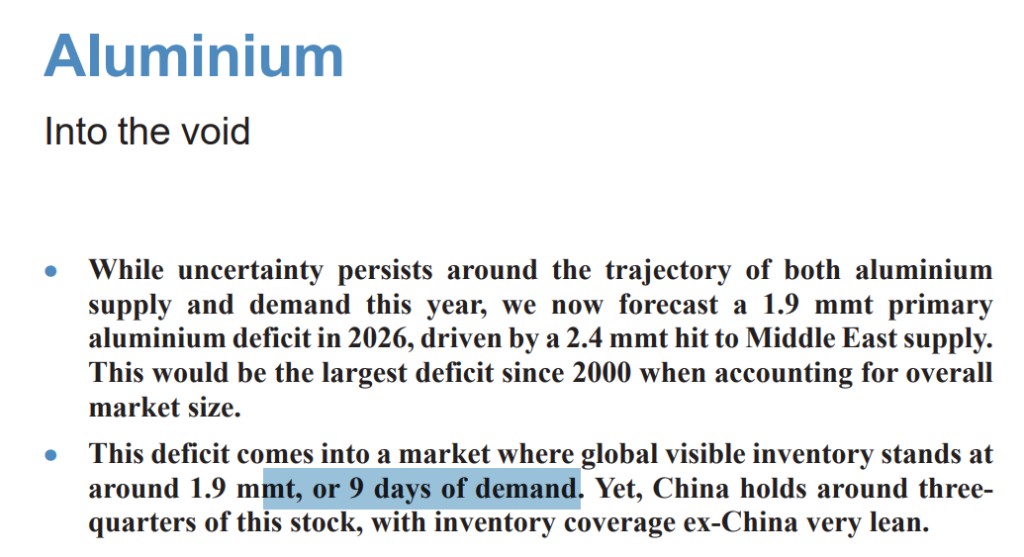
Global visible aluminum inventory (exchange inventory plus social inventory) is currently approximately 1.9 million tons, covering only nine days of demand.
How tight is this figure? Consider: early 2021 saw global inventory covering about 20 days of demand, with some regions outside Asia reaching up to 40 days. Today's buffer space is less than half of what it was back then.
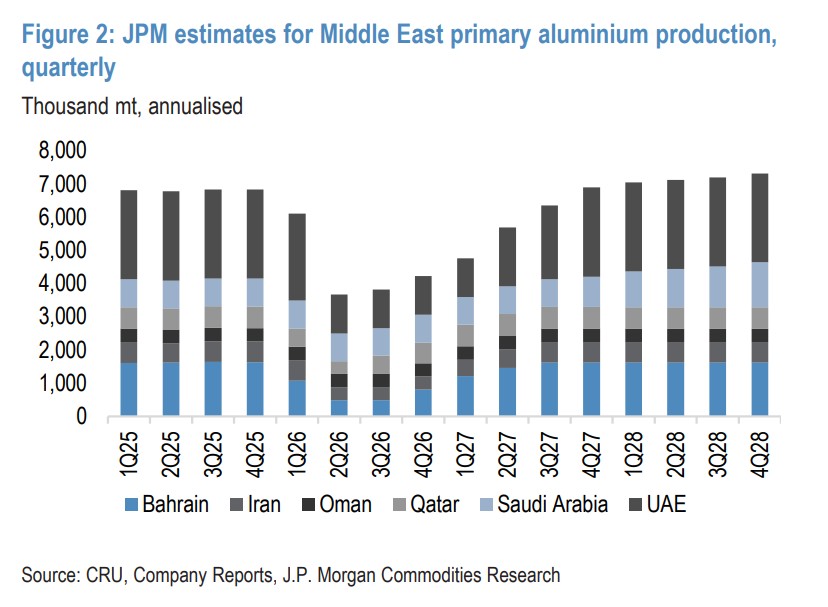
Supply "Event Horizon": 2.4 Million Tons Lost in the Middle East
JPMorgan uses the concept of a black hole's "event horizon" to describe the current situation—as soon as this critical threshold is crossed, regardless of how the situation evolves, the supply loss becomes irreversible.
The report suggests that as information continues to emerge regarding the damage sustained by the Abu Dhabi Al Taweelah smelter and Bahrain's Alba smelter on March 28, the aluminum market "has likely already crossed this threshold."
Specifically:
-
Al Taweelah Smelter (owned by EGA, with an annual capacity of 1.5 million tons) has confirmed production suspension, with a repair cycle lasting up to 12 months. This alone will reduce 2026 supply by over 1 million tons.
-
Alba Smelter (Bahrain) is currently estimated to have only lines 4 and 5 suspended (with lines 1-3 previously halted), while line 6 remains operational, achieving a capacity utilization rate of approximately 30%, consistent with Wood Mackenzie's preliminary assumptions.
-
Production losses in Iran remain under further assessment.
In summary, JPMorgan projects that Middle Eastern aluminum output will decline by 36% year-over-year in 2026, resulting in a loss of about 2.4 million tons; output in 2027 is still expected to be approximately 950,000 tons lower than pre-conflict forecasts.
A net reduction of nearly 2 million tons in global supply will mark the first year-on-year contraction in global aluminum production since 2019.
Other Regions Struggle to Fill the Gap
Can the gap be filled elsewhere? JPMorgan's answer is: difficult, at least not within 2026.
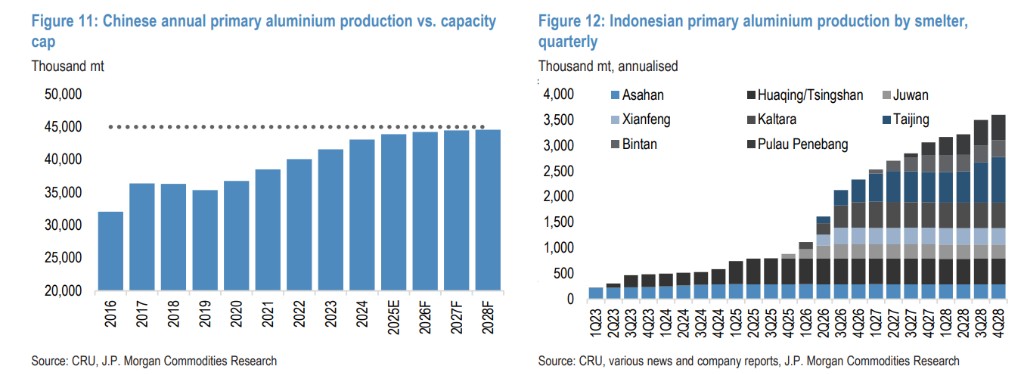
China: JPMorgan has raised its supply forecast for China for 2026-2028 by approximately 300,000–400,000 tons annually, citing high prices and improved profit margins driving capacity utilization toward the 450,000-ton-per-year ceiling. However, the report explicitly states that the probability of China raising its capacity ceiling is "relatively low"—this ceiling has been part of China's long-term policy framework since 2017, representing a policy outcome aimed at curbing excessive competition. Even if policies loosen, actual production responses would take several months to quarters, offering limited help for 2026.
Indonesia: JPMorgan slightly increased its Indonesia supply forecast for 2026 (accelerated commissioning of the Kaltara project), projecting total output growth of approximately 1 million tons for the full year 2026, with a fourth quarter 2026 annualized incremental increase of around 1.4 million tons compared to Q4 2025. However, larger increases are expected to materialize in 2027 and beyond.
Europe: With energy prices remaining high (most smelters closed after the 2022 energy shock), there is virtually no room for resumption of operations. Mozambique's Mozal smelter (annual capacity of 580,000 tons) is a potential candidate for restarting production but faces a lengthy ramp-up period and power supply challenges.
With supply plummeting, the demand side is also undergoing a reshuffle. JPMorgan has lowered its 2026 global primary aluminum demand growth forecast from over 1.7% to 1.4%.
Price Trajectory: Asymmetric Upside, Targeting $4,000
JPMorgan's core judgment is that the upward trajectory for aluminum prices has formed an asymmetric structure—regardless of how the situation evolves, prices tend to rise.
-
If the situation escalates further: Increased blockage of the Strait of Hormuz, expanded damage to smelting infrastructure, and broader shutdowns driven by alumina supply constraints will deepen the supply shock.
-
If the situation clearly de-escalates: Macroeconomic tail risks will subside, improving demand expectations, but since the supply loss is now inevitable, aluminum prices may actually strengthen further.
Currently, LME aluminum prices struggle to sustainably break above $3,500 per ton, partly because long positions held by commodity investors are already quite crowded. However, JPMorgan believes that as the supply gap becomes increasingly evident in physical markets, prices will accelerate upward.
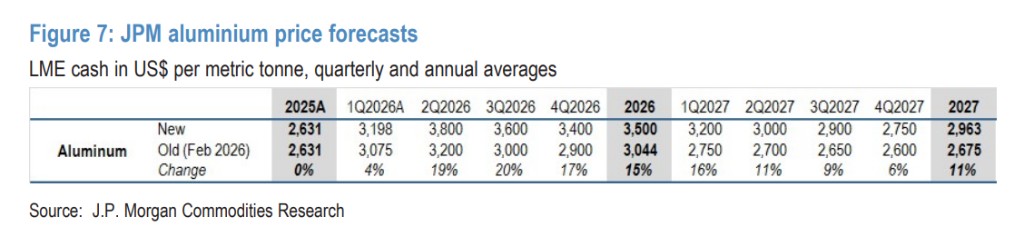
JPMorgan forecasts that aluminum prices could break through $4,000 per ton in the coming months, with a second-quarter average price forecast of $3,800 per ton and a full-year average of approximately $3,500 per ton.
The report also notes that if a prolonged blockade of the Strait of Hormuz triggers a severe macroeconomic recession, the impact on the demand side could far exceed current forecasts, potentially causing aluminum prices to fall more significantly within the year.
