"Short Now While You Still Can"! Goldman Sachs Warns US Stocks Have Risen Too Far, Proposes Six Hedging Trades

Wallstreetcn
2026.04.16 07:45

In response to escalating geopolitical tensions and risks of slowing growth, Goldman Sachs has outlined six trading strategies covering S&P 500 puts, widening credit spreads, receiver interest rate spreads, short sterling, and long grains. By using option structures to cap losses at the premium paid, the firm aims to capture potential returns of up to 13x amid volatility to mitigate potential de-risking shocks in the market

As risk assets return to historical highs, Goldman Sachs issues a warning: market gains have been too aggressive, presenting an opportune moment to deploy cross-asset hedges.

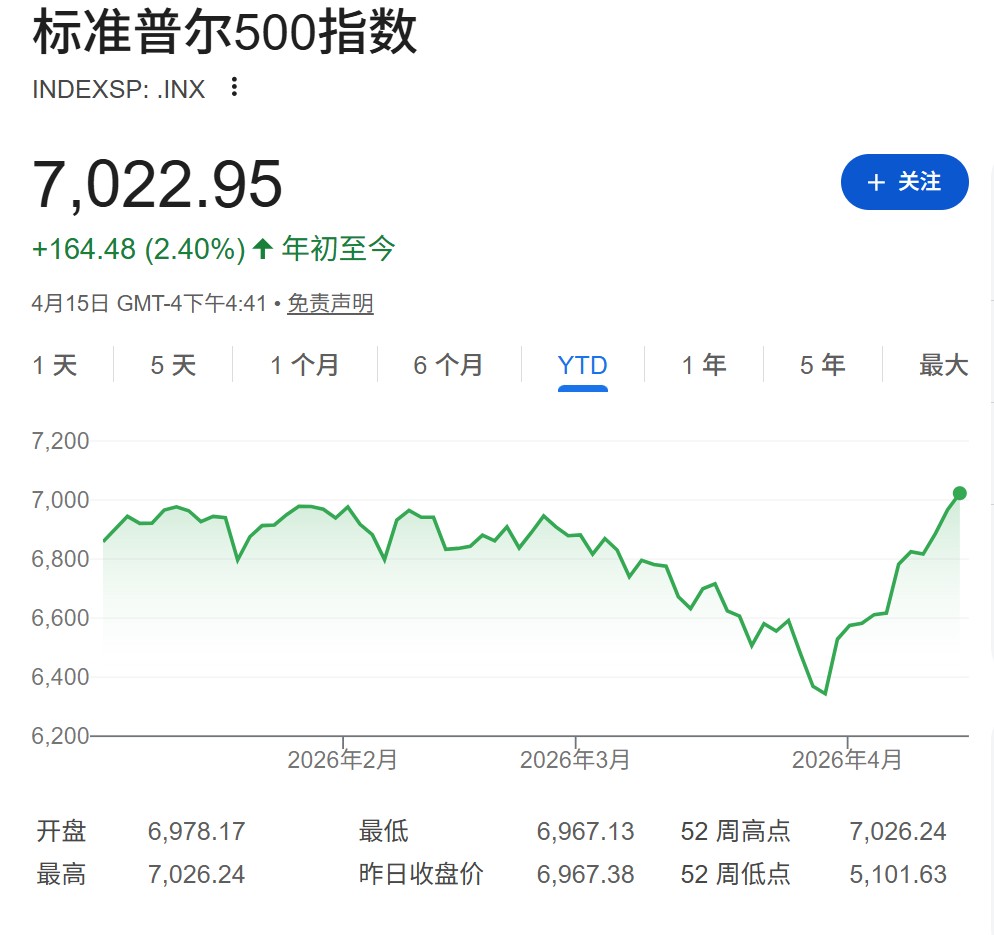
Goldman Sachs trader Tom Shea noted in a new report that the market has "risen too far," advising investors to "act while there is still time" to build hedged positions against two potential risk scenarios: a resurgence in geopolitical tensions, and continued de-risking coupled with slowing growth and elevated inflation. The report was released on April 16, as the S&P 500 index touched a record high of 7,022 points.

Goldman Sachs proposed six specific trades spanning five asset classes: equities, credit, rates, foreign exchange, and commodities. All structures are designed with the premise that maximum loss equals the premium paid, balancing risk control with potential returns. Some trades offer maximum gross return multiples exceeding 13 times.

Equities: S&P Correction Room Opens, Bear Put Spread Offers Attractive Value

Regarding equities, Goldman Sachs recommends buying SPY Bear Put Spread options.

The report notes that the S&P 500 fell from its January high of 6,978 points to a March low of 6,368 points, a decline of approximately 9%, before staging a strong rebound to record highs. Meanwhile, implied volatility has retreated significantly, making option pricing relatively cheap and providing a favorable entry point for directional hedges.

The specific structure involves buying a May 8 expiration SPY 680/630 Bear Put Spread for a premium of $3.80, with a reference price of $699.94. This expiration covers earnings reports for approximately 80% of S&P 500 constituents, as well as three key catalyst events: the Federal Reserve's interest rate meeting (April 29) and the non-farm payrolls release (May 8). If the S&P 500 falls back to its yearly low before May 8, the structure offers a maximum gross return multiple of 13.2x, with a breakeven point approximately 3.4% below current levels and a Delta of roughly -20%.

Credit: IG Spreads Normalize, HY Technicals Weakest

In the credit markets, Goldman Sachs is positioning across both investment-grade and high-yield segments.

For investment-grade credit, Goldman Sachs suggests buying protection on the CDX IG46 index. The report notes that CDX IG widened from 55 basis points to 68 basis points by late March, before fully contracting back to 54 basis points. As the most liquid instrument in the macro credit market, the CDX index can rapidly amplify beta exposure to equities under market stress, a dynamic clearly demonstrated in March. The new Series 46 is particularly attractive because it includes ultra-large cloud computing companies, giving the technology sector a 12% weighting. Once market attention shifts back to artificial intelligence and related financing topics, this index has the potential to widen significantly, while carrying relatively low holding costs.

For high-yield credit, Goldman Sachs recommends shorting the HY 100 cash bond basket. The report states that dollar-denominated high-yield bonds are currently the weakest segment in terms of capital flow technicals within the credit market, experiencing persistent net outflows over the past six months—the only sub-segment with net outflows. High-yield cash bond spreads are currently at the 5th percentile since 2007, offering an asymmetric risk-averse exposure suitable for positioning against deteriorating economic growth or a resurgence in credit risk. The specific operation involves selling a $100 million GSUCH100 basket while simultaneously purchasing $91 million worth of equivalent duration US Treasuries, stripping out rate exposure via swaps to purely bet on spread widening.

Rates: Front-End Receiver Spreads Regain Attractiveness

In the interest rate markets, Goldman Sachs recommends buying front-end receiver spreads.

The report notes that following a recent round of hawkish central bank meetings and deleveraging in the rate markets, the market is now pricing in only about 8 basis points of rate cuts for the year and fewer than two cuts over the next three years. However, Goldman Sachs believes the threshold for hiking rates remains extremely high—the current structure of the labor market does not support raising rates to suppress inflationary sources.

If interest rates fall significantly over the next year, it will likely be driven by the front end, as the labor market will then be the core driver of this shift. Goldman Sachs also points out that current rate volatility is approaching pre-conflict levels, making receiver spreads attractive again for entry. The report recommends longer-duration instruments maturing in one and two years: if geopolitical conflicts persist and near-term oil prices remain elevated, forcing the Federal Reserve to hold steady until more tangible progress on inflation is made, such structures would also prove effective.

FX: Sterling Could Be the Most Vulnerable Currency to Energy Shocks

In the foreign exchange arena, Goldman Sachs is bearish on the British pound against the US dollar, recommending buying GBPUSD binary put options.

The report outlines three rationales: First, long-dated energy prices remain quite firm, whereas the repricing of long-dated energy prices in 2022 drove GBPUSD down by approximately 22%, far exceeding the roughly 70 basis point decline year-to-date; downside space has not yet been fully priced in. Second, the Bank of England is currently priced for approximately two rate hikes this year, but youth unemployment is nearing 15%; if energy price shocks require rate hikes to curb inflation, it would bring significant recession risks. Third, the UK relies more heavily on natural gas than European peers, faces the highest industrial electricity costs, and carries high financing costs; once energy shocks persist, concerns over fiscal sustainability could resurface.

Additionally, the report notes that GBPUSD implied volatility has fallen below pre-Iran crisis levels, and the strike price skew required for binary options has been attractive over the past 15 years, offering a solid entry window.

The specific structure involves buying a GBPUSD December 18 expiration binary put option with a strike of 1.235, quoted at approximately 10% of the USD premium, with a reference spot price of 1.35. Maximum gross return is 10x, with losses capped at the premium paid.

Commodities: Grain Prices Lag Reaction, Agricultural Upside Underpriced

In the commodities sector, Goldman Sachs recommends buying call spread options on the BCOM Grains Index.

This index comprises corn, soybean, and wheat futures. It has already given back most of its March gains, rising only about 1% cumulatively since the outbreak of the conflict. The report attributes the lag in grain price reactions to the fact that farmers had largely completed fertilizer stocking for the current planting season before the conflict began, meaning demand-side impacts have not yet been significantly felt in the short term.

However, the report highlights that approximately 50% of global urea (a key nitrogen fertilizer) flows through the Strait of Hormuz. Even if the strait reopens immediately tomorrow, it would take months for urea prices to normalize. If fertilizer prices remain elevated before summer, when farmers begin placing orders for 2027, US corn acreage could drop from approximately 95 million acres to 80 million acres. A tightening supply-demand ratio would drive grain prices significantly higher.

The specific structure involves buying a 9-month BCOM Grains Index 34.25/39 call spread for a premium of 0.82, with a reference price of 31.20. Calculated on a $5 million premium scale, the maximum return multiple is approximately 6x, with losses capped at the premium paid.