


A 180 Billion Yuan Shadow War in Bank Technology
On April 14, PSBC successfully launched a remote sensing satellite in collaboration with Changguang Satellite, becoming the fourth commercial bank in China to participate in satellite development. ABC showcased a custom AI agent named "Lobster" to improve loan process efficiency. Industrial Bank's Executive Vice President presented technology progress via a digital avatar. China Merchants Bank proposed an "AI First" philosophy, while PAB views technology as its core competitive strength. The annual technology investment of 13 A-share listed banks exceeded 180 billion yuan, and the criteria for evaluating tech investment are shifting from scale to effectiveness
On April 14, the remote sensing satellite jointly developed by PSBC and Changguang Satellite was successfully launched on a carrier rocket in Jiuquan;
This full-color high-definition optical remote sensing satellite, featuring a resolution superior to 0.5 meters, has been integrated into the "Jilin-1" constellation system. Consequently, PSBC becomes the fourth commercial bank in China to independently participate in the development and launch of satellites.
Leaping from ground-level counters directly into space orbit, the banking industry is now enveloped in a strong geek atmosphere.
At ABC's performance briefing, Chairman Gu Shu unveiled the latest achievement—the ABC version of "Lobster."
Gu Shu stated that the company has launched a customized version called "Lobster (ABC-Claw)" based on the recently popular open-source agent OpenClaw. This tool helps relationship managers automatically cross-verify data and intelligently generate due diligence reports, thereby improving the efficiency of the credit process.
Industrial Bank's press conference presented an even more intuitive sense of technology, with Executive Vice President Sun Xiongpeng appearing on stage as a digital avatar to fluently report the bank's technological assets to investors.
The strategic positioning is equally clear across various financial statements:
China Merchants Bank proposed the "AI First" philosophy, building a new intelligent engine upon its existing retail advantages;
PAB, while scaling back high-risk businesses, regards technology as the core competitive strength to navigate economic cycles;
Industrial Bank defined digital and intelligent transformation as a life-or-death battle concerning the future in its financial report address.
This is a high-stakes bet on the future.
The total annual technology investment of 13 A-share listed state-owned and joint-stock banks exceeds 180 billion yuan.
Research reveals that behind these massive numbers, specific strategies among banks have begun to diverge. As net interest margins narrow into a norm, the yardstick for evaluating bank technology investment is shifting from scale to effectiveness.
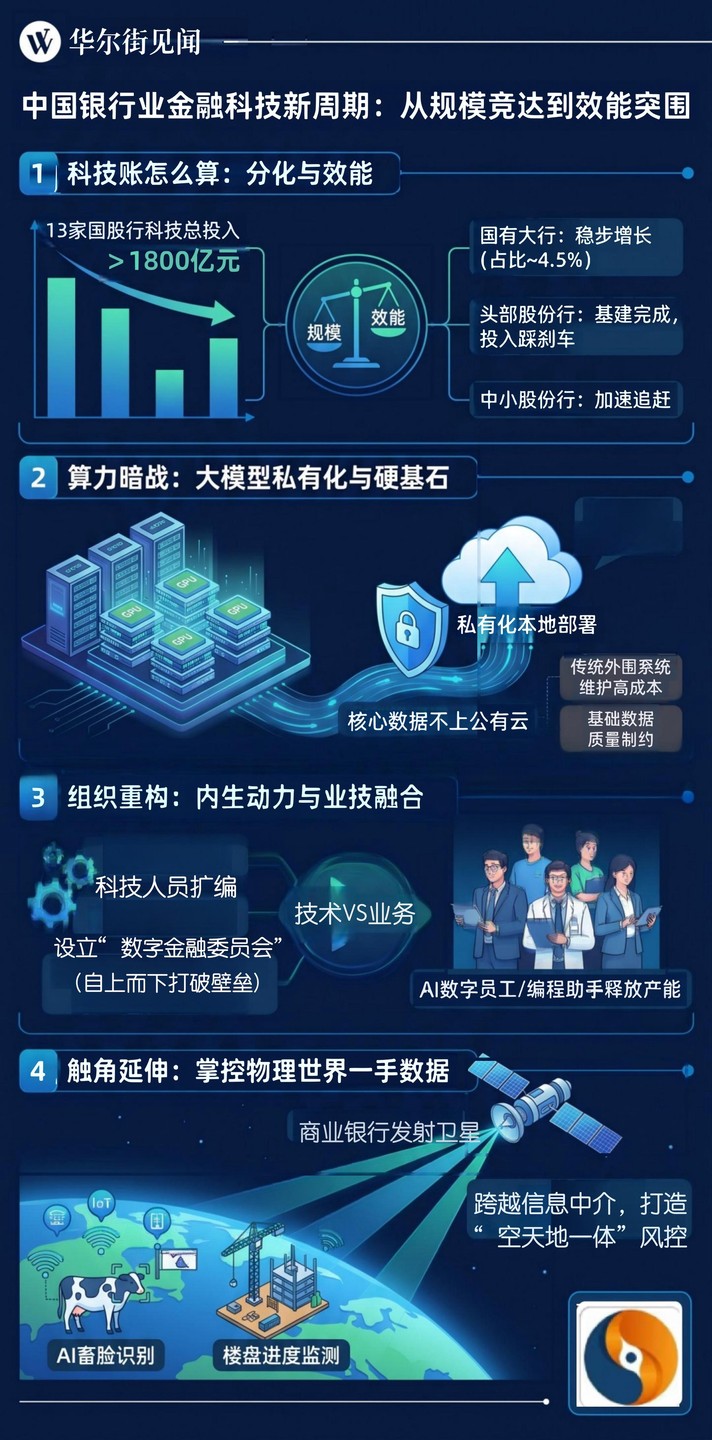
How to Calculate the Technology Account
According to annual report data, the financial technology of state-owned and joint-stock banks is currently at a subtle crossroads.
Excluding PAB and Zhejiang Commercial Bank which did not disclose specific data, the cumulative information technology investment of the 13 A-share state-owned and joint-stock banks in 2025 reached 183.878 billion yuan, a slight increase of 1.41% compared to 181.317 billion yuan the previous year;
From 2023 to 2025, the overall proportion of technology investment to revenue fluctuated slightly within the range of 4.53% to 4.57%.
Beneath this flat moving average, banks in different tiers present completely different evolutionary logics.
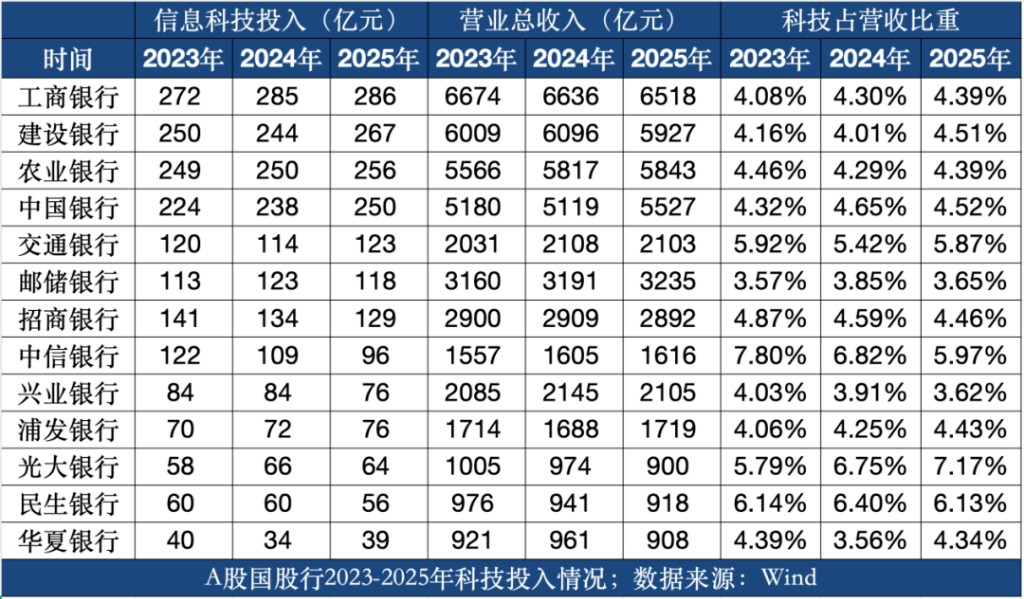
State-owned large banks rely on their revenue base to maintain stable investment and proportions.
From 2023 to 2025, the total information technology investment of the six major state-owned banks increased from 122.822 billion yuan to 130.091 billion yuan, with the proportion of revenue maintained around 4.0-4.5%, showing a slight upward trend.
BoCom, the most proactive, consistently maintains a technology investment proportion above 5%, while the relatively restrained PSBC remains below 4%;
ICBC, ABC, BOC, and CCB maintain highly consistent paces, with their 2025 investment proportions closely clustered around the 4.5% center point, at 4.39%, 4.39%, 4.52%, and 4.51% respectively.
More pronounced divergence occurs among joint-stock banks.
Joint-stock banks in the first tier of scale, such as China Merchants Bank, Industrial Bank, and CITIC Bank, have started to hit the brakes:
For example, China Merchants Bank's technology investment dropped from 14.126 billion yuan in 2023 to 12.901 billion yuan in 2025, and its proportion of revenue fell from 4.87% to 4.46%;
Industrial Bank's technology investment declined for three consecutive years, dropping to 3.62%, while CITIC Bank fell from 7.80% to 5.97%.
Some medium-sized joint-stock banks are still accelerating the chase:
For instance, Everbright Bank's technology investment proportion surged from 5.79% in 2023 to 7.17% in 2025. SPDB and Huaxia Bank also showed simultaneous increases in both the scale and proportion of their technology investments.
This is a group of abnormal divergences—why, when the narrative of financial technology and large models becomes increasingly hot in the market, do the actual capital flows of top institutions not jump significantly but instead tend to converge?
The underlying reason for the slowdown of top institutions may not be strategic contraction, but rather that IT infrastructure has completed a generational leap.
In recent years, the banking industry has been gradually updating its underlying architecture:
In the first quarter of 2025, ABC held a concluding summary meeting for its distributed core engineering project, announcing the completion of the shutdown of large mainframes. This means the bank is gradually shedding dependence on centralized hardware and shifting towards a more agile cloud architecture;
After completing its distributed transformation, CCB has stabilized all domestic and foreign business on its new system, breaking through data silos from the bottom layer;
Among joint-stock banks, PAB successfully put its new generation of distributed core systems into operation by the end of 2025, completing the leap of key business systems from centralized to distributed and unit-based architectures, paving the way for subsequent high-frequency calls of AI large models.
The conclusion of IT infrastructure construction at the level of tens of billions of yuan suggests that for early-investing top banks, the concentrated expenditure period for expensive hardware procurement and basic software licensing is gradually passing.
After completing the foundational construction, the initial technology investments of top banks are gradually releasing effectiveness:
For example, China Merchants Bank's two major apps maintained a monthly active user base of 150 million at a high level. AI digital employees reduced per-customer operating costs, and the risk control hub based on multi-dimensional graph calculations intercepted over 10 billion yuan in high-risk credit lines this year, keeping the non-performing loan ratio at a low 0.94%.
Industrial Bank's technology investment proportion is only 3.62%, with an ROE of 8.69%, placing it at the middle level among joint-stock banks;
Thanks to the comprehensive integration of its "Corporate Banking + Interbank" digital platform, the bank's online wealth distribution and matching transaction scales have grown significantly, directly pulling the proportion of non-interest income against the trend to break through 30%.
Shadow War of Computing Power
With the phased conclusion of cloud-native transformation, the battleground between top banks has shifted from software architecture to the hardware foundation supporting artificial intelligence—GPU computing clusters.
Under the compliance baseline of data security, the banking industry has long formed a consensus that core data will not reside on public clouds.
Leading state-owned banks including ICBC, ABC, BOC, CCB, BoCom, and PSBC have all publicly disclosed in 2025 that they have fully initiated and deeply promoted the private local deployment of mainstream open-source large models, locking core models and data assets within their own systems;
Research finds that now more than three state-owned and joint-stock banks, including ICBC and ABC, have initiated the localized deployment of Lobster.
Bringing models into the intranet is the first step of compliance.
An executive from the technology department of a joint-stock bank pointed out that in the deep water zone of large model implementation, traditional external security gateways, due to rigid rules, easily lead to damaged business experience and false positives. The industry often constructs a "triage" style layered defense:
The system first judges the user's query intent, diverting ordinary routine Q&A, while automatically assigning high-risk instructions involving core data to specialized models trained with strict security protocols;
At the same time, technical teams use high-frequency simulated attack tests (red-blue confrontation) to force models to build internal immune defenses internally, pushing external rigid interception gateways to the second line, serving only as the final safety backup.
However, whether training specialized models or supporting the private circulation of massive data, it represents that each bank must allocate more resources to heavy-asset computing power infrastructure construction.
CCB disclosed that by the end of 2025, its "CCB Cloud" total computing power scale (including general, intelligent, and high-performance computing) had reached 568.36 PFlops (FP32);
ICBC and ABC also mentioned plans for trillion-card (GPU) level computing clusters during their performance briefings.
However, another reality test is whether underlying hardware resources can penetrate organizational barriers to translate into frontline business productivity.
As early as 2023, the official figure for the average off-counter rate in the banking industry already exceeded 97%;
But in the actual operation of physical outlets, there are still many smart counter devices where the daily effective business processing volume falls short of expectations due to interaction thresholds and insufficient aging-friendly design.
Internal R&D links also suffer from a disconnect between hardware computing power and grassroots processes.
Insiders learned that the energy of bank technology teams is currently heavily consumed by frequent regulatory data reporting tasks such as EAST (Exam Analysis System).
Meanwhile, although cloud-native iteration of core trading systems is underway, peripheral branches and rigid management mechanisms remain.
Global IT consulting giant Capgemini disclosed in its industry report that banks still need to spend up to 43% of their IT budget maintaining traditional peripheral systems, which severely squeezes resources for AI innovation;
IT research firm Gartner pointed out that by 2026, more than 30% of global banking generative AI projects will be forced to abandon after proof-of-concept;
The core constraints of these AI projects are not model capabilities, but rather poor basic data quality, budget limitations, shortage of composite talents, and unclear business value.
All the above indicate that for state-owned and joint-stock banks' computing power layout to advance further, it must evolve from simple hardware procurement into a systematic engineering project involving organizational processes, data governance, and business logic reconstruction.
Organizational Restructuring
When computing power layout evolves into a systematic project, it inevitably forces a reshuffle of organizational structures.
In the past, banks tended to package a large amount of IT peripheral R&D and testing links to external technology companies;
Although introducing external technical services moderately remains an industry norm, under the trend of deep application of large models and data assetization, excessive reliance on outsourcing has triggered regulatory concern about data leaks and loss of operational control.
In the second half of 2025, regulators issued multiple related fines: CCB was fined 2.9 million yuan for lack of outsourcing management mechanisms, while Everbright Bank and Minsheng Bank received fines of 4.3 million yuan and 5.9 million yuan respectively for risks associated with outsourced system operations.
These continuous fines point to a underlying logic—
The inherent management blind spots of the traditional outsourcing model have repeatedly touched the red lines of compliance and security.
This does not mean the banking industry will completely abandon outsourcing, but rather declares that in the new cycle driven by computing power, the architectural control rights of key systems and the R&D of core business logic must be brought back in-house.
For large-scale state-owned banks with strong internal technology departments, this inward convergence of core R&D capabilities is particularly resolute.
This has spawned a wave of expansion in the technology lines of state-owned and joint-stock banks in recent years:
According to statistics, the 11 state-owned and joint-stock banks that continuously disclosed the number of technology personnel saw their technology employee count increase by 7.81% overall at the end of 2024 compared to the end of the previous year; by the end of 2025, the growth rate significantly expanded to 17.79%;
Among them, CCB, BOC, and ICBC all experienced significant recruitment drives.
From the perspective of configuration density, Industrial Bank, which has a relatively restrained technology investment proportion, has a technology personnel proportion as high as 13.88%, far leading the state-owned and joint-stock bank camp.
This may be because Industrial Bank pioneered a differentiated path of "technology internalization + external output."
Relying on its subsidiary Industrial Financial Technology, the only one in China to export core banking system technology, and the "Silver Silver Platform" connecting nearly 800 institutions, its massive technology team has transformed into a To-B service unit that generates direct revenue.
This exception also indicates that the tech shadow war of state-owned and joint-stock banks will not stop at simple "recruitment."
Synchronized with personnel expansion is the cross-departmental organizational reform led by management:
From 2024 to 2025, several state-owned and joint-stock banks represented by BoCom, Everbright Bank, and Minsheng Bank have successively established "Digital Finance Committees" or similar top-level bodies led by bank-level leaders, attempting to break down barriers between business and technology departments through a top-down approach;
Additionally, BOC restructured its FinTech Department and Business R&D Department to align the collaborative pace of business lines and technology lines architecturally;
SPDB has already added a dedicated Artificial Intelligence Center internally.
Organizational adjustments that deeply bind technology and business are essentially helping technology departments shake off their purely backend support positioning;
When technical investment is included in the overall performance coordination of the entire bank, R&D output faces stricter cost-benefit considerations, and technical development will be linked to real business conversion.
To achieve this real business conversion, high-quality business data is the core prerequisite.
"In actual practice, forcefully pressuring business departments to sort out underlying data yields little effect," pointed out an executive from the technology department of a joint-stock bank. The past chronic disease lies in the fact that the benefits of governing data belong to the whole bank, but the cost of work is pressed onto the business itself.
To break this departmental game surrounding data assets, the technical side is reshaping the underlying collaboration paths.
The person indicated that the industry is trying to make governance costs technological: technical teams first use tools to reverse-generate data drafts, while the business side only needs to correct errors online;
At the same time, they prioritize creating "golden data sources" in high-value areas such as risk control, allowing business departments to intuitively feel the substantive loss reduction brought by data accuracy, thereby truly transforming technical collaboration into business benefits.
Besides relying on underlying tools to resolve collaboration friction, to fundamentally solve the chronic disease of mutual ignorance between business and technology, each bank is also starting to exert effort at the micro-job level.
For example, in 2025, Minsheng Bank further expanded its business analyst team, enabling professionals who understand both financial logic and code architecture to act as translators, reducing cross-departmental demand transmission and development losses;
SPDB deployed key personnel to form a "Credit Chain Engineering Task Force," using the task force model to directly break line segmentation and collaboratively develop and integrate the supply chain finance system.
In addition to internal transfers and training, this trend is also directly reflected in social recruitment.
For example, in 2025, when China Merchants Bank, Industrial Bank, PAB, and other joint-stock banks recruited positions such as trade finance/supply chain finance product managers and data analysts at headquarters and branches, they required candidates to deeply understand business pain points and coordinate technical development.
Organizational restructuring and the breaking of communication barriers have also allowed AI technology to first run through the financial closed loop of cost reduction and efficiency improvement in some high-frequency, standardized middle/back-office and corporate scenarios.
In the centralized operation and accounting links of middle/back offices, ICBC's 2024 calculation data shows that the AI digital employee matrix built within the bank bears a workload equivalent to 55,000 employees' annual man-hours every year;
In the high-standard scenario of financial market fund trading, CITIC Bank disclosed that its 2025 transaction automation rate broke through 80%, transaction processing efficiency increased by 5 times, thereby driving a rise in related transaction volumes;
Industrial Bank stated that its deployed AI programming assistants have covered over 90% of R&D personnel, significantly improving output efficiency in code writing and basic testing links.
Extending Reach
No matter how much computing power grows or how agile the middle-office organization becomes, banks ultimately have to face the more complex and treacherous real world of commerce.
For a long time, traditional bank risk control logic has always had structural blind spots—
Ledger risk control based on paper contracts, core enterprise guarantees, and traditional warehouse receipts is repeatedly penetrated easily when facing complex real assets in the sinking market and intentional fraud.
Real explosive cases have peeled open the fragile outer shell of traditional models many times.
Taking the "Chengxing Group" fraud case, which occurred in 2019 and dragged on until 2026, as an example: in this case, criminals simply used forged official seals and fictitious accounts receivable contracts to fabricate a huge underlying trade flow, with the total involved amount exceeding 30 billion yuan.
Primitive fabrication methods pierced through the supply chain defense lines of multiple banks, also warning that when paper vouchers and intermediary credit are unreliable, banks need more than ever to bypass information intermediaries and directly control first-hand objective data from the physical world.
This extension of defense into the physical world is first reflected in the penetration of micro-business scenarios.
For example, living collateral is turning into unalterable digital mirrors through IoT technology.
Since 2024, ABC has widely promoted "AI Smart Livestock Face Recognition Loans" in Xinjiang and other places, using IoT devices to monitor livestock's vital signs and trajectories around the clock, greatly filling the risk control blind spots of repeated collateralization and asset loss;
The biological asset digital supervision platforms launched by Industrial Bank and PAB have also enabled living assets in remote areas to be remotely visible and controllable on the head office risk control dashboard.
When micro-ground sensors touch the limit of base station coverage, some large banks have continued to connect wide-area IoT to space constellations, attempting to further tighten the data closed loop of underlying assets with an "air-ground-integrated" architecture.
A wave of self-built constellations initiated by commercial banks is playing out in space.
In April 2026, the "PSBC Number" remote sensing satellite successfully entered orbit. This satellite possesses high-definition imaging capabilities with a resolution superior to 0.5 meters, empowering high-standard farmland, reserve forests, and infrastructure and other core corporate scenarios;
Before this, China Merchants Bank also densely launched low-orbit broadband satellites such as "CM Bank No. 1" and "CM Bank No. 2" in 2025;
SPDB sent the "Pu Yin Digital Intelligence" satellite into orbit and fully accessed the low-orbit IoT constellation.
Behind these aerospace actions are not just single risk control considerations, but the comprehensive extension of financial technology's reach in the physical world. Banks are surpassing traditional data service providers to directly convert massive spatial trajectories into exclusive high-value data assets.
When the sky becomes the data conveyor belt, remote sensing images and IoT signals become electronic fences in business.
It is reported that China Merchants Bank, leveraging its self-developed remote sensing interpretation system, has achieved real-time monitoring of construction progress for national key cooperative mortgage buildings with up to 95% accuracy.
By 2026, reviewing this total 180 billion yuan technology ledger, the context of financial technology in state-owned and joint-stock banks has gradually become clear.
Tighter regulation and narrowing interest margin spaces are jointly forcing every technology investment to become pragmatic. Institutions that cannot convert R&D expenditures into actual effectiveness will surely bear heavier financial drag in the new cycle.
Top banks today have also gradually bid farewell to the rough era of stacking server scales and simply emphasizing technical concepts, starting to solidify the computing power foundation and data sovereignty, break barriers between business and technology, and extend data reach to transaction nodes in the physical world.
For the next development cycle, a comprehensive reconstruction covering underlying computing power, production relations, and data elements is an inevitable threshold for competition among state-owned and joint-stock banks;
Only by truly converting every line of code into a substantial risk control defense line and ensuring every unit of computing power is firmly embedded in the income statement can they stabilize their survival base in the harsh market.
Risk Disclosure and Disclaimer
Market involves risk; investment requires caution. This article does not constitute individual investment advice and does not take into account the special investment objectives, financial status, or needs of individual users. Users should consider whether any opinions, views, or conclusions herein are appropriate for their specific circumstances. Investment made based on this is at the user's own risk.
