


JPMorgan: GPU Leasing Prices Surge Across the Board in March, DRAM and NAND Price Hikes Slow in Q2
AI infrastructure demand continues to heat up, with GPU leasing prices rising across the board in March. B200 surged 23.5% in a single month, while its premium ratio over H100 recovered to 2.07x, reflecting the market's urgent demand for next-generation computing power. On the storage front, DRAM and NAND contract prices rose sequentially by 96% and 88% respectively in Q1, with growth expected to slow sequentially to 61% and 73% in Q2
Rising AI infrastructure demand has driven GPU leasing prices higher across the board in March 2026, with B200 seeing particularly notable gains; meanwhile, although storage chip contract prices continue their upward trend, the pace of expansion is expected to moderate in the second quarter.
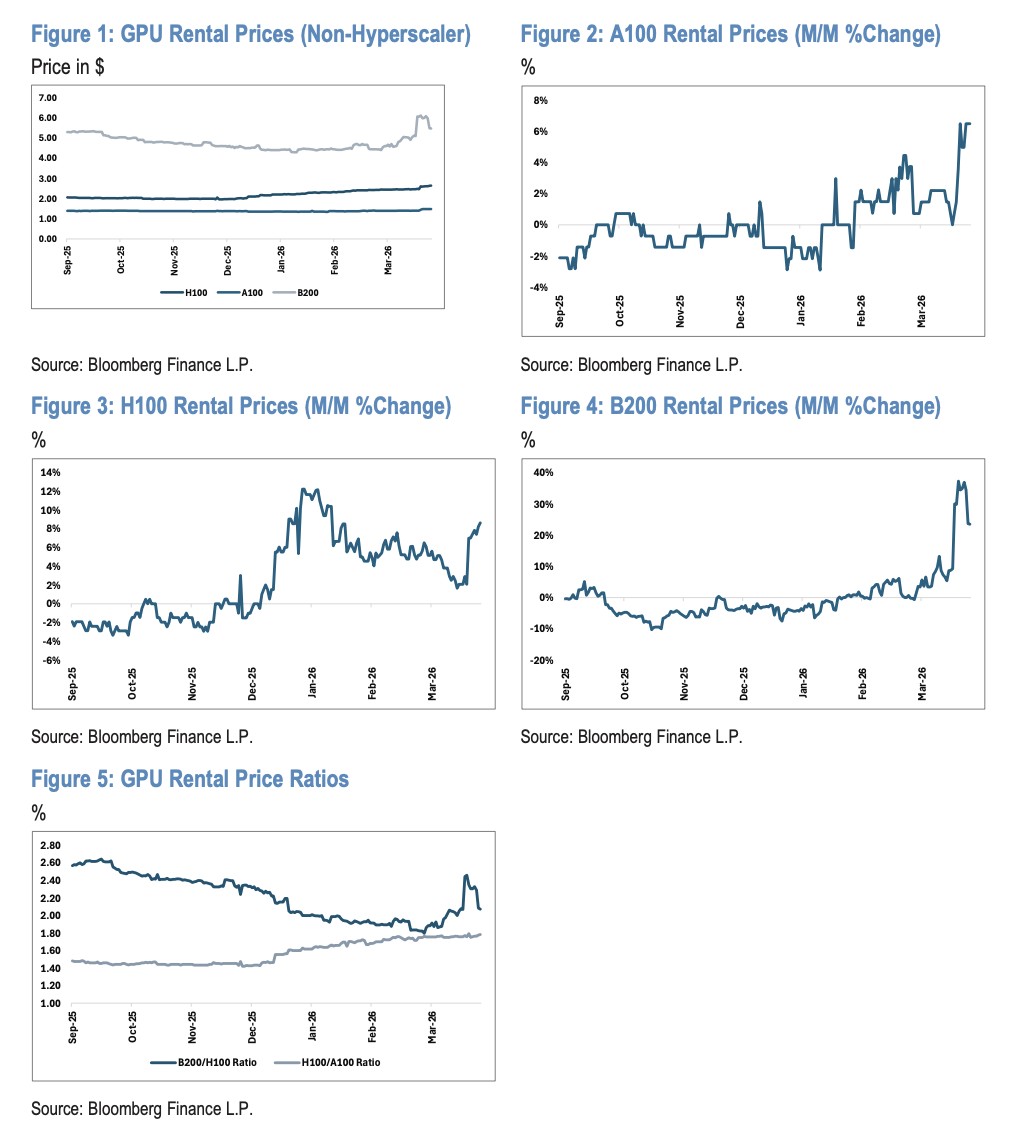
According to Trading Feng (Zhuifeng), JPMorgan released a data center tracking report on April 19 stating that leasing prices for all three tiers of GPUs rose sequentially in March, with B200 surging 23.5% in a single month, causing the price ratio between B200 and H100 to rebound.
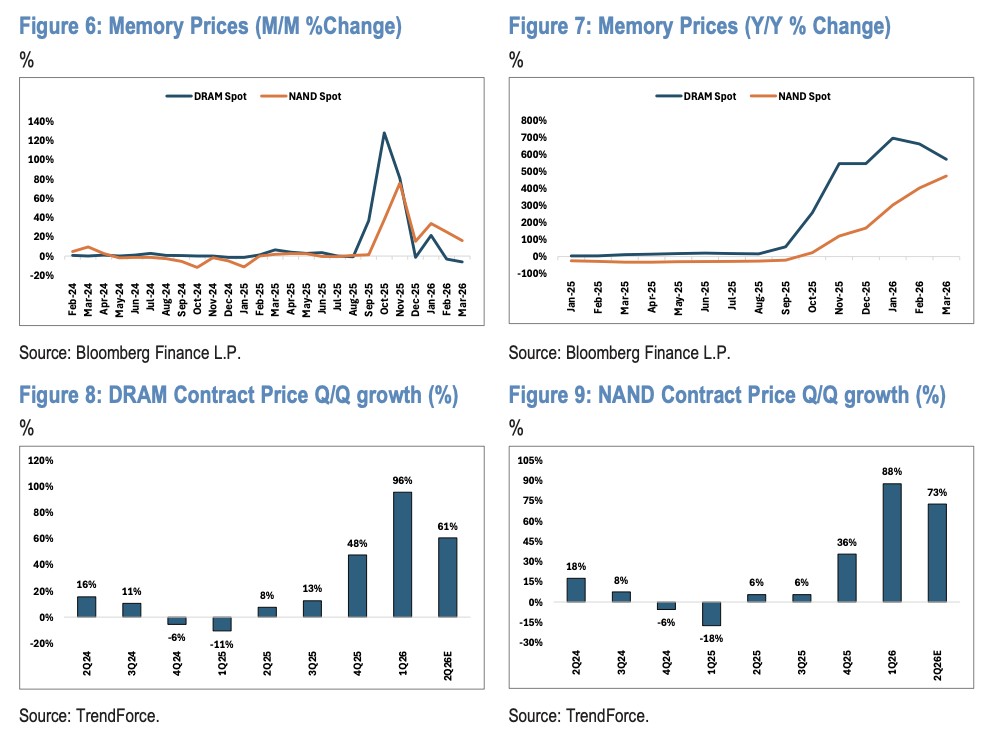
On the storage side, according to TrendForce data, DRAM contract prices jumped 96% sequentially in Q1, while NAND contract prices rose 88% sequentially; both are expected to continue their upward trajectory in Q2, though sequential growth rates will slow to 61% and 73%, respectively.
The broad-based rise in GPU leasing prices reflects strong market demand for high-performance computing power; while storage contract prices remain at multiples year-over-year, indicating that the supply-demand dynamics have not fundamentally reversed, only the slope of expansion has flattened.
B200 Leads the Rally as GPU Leasing Prices Rise Across the Board in March
According to Bloomberg Index data, as of the end of March 2026, B200 leasing prices reached $5.47 per GPU-hour, a sharp 23.5% sequential increase, significantly higher than February's -0.2% and January's +0.7%.
This surge reversed the compressing trend of the B200 premium over H100 that had persisted since the index launched in September 2025. The price ratio between B200 and H100 rebounded from 1.82x in February to 2.07x in March, although it remains below the approximately 2.63x seen shortly after the index's launch.
H100 leasing prices continued their upward trajectory, reaching $2.64 per GPU-hour in March, a sequential increase of 8.6%, higher than February's 5.2% and January's 4.5%, marking the fourth consecutive month of sequential positive growth.
A100 leasing prices stood at $1.48 per GPU-hour in March, a sequential increase of 6.5%, accelerating noticeably from February's 3.7% and January's 1.5%, recording a third consecutive month of accelerating growth.
The price ratio between H100 and A100 also expanded slightly from 1.75x in February to 1.78x, continuing the widening trend and reflecting sustained market demand migration toward higher-performance GPU tiers.
DRAM and NAND Contract Prices Expected to Moderate in Q2, Yet Still Up Multiple Times Year-Over-Year
According to TrendForce data, DRAM contract prices expanded 96% sequentially in Q1, a significant acceleration from the 48% in Q4; NAND contract prices grew 88% sequentially in Q1, also exceeding the 36% in Q4.
Entering Q2, both are expected to continue rising but at a slower pace: DRAM contract prices are forecast to grow 61% sequentially, while NAND contract prices are projected to grow 73% sequentially.
From a year-over-year perspective, the increases remain substantial. Latest forecasts indicate that DRAM contract prices are expected to rise 421% year-over-year in Q2 2026, while NAND contract prices are expected to rise 362% year-over-year.
Spot price trends have begun to diverge. DDR5 16Gb spot prices were $31.18 in March, down 6.1% sequentially, marking the second consecutive month of weakness, yet still up 573% year-over-year, nearly seven times the $4.63 recorded last year.
NAND 1Tb spot prices continued their upward trend, reaching $28.96 in March, up 16.0% sequentially and 475% year-over-year, nearly six times the $5.04 from the same period last year, though the sequential growth rate has moderated compared to previous periods.
Supply-Demand Dynamics Support Price Centers; Slowing Growth Does Not Alter Upward Trend
In summary, the broad-based rise in GPU leasing prices and the continued expansion of storage contract prices jointly point to robust demand-side drivers under the AI infrastructure investment boom.
The exceptional surge in B200 leasing prices is particularly noteworthy; its rapid recovery of the premium ratio over H100 may signal that the market is repricing its urgent demand for the latest generation of computing power.
Regarding storage, the slowdown in contract price growth in Q2 does not signal weakening demand, but rather a natural return following a high base effect.
The two-month decline in DDR5 spot prices contrasts with the continuous rise in NAND spot prices, potentially reflecting differences in pacing during the supply-demand rebalancing process across different product lines.
For equipment manufacturers, storage cost pressures will remain high in Q2, despite some moderation in marginal pressure compared to Q1.
