


Envicool 2025 Revenue Grows 32%, Net Profit Rises 15%: AI-Driven Data Center Cooling Demand | Financial Report Insights
In 2025, Envicool achieved revenue of 6.068 billion yuan, a year-on-year increase of 32.23%; net profit attributable to shareholders was 522 million yuan, up 15.30% year-on-year. Liquid cooling business has become the core engine as it enters AI data centers; its products were included in NVIDIA's MGX ecosystem and custom CDU products were developed for Google, further binding relationships with leading manufacturers
Precision temperature control equipment provider Envicool released its 2025 annual report, with both revenue and net profit achieving double-digit growth, with liquid cooling business accelerating penetration into the data center market becoming the core driver.
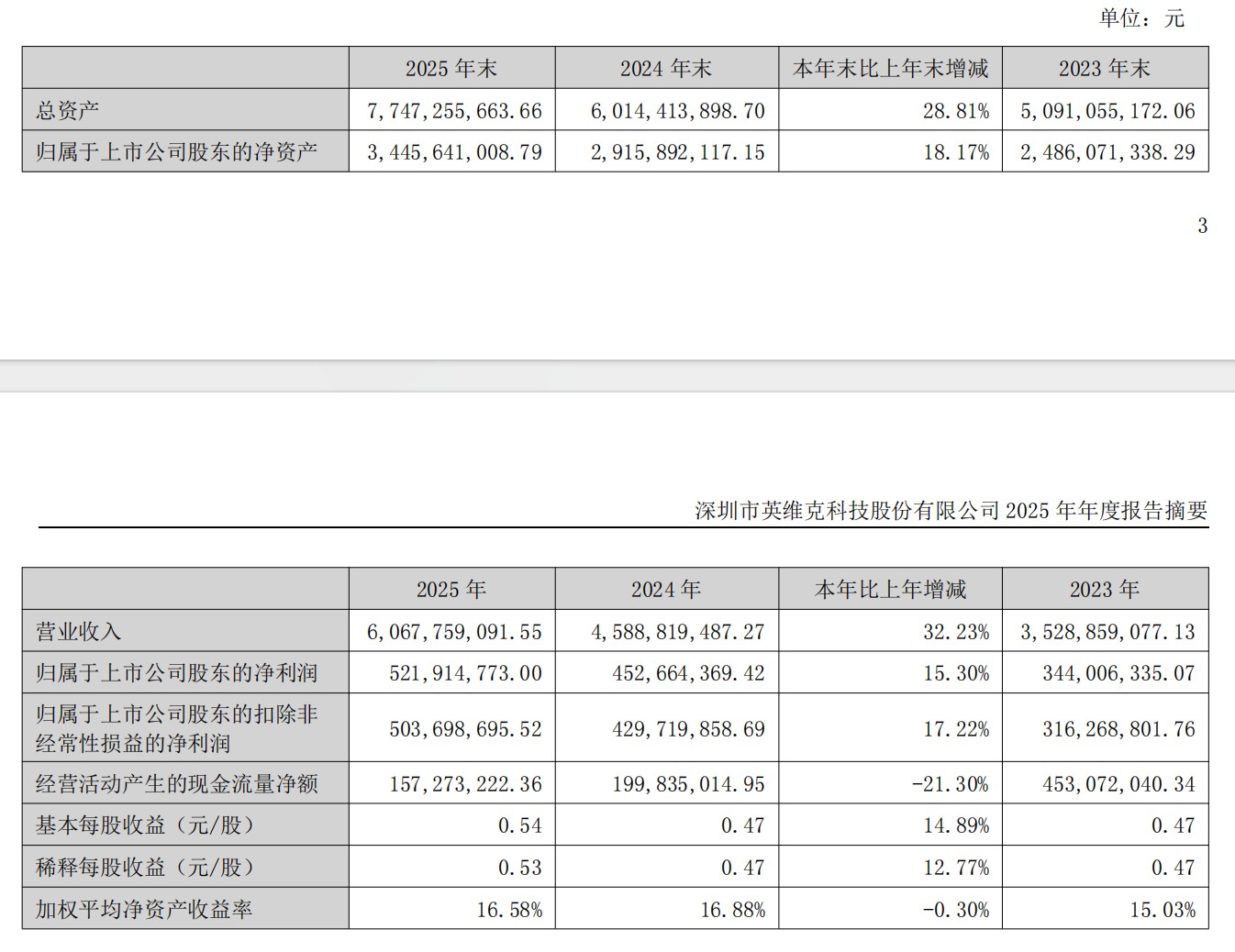
The company achieved revenue of 6.068 billion yuan in 2025, a year-on-year increase of 32.23%; net profit attributable to shareholders was 522 million yuan, up 15.30% year-on-year.
By product line, revenue from data center temperature control and energy saving products reached 3.448 billion yuan (+41.28%), accounting for 56.8%, serving as the main growth driver; cabinet temperature control product revenue was 1.977 billion yuan (+15.30%), with growth slowing.
By region, overseas revenue was 849 million yuan (+28.70%), with a gross margin of 52.64%, significantly higher than the domestic 23.83%. The expansion of high-margin overseas businesses contributed to structural optimization.
Behind the profit expansion, signs of pressure emerged in the company's operating cash flow. In 2025, net cash flow from operating activities was 157 million yuan, down 21.30% year-on-year, narrowing significantly from 453 million yuan in 2023, reflecting increased capital turnover pressure during the rapid expansion phase.
The company's first quarter 2026 revenue was 1.175 billion yuan, up 26.03% year-on-year; net profit attributable to shareholders was 8.6576 million yuan, down 81.97% year-on-year.
Rapid Growth in Data Center Temperature Control, Deepening Liquid Cooling Layout
Data center temperature control and energy saving business was the primary source of Envicool's 2025 performance growth. During the reporting period, this business segment saw rapid revenue growth; while the second-half growth rate slowed compared to the first half, overseas revenue in the second half increased significantly, and gross margins rose substantially compared to the same period last year, showing clear structural improvement.
From a technical perspective, liquid cooling has become the core strategic pillar for the company in the data center field. Driven by AI computing power demand leading to large-scale deployment of high-power chips, the adoption of liquid cooling in high heat density scenarios is accelerating into the scale application stage.
The company's Coolinside full-chain liquid cooling solution covers "end-to-end" products including cold plates, quick connectors, Manifolds, CDUs, cabinets, and piping. At the 2025 OCP Global Summit, it exhibited the Deschutes 5 CDU product custom-developed for Google.
In terms of ecosystem cooperation, the company's UQD and MQD products were included in NVIDIA's MGX ecosystem partner system during the 2025 OCP Global Summit, further strengthening its binding relationship with leading computing chip manufacturers.
The company's cold plate products have been listed as the premier cold plate liquid cooling solution integrator for Intel's Xeon 6 platform.
Regarding customer resources, the company has provided refrigeration products and systems to major data center operators such as ByteDance, Tencent, Alibaba, China Mobile, and China Telecom over the years.
Energy Storage Temperature Control Revenue Reaches 1.7 Billion Yuan, Overseas and Commercial & Industrial Energy Storage Expansion Accelerates
During the reporting period, energy storage temperature control business revenue was approximately 1.7 billion yuan, up about 14% year-on-year, but the overall gross margin of the cabinet temperature control and energy saving business declined due to changes in revenue regional composition.
On the product level, the company continues to enrich its energy storage liquid cooling product matrix, covering two major tracks: large-scale centralized energy storage and distributed commercial and industrial energy storage.
Launched the 6.X energy storage system full-chain liquid cooling solution, 6MWh+ liquid cooling solution, dedicated energy storage liquid cooling units for high-temperature scenarios in the Middle East, and multiple new products including CubeCool-F series ultra-thin door-mounted liquid cooling for commercial and industrial energy storage, and BattSilent commercial and industrial energy storage silent worry-free cabins.
The company is one of the earliest domestic manufacturers to enter electrochemical energy storage temperature control and currently holds a leading position in the industry. With the advancement of "dual carbon" goals and continued expansion of domestic and international energy storage power station construction demand, this business remains an important support direction for the company's medium-term growth.
Financial Structure: Asset Expansion Accelerates, Cash Flow Management Under Pressure
On the balance sheet side, as of the end of 2025, the company's total assets were 7.747 billion yuan, up 28.81% from the end of 2024; net assets attributable to shareholders of the listed company were 3.446 billion yuan, up 18.17% year-on-year, indicating a significantly accelerated pace of asset expansion.
Regarding profitability quality indicators, the weighted average return on net assets for 2025 was 16.58%, a slight decrease of 0.30 percentage points from 16.88% in 2024, suggesting that asset expansion speed slightly outpaced profit growth. Basic earnings per share was 0.54 yuan, up 14.89% year-on-year.
In terms of quarterly rhythm, the company's revenue is highly concentrated in the second half of the year, with fourth-quarter revenue reaching 2.042 billion yuan, accounting for about 34% of the full year, while the first quarter was only 933 million yuan.
Operating cash flow remained negative for the first three quarters, with concentrated collections in the fourth quarter (net inflow of 476 million yuan), resulting in a full-year decline of 21.3%. This characteristic indicates that working capital faced significant occupation pressure during the business expansion period.
