


The End of the Cook Era: What Will John Ternus Bring to Apple?
Tim Cook will step down as Apple CEO on September 1, succeeded by John Ternus. This marks only the second CEO transition in Apple's 30-year history, with Cook remaining until WWDC to oversee the AI strategy launch. Morgan Stanley views this as a true succession rather than a disruption, noting that short-term strategic shifts are unlikely. Ternus, a hardware engineering veteran who has been with Apple for over 25 years, led development of key products. Chip architect Johny Srouji is promoted to Chief Hardware Officer
After 15 years at the helm, Tim Cook will officially step down as CEO on September 1, succeeded by John Ternus, a hardware engineering veteran with over 25 years of tenure at Apple. This marks only the second CEO transition in Apple's 30-year history and the most significant leadership change since Steve Jobs handed over to Cook.
This leadership transition was meticulously planned and executed smoothly.
Cook will remain in his role until after WWDC (June 8) before formally departing, ensuring that Apple's most critical AI strategy announcement remains under his direction; Ternus will then host the iPhone event in September, making his debut in the most natural way possible—on the stage he knows best as the former head of hardware engineering.
Morgan Stanley's assessment is clear and direct: This is a true succession, not a disruptive transformation. Whether it is the vertical integration strategy across hardware, services, software, and chips, or the annual share buyback program ranging from $80 billion to $100 billion, the dividend strategy showing mid-single-digit growth annually, or even the "build over acquire" philosophy for small acquisitions, none will undergo fundamental changes in the short term. However, precisely because of the new CEO, investors now have renewed room to reimagine Apple's long-term narrative.
History may repeat itself—according to Morgan Stanley data, within 12 months following the previous CEO transition, Apple's stock outperformed the S&P 500 index by as much as 57.1%.
A Deeply Technical Hardware Veteran
John Ternus, currently 50 years old, joined Apple in 1998, three years after Cook, yet embedded himself deeply into Apple's product DNA in a different way.
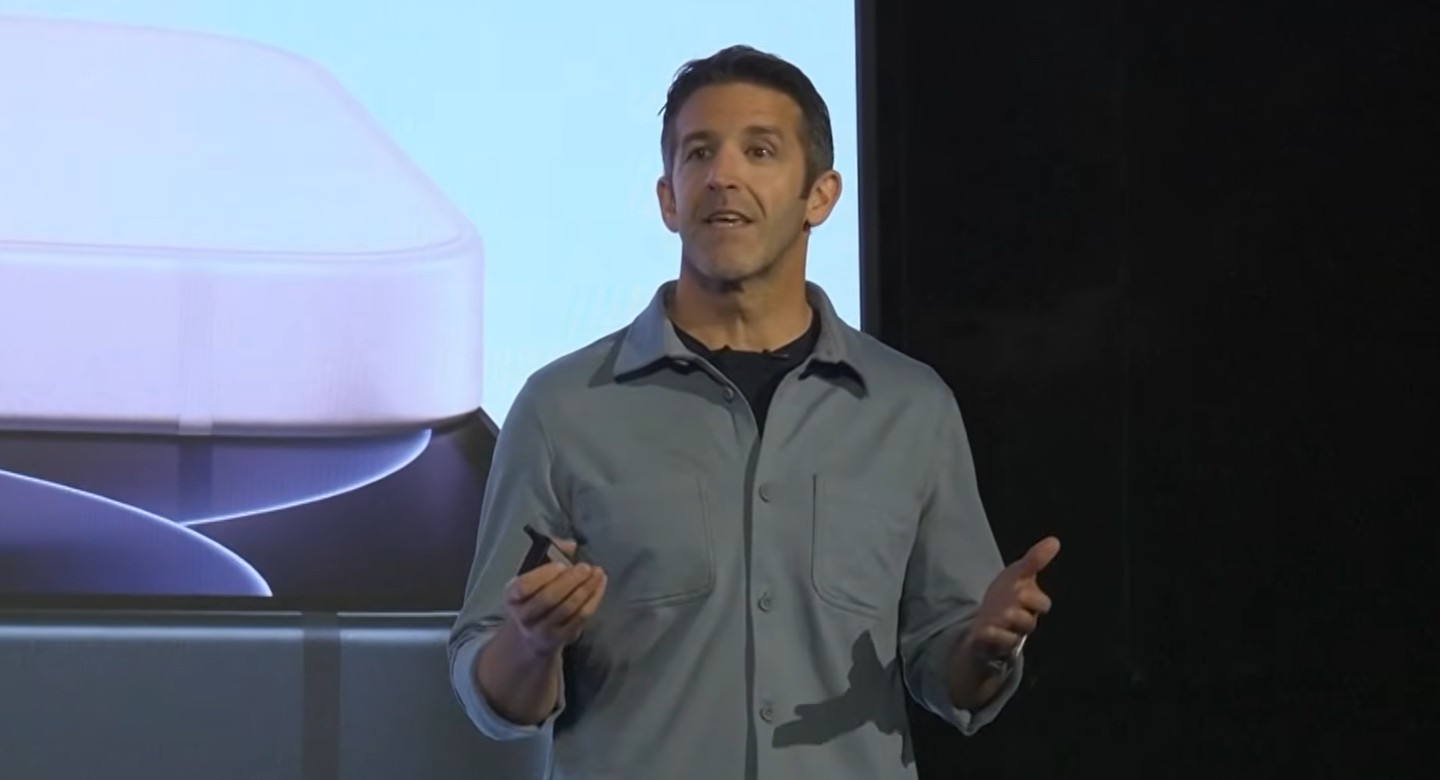
Over the past 25 years, he led hardware engineering for the iPhone, Mac, iPad, Apple Watch, and AirPods, witnessing and driving Apple Silicon Macs' historic transformation and the expansion of wearable device categories. His appearances on stage at Apple product events have long become an important footnote in Apple's recent product cycles.
Meanwhile, chip architect Johny Srouji (now 62) has been promoted to Chief Hardware Officer, expanding his responsibilities from hardware technology to the entire hardware engineering system.
Notably, Srouji joined Apple in 2008 and spearheaded the development of the first self-designed Apple chip, the A4 processor, subsequently building a complete proprietary technology stack covering processors, modems, cameras, displays, and batteries. The partnership between Ternus and Srouji represents a dual bet by Apple on deep integration between hardware and chips.
Cook's Legacy Will Be Fully Inherited
Morgan Stanley outlined five questions most concerning to investors, with highly consistent answers: minimal changes in the short term.
In terms of capital allocation, the expected path is clear—annual dividend growth will maintain mid-single-digit rates, annual buyback scale will remain between $80 billion and $100 billion, completing 10 to 20 small technology acquisitions annually, with long-term goals maintaining net cash neutrality.
Current CFO Kevan Parekh (52), also nurtured within the systems of Cook and former CFO Luca Maestri, ensures continuity.
Regarding AI capital expenditure, since Cook will still lead the June 8 WWDC, Apple's current AI strategic framework will not change in the short term.
Morgan Stanley forecasts Apple's capital expenditures will reach $20 billion by FY28, primarily driven by the deployment of self-designed chips in Apple's private cloud computing, without expecting a large-scale jump in capital spending after Ternus takes office.
Execution Remains the Greatest Unknown
Morgan Stanley admits that the primary risk lies in execution. Ternus has never served as a public company CEO, let alone leading one of the world's top three tech giants by market cap. His public market communication style, tolerance boundaries for risk, and decision-making logic amid macroeconomic turbulence remain a "black box" to the market.
"Are you more like Jobs or more like Cook? How much risk are you willing to take?" These will be the core questions repeatedly asked by analysts and investors over the coming quarters.
Furthermore, over the past 18 months, Apple has completed a deep management reshuffle—the long-serving CEO, CFO, COO, head of AI, and general counsel have all resigned or are about to depart. Although successors come from Apple's deep internal talent pool, the synergy and integration period of the new team itself constitutes an unavoidable friction cost of transformation.
After Jobs Handed Over to Cook, Apple Stock Outperformed the Market by 57% in 12 Months
Citing historical data, Morgan Stanley noted that on the day Steve Jobs announced his resignation in 2011, Apple's stock had an excess return relative to the S&P 500 of only -0.6%; subsequent excess returns at 1 month, 3 months, and 6 months were 11.0%, -0.8%, and 17.9% respectively; while 12 months later, the excess return reached 57.1%—the sustained strength in fundamentals was the fundamental driver behind the stock's rise at that time.
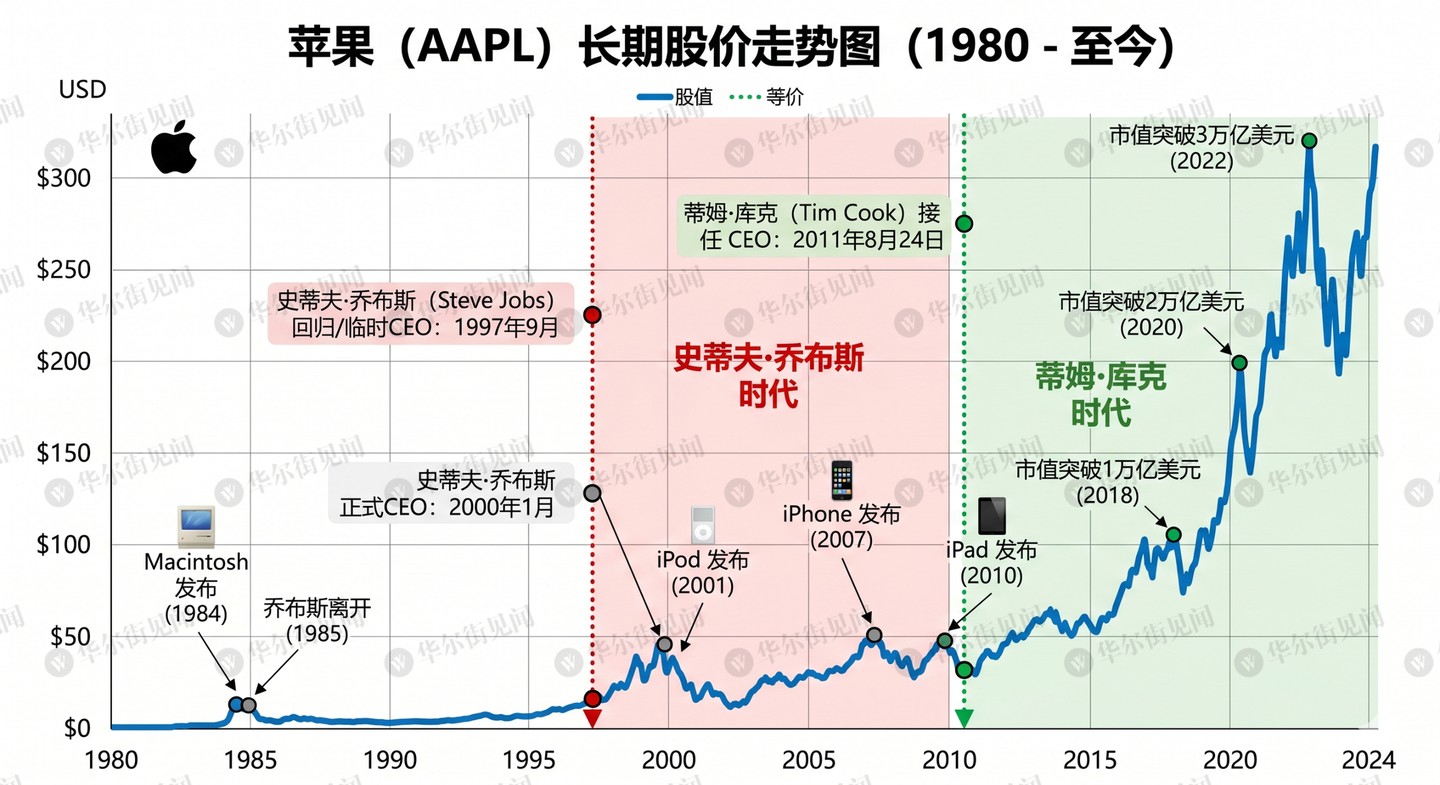
Apple's fundamentals today remain equally solid.
Morgan Stanley's three-scenario valuation framework provides: Bull case target price of $414 (corresponding to FY27 bull EPS of $10.60, a P/E ratio of 39.1x, which also embeds potential upside from robotics business at $22 per share), base case target price of $315 (corresponding to FY27 EPS of $9.76, approximately 32x P/E), and bear case target price of $194 (corresponding to FY27 bear EPS of $7.89, a P/E ratio of 24.6x).
Uncertainty Nurtures New Narratives; Fundamentals Provide a Safety Cushion
In summary, Apple in the Cook era was a company whose core flywheel revolved around supply chain management, scale operations, and ecosystem monetization. Apple in the Ternus era will build upon this foundation with stronger product and hardware DNA, along with new strategic imagination space for technological integration in the AI era.
For investors, the CEO transition itself is not a risk but rather a window to re-examine Apple's long-term pricing. Morgan Stanley's logic is clear: fundamentals will not suddenly deteriorate, but the narrative variables brought by the new CEO could become catalysts for revaluation. Historically, it was precisely during the uncertainty of transitional periods that Apple stocks quietly accumulated excess returns.
Risk Disclosure and Disclaimer
Investment involves risk; caution is advised. This article does not constitute personalized investment advice nor does it consider individual users' special investment objectives, financial situations, or needs. Users should consider whether any opinions, viewpoints, or conclusions herein align with their specific circumstances. Investments made based on this content are the user's own responsibility.
