


Value Investing Legend Grantham: Hard Work Can Hinder Thinking; Without AI's Lifeline, US Stocks Would Have Plunged 40%
"AI is like someone suddenly discovering railways in 1930; without the AI boom, US stocks could have fallen 40% and entered a deep recession as early as 2023"; "Extremely hard work can actually hinder thinking because you are busy stuffing new data into your brain with no time to truly think"; "Historically, every surge in oil prices has led to recessions, yet US stocks completely ignore reality."
As the founder of GMO, a globally renowned asset management firm, Jeremy Grantham is celebrated for accurately foreseeing the 1989 Japanese bubble, the 2000 internet bubble, and the 2008 housing bubble.
In his latest interview, this 88-year-old investment legend issued another deafening warning: current US stocks are among the top three most overvalued in commercial history, while the global environment is the most dangerous ever witnessed. He believes that while the emergence of AI has postponed a recession, it has also made the trajectory of the bubble more convoluted.
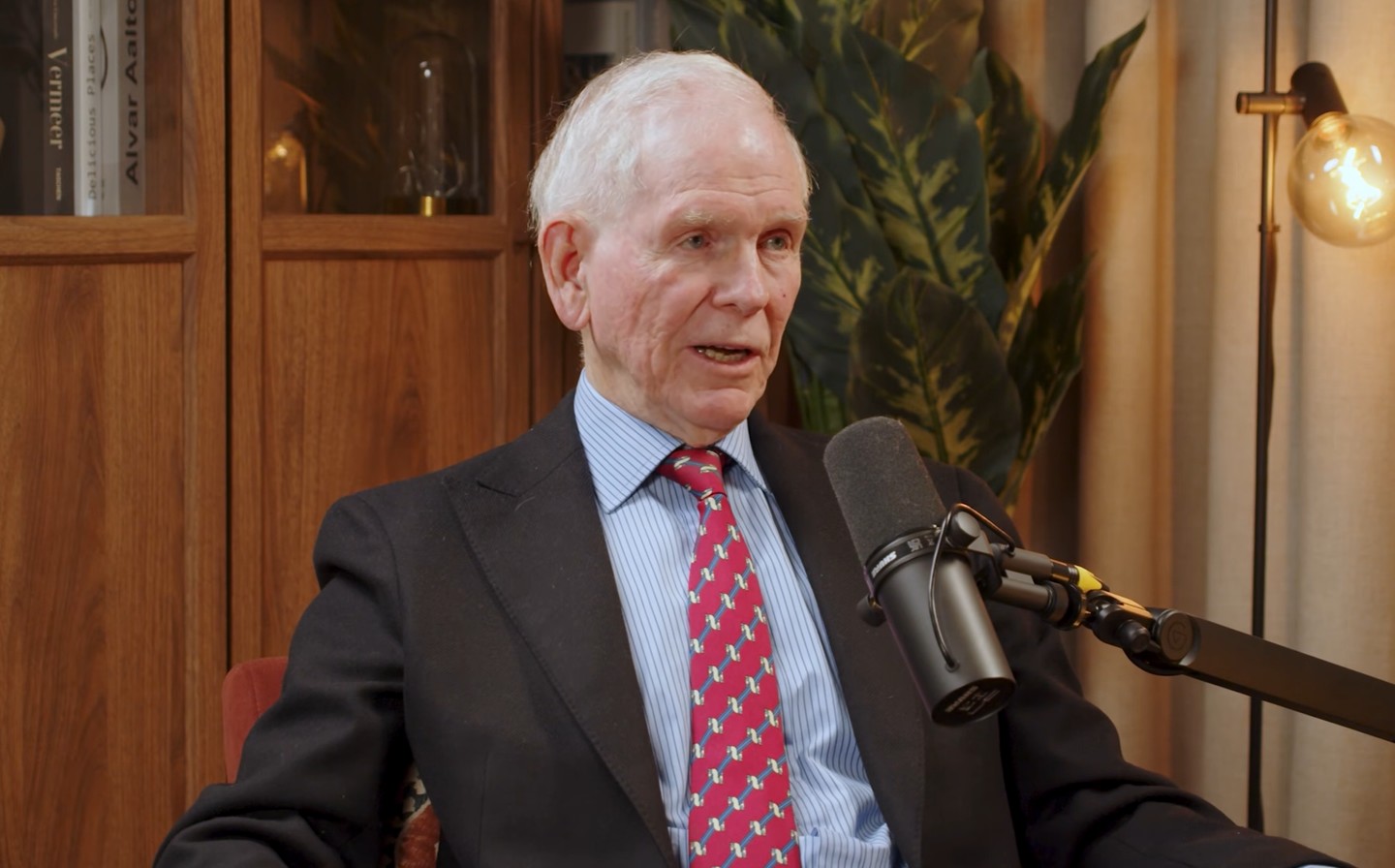
Wall Street News has compiled the key takeaways below:
-
"I do not believe this is about 'timing the market'; I believe it is about exiting significantly overvalued stocks and consistently concentrating investments in cheap ones." "Value is the equivalent of gravity. Sooner or later, cheap will yield results, and expensive will have consequences."
-
"Extremely hard work can actually hinder thinking because you are busy stuffing new data into your brain with no time to truly think." "Let your mind wander at a comfortable walking pace and see where it leads."
-
"Humans are a species prone to 'optimistic thinking'... If economic data is bad, we cheer that the Federal Reserve will cut rates; if data is good, we cheer that profits will rise. We are always looking for excuses to be happy."
-
"The market does not reverse when seeing the light at the end of the tunnel; it reverses when everything still looks pitch black, but just a little less dark than yesterday."
-
"AI is like someone suddenly discovering railways in 1930. It greatly stimulated capital expenditure and 'animal spirits'. Without the AI boom, US stocks could have fallen 40% and entered a deep recession as early as 2023."
The "Gravity" of Investment: Why Value Always Returns?
In the world of investing, Jeremy Grantham is often labeled a "perpetual bear," though he prefers to call himself a "realist." He uses a vivid metaphor to explain the core of value investing:
"Imagine dropping a bag of feathers from the top of a skyscraper during a hurricane. You cannot predict where they will drift in the short term, but you can be 100% certain: all feathers will eventually hit the ground. In investing, 'value' is the equivalent of gravity."
Jeremy Grantham emphasizes that his so-called "timing the market" is not daily speculation, but risk avoidance based on common sense. He points out that every person born in Yorkshire instinctively knows that "cheap is better than expensive," whereas today's investors are trying to challenge the laws of physics.
Bubble Evolution: 2000 vs. 2026
When Wilfred Frost asked about the similarities and differences between the current market and historical bubbles, Jeremy Grantham expressed great concern.
2000 Had Safe Havens: During the peak of the internet bubble, although tech stocks were extremely expensive, small-cap stocks, value stocks, and REITs were very cheap.
Current Dilemma: Jeremy Grantham believes that currently, there are almost no obvious "safe havens" in US stocks; the only reasonable valuations exist in markets outside the US (such as emerging markets, Europe, and Australia).
He pointed out that the current global environment is one of "extreme anxiety and limited growth":
Demographic Collapse: Population declines in Japan and South Korea will suppress global growth for the long term.
Climate Costs: Economic losses caused annually may already account for 0.5% of global GDP.
Geopolitics: Trade wars and localized actual combat are dismantling post-war growth dividends.
Is AI a "Firefighter" or a New "Irrational Exuberance"?
Regarding the recent bull market driven by AI, Jeremy Grantham admitted it exceeded his previous expectations.
"AI is like someone suddenly discovering railways in 1930. It greatly stimulated capital expenditure and 'animal spirits'. Without the AI boom, US stocks could have fallen 40% and entered a deep recession as early as 2023."
However, he warned that although the "Magnificent Seven (MAG 7)" are high-quality companies, this masks risks in the data. When market leaders begin to weaken while blue-chip stocks continue to surge, it is often the final sign of a bubble bursting. He quoted former Citigroup CEO Charles Prince: "As long as the music is playing, you have to keep dancing." But in Jeremy Grantham's view, the dance floor is already extremely crowded.
Top Investors' Secret Weapons: "Butterfly Thinking" and "Walking Meditation"
When discussing the reasons for his personal success, Jeremy Grantham shared a unique philosophy of "anti-efficiency":
Butterfly Thinking: He does not require colleagues to stick strictly to the topic but instead jumps between different topics like a butterfly. He believes that over-focusing on a single theme stifles creativity.
Walking Meditation: He believes true wisdom arises during a shower or a walk, not while staring at Excel. Overly hard work is often the enemy of thinking because the brain gets clogged with trivial data.
Finding "Destroyers": He emphasizes that every brilliant idea needs a partner who can instantly spot its logical fallacies.
How to Find the Bottom in the "Darkest Hours"?
As a master who has successfully bottom-fished multiple times, Jeremy Grantham offered his most insightful operating principle: Reinvest when fearful.
Recalling his bottom-fishing in March 2009, he noted that investors were in a state of "ultimate paralysis," finding even going to the office to work difficult.
"You must understand that the market does not reverse when seeing the light at the end of the tunnel. It turns when everything still looks pitch black, but just a little less dark than yesterday."
Do Not Mortgage Future Generations
At the end of the interview, Jeremy Grantham quoted President Eisenhower's farewell address, calling for society to reflect on the current growth model. He believes we cannot plunder tomorrow's resources for today's comfort.
For today's investors, Jeremy Grantham's advice remains concise and powerful: "Watch your tail." In an era where valuations reflect the "top three best" futures in history while reality is full of crises, staying sober may be more important than pursuing returns.
Below is the full transcript of the interview:
On "Timing the Market" and the Nature of Bubbles
Jeremy Grantham: I do not believe this is about "timing the market." I believe it is about exiting significantly overvalued stocks and consistently concentrating investments in cheap ones.
If you hold low-priced stocks for the long term, you will eventually win. So, do not stubbornly persist in severely overvalued markets unless you ultimately want to suffer. Of course, others may outperform you in the interim, but in the long run, you will win.
Jeremy Grantham: The current environment is extremely dangerous on every level: population decline, climate change, geopolitical tension, trade wars, and several ongoing actual conflicts. Things can turn very bad in an instant.
So how is the market reacting? It is reflecting this by presenting itself as one of the top two or three markets with the highest valuations in commercial history.
If you believe the top two or three periods of performance in the next century are right here, you must be daydreaming. This is a world filled with anxiety, danger, and limited growth.
"Butterfly Thinking" and Innovative Ways of Thinking
Wilfred Frost: Welcome to the Master Investor podcast. I am Wilfred Frost. Today's guest, Jeremy Grantham, is a true investment legend. He founded and led GMO for decades and remains the company's long-term strategist today. Throughout his 60-year career, he accurately predicted almost all major stock market bubbles and their subsequent rebounds. Jeremy, welcome back.
Jeremy Grantham:
Thank you, glad to be here. However, I must refute the word "predict." I did not "predict" the bubbles; I simply pointed them out when they appeared. If I could foresee them appearing out of thin air, that would be true skill.
All I can do is wait for them to appear—which often look very obvious when they do—and then say: "Look, it's there."
Wilfred Frost:
Talk about your mindset. You published a new book in January titled Grantham's Grump: The Perils of Long-Term Investing in a Short-Term World. You are a "pre-war baby" born in 1938 from a Quaker family in Yorkshire. You say these backgrounds gave you an innate understanding of "value." You say every qualified person born in Yorkshire knows "cheap is better than expensive" from birth.
Jeremy Grantham:
Exactly. Regarding my "butterfly effect" thinking, I find it difficult to focus on a specific topic for a long time, which often annoys colleagues. I jump from one topic to another completely different one, like a butterfly.
But I am very patient; I will turn back after a while. Like a butterfly in a garden, you think it has flown away, but it is actually hovering around those few flowers.
I think brainstorming should be like this. If you rigidly demand "sticking to the topic," your thinking will dry up and become like hitting a wall. Temporarily leave the center and wander to the edges; when you return, your mind will be open, and inspiration may arise.
Why Does Overly Hard Work Hinder Investment?
Wilfred Frost:
In your book, you write that overly hard work sometimes hinders thinking due to being busy processing new data. Do you think current investment professionals spend too much time on Excel or AI models?
Jeremy Grantham:
Yes. True thinking is not punching numbers in a spreadsheet but taking a walk in Boston Park or taking a hot bath, letting the mind wander freely at a walking pace. In those past days, when I walked to the office, I usually had come up with two or three ideas, although my colleague Chris Darnell could often prove within 20 seconds that they were terrible ideas.
Having a partner who can quickly spot your logical fallacies is incredibly powerful. We screen 10 to 20 ideas before placing just one into our deep research library.
Wilfred Frost:
Is your core tool the "Dividend Discount Model" (DDM)?
Jeremy Grantham:
I do not view it as an "idea"; it is the ruler we use to measure whether an idea is good or bad. We calculate the DDM for each stock.
If it is 0.79 relative to fair value, it is 21% cheap; if it is 1.12, it is 12% expensive. We found that collections of cheap small stocks are extremely valuable, while collections of expensive large stocks are extremely dangerous. This gives us a toolkit to test intuition.
Wilfred Frost:
What is your view on the factors of "momentum" and "quality"?
Jeremy Grantham:
I maintain a subconscious respect for anything effective, even if it seems absurd. Momentum is an extremely simple inefficient manifestation that shouldn't work, yet it has worked throughout my career.
And "quality" is the largest market inefficiency—high-quality companies have less debt, more stable profits, are less likely to go bankrupt, have lower risk, yet higher returns. Academia took decades to realize that owning these high-quality stocks actually provides a "free lunch."
Comparison of 2000, 2008, and the Present
Wilfred Frost:
Talk about historical bubbles. In 1999, your clients blamed you for identifying the bubble too early and underperforming. But you said there were many safe havens in 2000, such as real estate (REITs) selling at a discount to net asset value, and small-cap stocks were also cheap.
Jeremy Grantham:
Correct, 2000 was great because it provided many places to hide. But in 2008, there was nowhere to hide. The current market (2025/2026) is somewhere in between. It is somewhat like 2000; stocks outside the US—emerging markets, Europe, Australia, Canada—their valuations are actually quite reasonable.
Wilfred Frost:
Many believe AI or the internet brings leaps in productivity and GDP, so high valuations are reasonable. What do you think?
Jeremy Grantham:
Historically, high price-to-earnings ratios (PE) have never successfully predicted higher profits or productivity. Quite the opposite, extremely high PE often signals difficult times ahead.
The Great Depression followed the 1929 peak, and Japan's "Lost Decades" followed the 65x PE of 1989.
The world today is doing many wrong things: destroying post-war growth with tariffs and trade wars, causing massive annual economic losses due to climate change, and populations beginning to plummet in many countries. To think the market should be at its historical peak under these circumstances is absurd. Historically, every surge in oil prices has led to recessions, yet US stocks completely ignore reality.
The Famous "Feather Metaphor"
Wilfred Frost:
Talk about your famous metaphor about feathers.
Jeremy Grantham:
Imagine dropping a bag of feathers from a tall building during a hurricane. You don't know where they will drift, possibly even thousands of miles away.
But there is one thing you can be 100% certain of: all feathers will eventually fall back to the ground.
In investing, "value" is the equivalent of gravity. In the long run, expensive will inevitably have consequences. The gravity effect will ultimately prevail.
Are the Current Magnificent Seven the Last Carnival?
Wilfred Frost:
In your book, you mentioned that the strangest sign of a bubble bursting is: previous market leaders start falling sharply, but the market continues to surge under the leadership of blue-chip stocks.
This happened in 1929, 1972, and 2000. Does the current performance of the "Magnificent Seven" give you that feeling?
Jeremy Grantham:
I said "let the carnival begin" in 2021, and US stocks fell sharply that year.
But at the end of 2022, ChatGPT emerged, changing the situation. AI is like someone suddenly discovering railways in 1930. It greatly stimulated capital expenditure and 'animal spirits'. Without the AI boom, US stocks could have fallen 40% and entered a deep recession as early as 2023.
The complexity now is that MAG 7 are mostly high-quality companies, which interferes with the data.
But history tells us that when Charles Prince (former Citigroup CEO) says "as long as the music is playing, you have to keep dancing," this is usually the endgame. These bankers and investment institutions will never tell you to sell because they must follow the crowd.
Finding the Bottom: Enter When Fearful
Wilfred Frost:
Talk about how you caught the market bottom. In March 2009, you wrote to The Wall Street Journal saying stocks were extremely cheap.
Jeremy Grantham:
That report was called Reinvest in Fear. The point was: if you are not afraid, it means you are not paying attention to reality.
The fear at the time led people to "ultimate paralysis," making even going to the office to work feel difficult. I wanted to tell everyone that the market does not reverse when seeing the light, but when everything looks pitch black, yet just a little less dark than yesterday.
