


5 Trillion Dollar Opportunity! AI Consumes Not Just Power: Water and Metals Face Critical Shortages
Bank of America warns that the expansion of AI data centers is triggering a full-chain crisis across power, water resources, and critical metals, one that markets have yet to fully price in. By 2030, annual electricity consumption by data centers is projected to exceed Japan's total usage, while water consumption will equal New York City's entire annual drinking water supply. Meanwhile, copper, aluminum, and metals such as gallium and germanium face structural shortages and soaring prices. The true bottleneck lies not in cost but in the mismatch between 'deliverability' and construction cycles, as AI competition extends from computing power to a revaluation of energy and resource infrastructure
The expansion of AI data centers is triggering a full-chain resource shock spanning power, water resources, and critical metals—a crisis far from being fully priced into the market.
According to Wind Trading Desk, Bank of America (BoA) stated in its latest research report that the number of global data centers has exceeded 11,200. AI-specific computing capacity has tripled over the past 18 months, with global data center capacity expected to double to 200 GW by 2030, mobilizing a cumulative $7 trillion in capital investment.
From a numerical perspective, the intensity of this shock exceeds general market expectations. In 2025, global data center electricity consumption will rise to approximately 485 TWh, accounting for over 1.5% of global power use, with AI-specific data centers seeing a single-year surge of 50%. By 2030, annual data center electricity consumption will surpass Japan's national usage level, contributing over 20% of the power demand increase in developed economies.
At the same time, a single 100-word AI query consumes about half a liter of water; by 2030, global annual water consumption by data centers will exceed 1.2 trillion liters, equivalent to New York City's entire annual drinking water supply. Each megawatt of embedded metal in data centers amounts to roughly 60 to 75 tons. Delivery times for large transformers have extended to 2–4 years, with prices surging 60% to 80% compared to pre-2020 levels. Gallium prices have skyrocketed 798% since 2023, reaching a historical high of $2,246 per kilogram, while germanium prices have surged 514% to $8,597 per kilogram.
Bank of America has screened 67 stocks rated "Buy," covering power generation, electrical equipment, metals, and water/cooling solutions, with a combined market capitalization of approximately $5.5 trillion.
BoA's core judgment is: Value is migrating upstream along the AI value chain; beneficiaries are no longer limited to chips and software, but include the "physical enablers" that provide stable power, electrical infrastructure, cooling systems, and strategic metals. The supply gaps in these areas have evolved from cost issues into timing problems—not whether something is "expensive," but whether it can be delivered on time. Market understanding of this structural repricing remains severely lagging.
Power Transition: Data Centers Are Reshaping the Global Power System
Bank of America points out that the expansion of AI infrastructure is fundamentally an electricity revolution. The core contradiction has shifted from "whether enough power can be generated" to "whether stable, controllable power can be delivered to the right locations on schedule."
The IEA estimates that global data center electricity consumption will nearly double from approximately 485 TWh in 2025 to around 950 TWh by 2030.
In the United States, the Department of Energy estimates that data center electricity consumption will rise from approximately 176 TWh in 2023 to between 325 and 580 TWh by 2028, accounting for about 7% to 12% of national power consumption. In Europe, BoA European utilities analysts estimate that if all announced projects proceed as planned, European data center electricity consumption will surge from approximately 83 TWh in 2025 to around 331 TWh by 2030, with about 75% of the increase concentrated in the UK, France, Germany, Spain, and Italy.
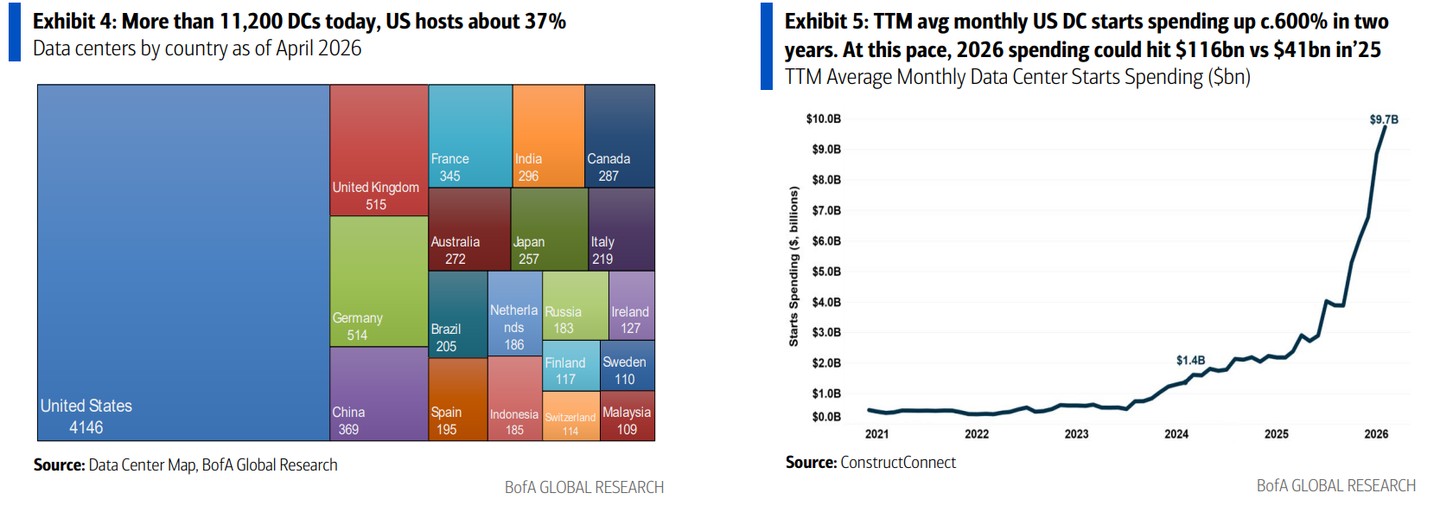
The bottleneck is not total power volume, but "deliverability."
Approval cycles for high-voltage transmission projects in Europe and the US typically span 7 to 10 years, whereas digital capital expenditure deployment cycles require only a few quarters to several years. This timing mismatch is transforming data center growth from a marginal demand issue into a systemic power crisis.
Ireland serves as a cautionary tale: The share of data center metered electricity in the country rose from about 5% in 2015 to approximately 22% in 2024, becoming a key variable affecting grid stability in less than a decade.
Citing Uptime Institute data, Bank of America notes that power outages are the primary cause of data center downtime, accounting for about 54% of major incidents.
Hyperscale cloud providers are adopting proactive strategies to move "upstream" into the energy supply sector.
BoA data shows that in 2025, hyperscale cloud providers accounted for about 80% of the top ten global corporate clean energy purchases. Meta and Google contributed two-thirds of new signing volumes in the top ten global clean energy power purchase agreements in Q1 2026.
Contracted capacity for data centers and small modular reactors (SMRs) increased from approximately 25 GW at the end of 2024 to around 45 GW by the end of 2025. Microsoft, Google, Amazon, and Meta have sequentially secured long-term nuclear power procurement agreements, positioning nuclear energy as the preferred source of high-utilization stable power.
BoA also observed that what was once considered a "transitional grid access" behind-the-scenes power strategy is evolving into a long-term hybrid power model lasting over 15 years. BoA expects installed capacity for battery energy storage systems (BESS) in new AI data centers to grow at a compound annual rate of about 22%, reaching approximately 55 GWh by 2030, representing about 8% of global new BESS installations.
Water Crisis: AI's "Hidden Bill" Far Exceeds Market Expectations
Beyond power, Bank of America identifies water resources as a physical constraint tightening even faster than energy supply, with scale and distribution highly concealed.
A single 100-word AI query consumes about half a liter of water. Medium-sized data centers can consume between 1 million and 2 million liters daily. In 2024, Google's data center in Iowa alone consumed 1.4 billion gallons annually, equivalent to New York City's entire daily water supply. BoA projects that by 2030, global annual water consumption by data centers will exceed 1.2 trillion liters, matching New York City's annual drinking water consumption.
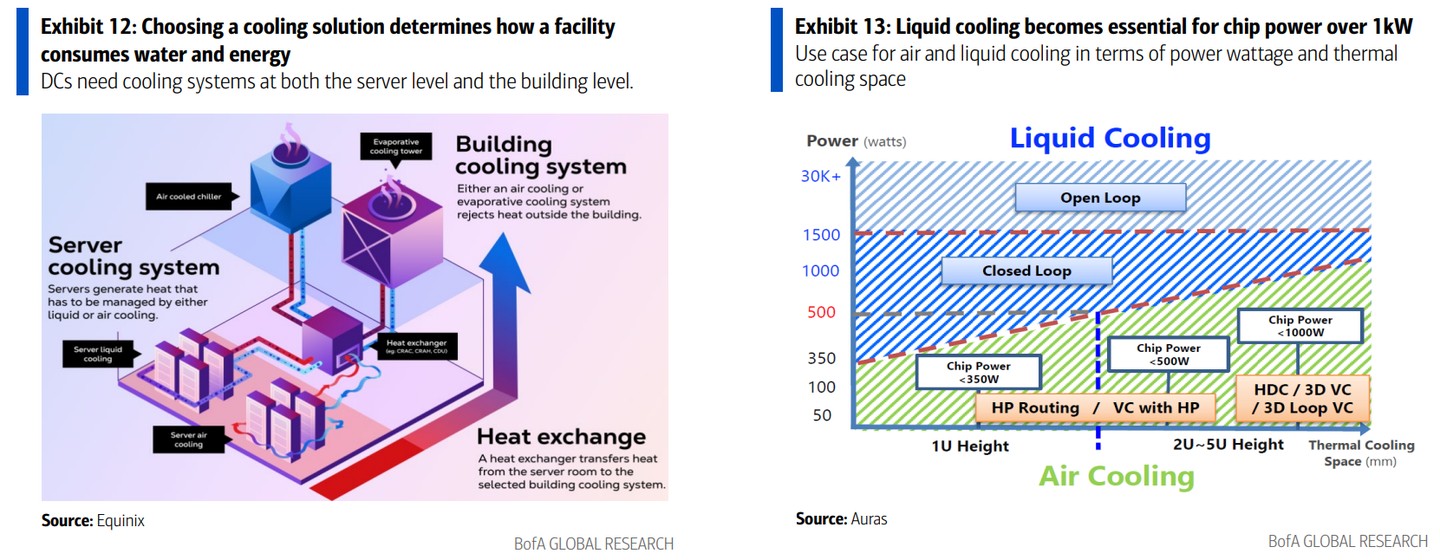
BoA emphasizes that the water footprint of data centers is highly opaque. For a typical data center, only about one-quarter of water use occurs on-site (cooling towers, humidification systems, etc.), while the remaining ~75% is off-site water use, sourced from fossil fuel and nuclear plants providing power, as well as upstream chip manufacturing—semiconductor fabs consume approximately 10 million gallons of ultra-pure water daily to produce advanced chips.
This means a data center may perform well on water efficiency (WUE) metrics yet indirectly consume vast amounts of water through electricity use. In most markets, grid water intensity rather than cooling system design is the dominant factor driving operational water risk.
Geographic contradictions are equally pronounced. Since 2022, about two-thirds of new data centers in the US have been located in highly or extremely water-scarce regions. California, Arizona, Texas, Illinois, and Virginia together account for approximately 72% of new data center development in water-stressed areas.
In stark contrast, 54% of US water utility stakeholders have not yet incorporated data center and advanced manufacturing water demands into resource planning (Black & Veatch, 2025 Water Report), creating an estimated infrastructure investment gap of $10 billion to $58 billion.
Technological upgrades are becoming the primary response lever.
Liquid cooling systems can reduce water consumption by 70% to 90%, with closed-loop liquid cooling offering up to 3,000 times higher efficiency than traditional air cooling. Microsoft mandated closed-loop direct liquid cooling for all new data centers in 2024, lowering overall WUE to 0.30 liters per kWh—a 39% efficiency improvement over 2021—and saving over 125 million liters of water per data center annually. Microsoft, Meta, and Google have all committed to achieving "water positive" status by 2030, meaning replenishment will exceed direct operational consumption.
Metal Bottlenecks: Timing Breaks First, Not Cost
Bank of America puts forward a key judgment in its report: In the construction cycle of AI data centers, "timing breaks first—not cost, nor absolute supply totals." Transformer delivery cycles of 2 to 4 years, grid access delays, and custom development cycles for cooling systems will pull metal demand ahead of the point when AI revenue materializes, forcing hyperscale cloud providers to lock orders early and treat power hardware and metals as strategic asset reserves.
Data centers are highly metal-intensive infrastructure, embedding approximately 60 to 75 tons of metal per megawatt, primarily copper and aluminum. Cooling and backup power systems collectively contribute about 75% of metal intensity.
Although metals account for less than 5% of data center capital expenditures, supply bottlenecks have already caused significant delays in actual projects. Delivery times for large power transformers have extended to 2–4 years, with prices surging 60% to 80% compared to pre-2020 levels, driven by dual shortages of copper and grain-oriented electrical steel (GOES). US hyperscale cloud providers are already engaging in a tug-of-war with utilities over limited transformer capacity, further tightening bottlenecks across the entire power system.
Copper supply pressure will continue to accumulate over the next decade.
Citing BloombergNEF data, Bank of America notes that annual copper consumption by data centers over this decade will average about 400,000 tons, with cumulative demand exceeding 4.3 million tons. During the same period, global copper supply will only modestly increase to approximately 29 million tons annually, creating a structural deficit of about 6 million tons. By 2030, AI data center copper demand will rise from currently under 1% to about 2% of global total demand, with China pulling direct AI-related copper demand share to 5% to 6%. Aluminum demand will similarly rise from approximately 330,000 tons in 2025 to about 695,000 tons by 2030, growing at a compound annual rate of about 16%.
The situation for rare metals is particularly severe. Currently, gallium prices have reached a historical high of $2,246 per kilogram (a 798% surge since 2023), while germanium prices have climbed to $8,597 per kilogram (a 514% increase). BoA points out that these materials form irreplaceable "chokepoint" segments in the data center value chain. Shortages not only raise costs but will directly constrain AI hardware supply and cap overall computing power deployment.
