


After Breaking Key Levels, Where is the Bond Market Heading
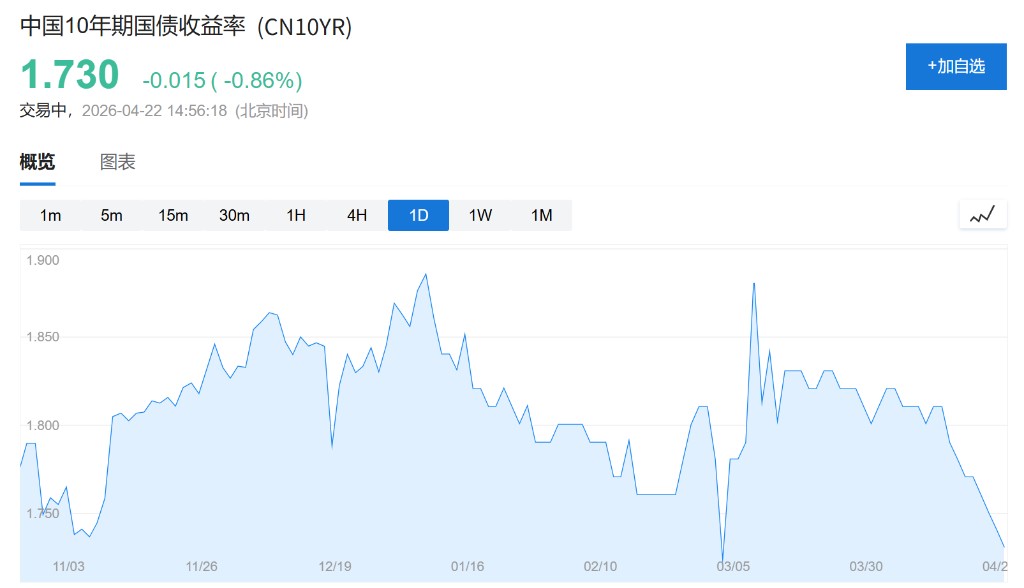
The 10-year treasury yield has decisively broken below 1.75%, while extremely loose liquidity conditions combined with a shortage of assets have driven the bond market to rise for three consecutive weeks. However, Huatai Securities and Zhongyou Securities have issued joint warnings: a structure dominated by mutual fund trading desks 'lifting each other up' hides underlying fragility; the central bank's stance remains a sword of Damocles overhead; the 'smoothest phase' may be nearing its end; those who missed the rally chasing the uptrend can only prolong the duration but cannot alter the medium-term risk landscape
The 10-year treasury yield has decisively broken through the key psychological threshold of 1.75%, while the 30-year treasury yield has fallen to around 2.25%—a concentrated outburst of sustained strength in the bond market over the past three weeks, an inevitable product of extremely loose liquidity conditions resonating with institutional logic regarding a "shortage of assets".
The underlying support for this market rally is clear: extremely loose liquidity (DR001 hovering around 1.2%), continuous net subscriptions from wealth management products and bond funds forming a positive cycle, the clearing of supply-side uncertainty following the clarification of the ultra-long special treasury bond issuance plan, and bill rates falling beyond seasonal norms (the transfer discount rate for October national bank acceptance bills dropped to 0.79%) confirming persistently weak credit demand.
However, recent research reports from Huatai Securities and Zhongyou Securities have simultaneously issued warnings: while market inertia persists in the short term and overall risks remain controllable over the next 1-2 weeks, the "smoothest phase" is nearing its end, yield spreads are entering the latter half of compression with gradually narrowing space, and medium-term risks are quietly accumulating.
Both brokerages point out that the core force driving this market rally is the "lifting of carts" by trading desks represented by public mutual funds, rather than active entry by allocation desks—this structural characteristic determines the inherent fragility at current price levels.
The largest risk variable has turned yellow: money market rates have breached the central bank's policy rate and are approaching the lower limit of "policy rate minus 20 basis points," making the central bank's attitude a Sword of Damocles hanging over the market. Huatai Securities warns that if DR001 rises back to the 1.3%-1.4% range, it will bring significant volatility; Zhongyou Securities explicitly states that in a pessimistic scenario, if the money market rate center is forced to return to the policy rate, trading desks could face a situation of mutual stampedes.
Four Major Drivers of This Market Rally
The fixed-income team at Huatai Securities systematically outlined the four major drivers of this market rally in a research report on April 22.
First, persistently and extremely loose liquidity is the core support for this market rally.
Since March, external uncertainties have risen, making economic stabilization the policy focus, leading to a moderately loose liquidity environment; large-scale liquidity injection by the central bank at the beginning of the year, combined with net reductions in fiscal deposits of 616.5 billion yuan in February and 854.7 billion yuan in March, significantly boosted market liquidity as fiscal measures took effect; marginal weakening in credit demand led to obvious accumulation of funds in the banking system; simultaneous downward adjustments in bank liability rates and rising remittance demand driven by RMB appreciation collectively pushed DR001 to hover around 1.2%. Huatai Securities summarizes this as "one force overcoming ten skills"—extremely loose liquidity overshadowed all fundamental and inflationary disturbances.
Second, trading desks are an important thrust of the market rally.
Recently, wealth management products and bond funds have continued to receive net subscriptions, significantly increasing passive allocation pressure for non-bank institutions. Fund trading desks have become the primary buying force in the market, forming a positive cycle of "capital inflow → declining yields → further increase in subscriptions." In contrast, allocation desks remain cautious, with banks recently focusing mainly on realizing gains at low levels, and insurance allocation intensity remaining weak.
Third, the implementation of the ultra-long special treasury bond issuance plan has cleared supply-side uncertainty.
Previously, the market had concerns regarding issuance scale, pace, and maturity structure. With the plan clarified, suppression factors were removed, net supply was low in the past two weeks, opening up space for long-end rates to decline. Ultra-long-term bonds with maturities of 20 and 50 years performed particularly well in this rally, with catch-up gains in the ultra-long segment becoming a core characteristic.
Fourth, bill rates fell beyond seasonal norms, sending a clear signal of weak credit.
Bill rates declined sharply and continuously ahead of schedule in April, with the October national bank acceptance bill transfer discount rate dropping to 0.79%, breaking the yearly low and falling below seasonal levels. The spread between bills and government bonds, as well as interbank certificates of deposit, narrowed to -37 basis points and -62 basis points respectively, pointing to average credit issuance in April and still-weak economic recovery momentum.
Structural Breakdown Behind Simultaneous Stock and Bond Gains
In a research report on April 20, Zhongyou Securities provided an independent explanation for the abnormal phenomenon of "simultaneous stock and bond gains."
Zhongyou Securities pointed out that while bond yields accelerated their decline in April, equity sectors such as technology rose synchronously, which is significantly different from previous correlation patterns. This divergence does not stem from a general repricing of risk by the market but is more likely due to short-term capital behavior—for example, concentrated allocation behavior by "fixed income plus" products.
The key judgment lies in the fact that term spreads have not compressed. The bond market prices risk preference into term spreads rather than absolute yield levels. Currently, the 30-year minus 10-year term spread has only slightly compressed, while the 10-year minus 1-year term spread has even reached a new high. The most compressed spread is between active and inactive 30-year bonds (mainly reflecting institutional bets on bond swapping and supply factors).
This means the essential characteristic of the current rally is a "overall downward shift of the yield curve" rather than "compression of term premium," with elevated term premiums still pricing in later inflation expectations and upward risk preference expectations.
Zhongyou Securities further summarized the dominant logic of this round: relatively loose bank liabilities drove money market rates and short-end rates to continue falling, with the 1-year treasury yield dropping to 1.16%, overnight rates approaching 1.2%, and the 7-day rate center breaking below 1.4%; under the condition of "nothing left to buy" in the short end, mutual fund products and other trading accounts actively extended duration, driving down yields at the long and ultra-long ends. Large bank allocation accounts still face persistent supply pressure from ultra-long bonds, and the so-called "shortening of issuance duration" is merely a gimmick by trading desks.
How Much Downside Space? Two Brokerages Offer Quantitative Judgments from Different Dimensions
Huatai Securities provided a relatively clear quantitative judgment on future space: the 10-year treasury has already broken previous lows, leaving limited room for further decline; if the 30-year minus 10-year term spread compresses below 45 basis points, space may be basically exhausted; downside resistance for the 30-year treasury will increase significantly below 2.2%.
Over the next 1-2 weeks, loose liquidity, bullish inertia, and weaker-than-expected April data will continue to support the market, with overall risks controllable, but the "smoothest phase of the rally" may have entered its twilight.
Zhongyou Securities analyzed space from the perspective of the game between allocation desks and trading desks: for long-end and ultra-long-end rates to decline further, coordination between allocation desks and trading desks is needed, but the probability is low. Maintaining elevated term premiums implies allocation desks will not rush to enter; if long-end rates continue to fall, the attractiveness to allocation desks actually decreases significantly.
Analysts believe the trading-desk-driven rally may have gone "a bit further" than the February rally—because after banks replaced high-yield CDs in the first quarter, bank cost rates and FTP pricing will likely both decline—but only "a bit." Chasing the uptrend by those who missed the rally may extend the duration of the trading rally and potentially see lower price points, but without sufficient protection from allocation desks, lower price points will not become a new interest rate center.
