


AI's Next Big Opportunity: Game Creation!
Morgan Stanley's latest report reveals that generative AI could slash AAA game development costs by 44%, unlocking $22 billion in incremental profits—but the benefits will not be evenly distributed. Tencent, Roblox, and AppLovin are highlighted as the top beneficiaries, while manufacturers of homogenized content face pressure to exit. IP accumulation, core gameplay design, and real-time operations remain three barriers difficult for AI to replicate in the short term
Generative AI is reshaping an industry with an annual consumption scale of up to $275 billion.
According to Zhui Feng Trading Desk, Morgan Stanley released an in-depth report on April 21. Analysts stated in the report that AI tools have the potential to cut AAA game development costs by nearly half, releasing approximately $22 billion in incremental profit space.
Morgan Stanley estimates that global gaming consumer spending will exceed $275 billion in 2026, with about $55 billion (approximately 20%) reinvested into development and operations. The rapid evolution of generative AI and agent workflows could compress development costs for large-scale AAA games by about 44%, forming a $22 billion industry-wide incremental profit pool—equivalent to increasing existing publishers' profit scales by about 35%.
However, the report simultaneously warns that this pie will not be sliced evenly: some dividends will be retained by AI compute providers (estimated at over $90 billion in annual compute investment), while another portion will be absorbed by the market amid intensifying competition.
"Value will concentrate on scaled platforms and content discovery layers, particularly companies possessing proprietary data, IP, and active operational capabilities."
Four Scenarios, Three Destinies: Who Are the Real Winners?
Morgan Stanley constructed four scenario frameworks, progressing logically from "Incumbent Adaptation" to "Platform Disruption."
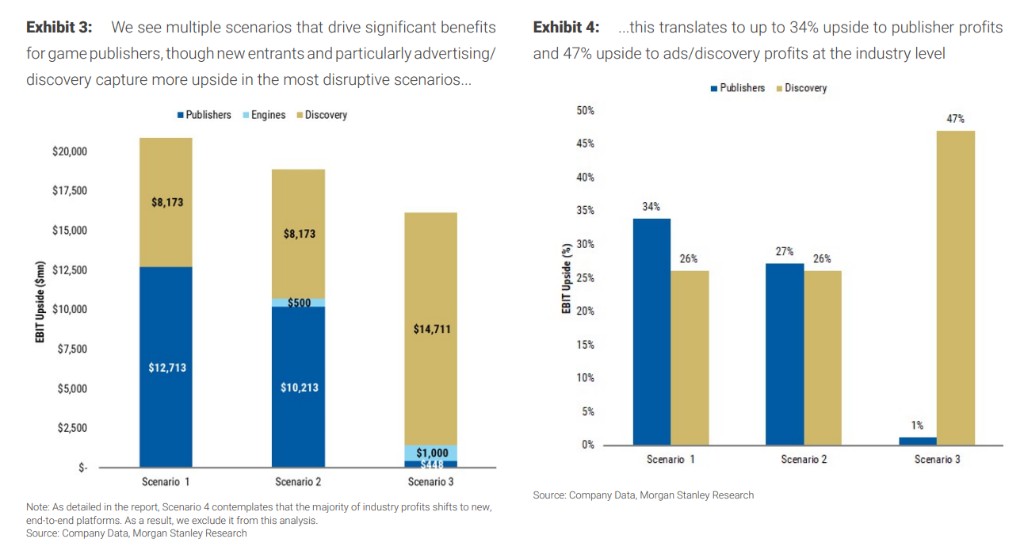
In the mildest Scenario One (Incumbent Adaptation), traditional publishers could gain approximately $13 billion in incremental profits (EBIT up 34%), while ad/discovery platforms would benefit by about $8.2 billion (EBIT up 26%).
In the more disruptive Scenario Three, publisher profits would be almost entirely consumed by competition, while the advertising ecosystem would instead enjoy approximately $14.7 billion in incremental gains (EBIT up 47%)—the core logic being: when game content becomes ubiquitous, the cost of competing for user attention will inevitably skyrocket.
The top beneficiaries named in the report warrant close attention: Tencent has built a full-stack AI framework ranging from custom chips to world models; its 2025 game revenue growth (+22%) far outpaces the global industry (+7%); Roblox possesses dual attributes of a creation platform and distribution layer, where deep embedding of AI tools and creator network effects form a positive feedback loop; AppLovin is viewed as "the biggest winner in the era of content abundance"—the more games there are, the higher the value of the discovery and monetization platform.
"The more abundant the content supply, the scarcer attention becomes, which paradoxically strengthens the strategic value of platforms that efficiently connect creators and users."
Sony, NetEase, and NCSOFT also received positive ratings due to their IP reserves, live streaming operational capabilities, or early AI deployment.
Moats Still Exist, but Distinguish Which Kind
The report remains calm regarding the market narrative that "AI will disrupt everything."
IP accumulation, core gameplay design, and real-time operations (Live Ops) are considered the three barriers difficult for AI to replicate in the short term. Just as the proliferation of smartphones made photography accessible to everyone, top directors remain scarce—game creation democratization does not mean the scarcity of high-quality content disappears.
In contrast, manufacturers relying on homogenized content (such as Playtika and Netmarble) face pressure; Unity and Unreal Engine stand at the crossroads of "adapt or perish."
