


After Trump's Threat of an "Indefinite Blockade," Brent Crude Returns to $108, Quietly Approaching Conflict Highs
Brent crude rose for the seventh consecutive trading session, approaching the $115 per barrel high seen during the Iran war, as market concerns over a prolonged blockade of the Strait of Hormuz continue to intensify
Brent crude rose for the seventh consecutive trading session, approaching the $115 per barrel high seen during the Iran war, as market concerns over a prolonged blockade of the Strait of Hormuz continue to intensify.
According to previous reports by Xinhua News Agency, Trump has informed his aides to prepare for a long-term blockade of Iran. Trump assessed that maintaining a blockade carries relatively lower risks compared to resuming bombing campaigns or withdrawing from the conflict. This judgment has significantly heightened market expectations for a prolonged disruption in the Strait of Hormuz, driving oil prices higher at an accelerated pace.
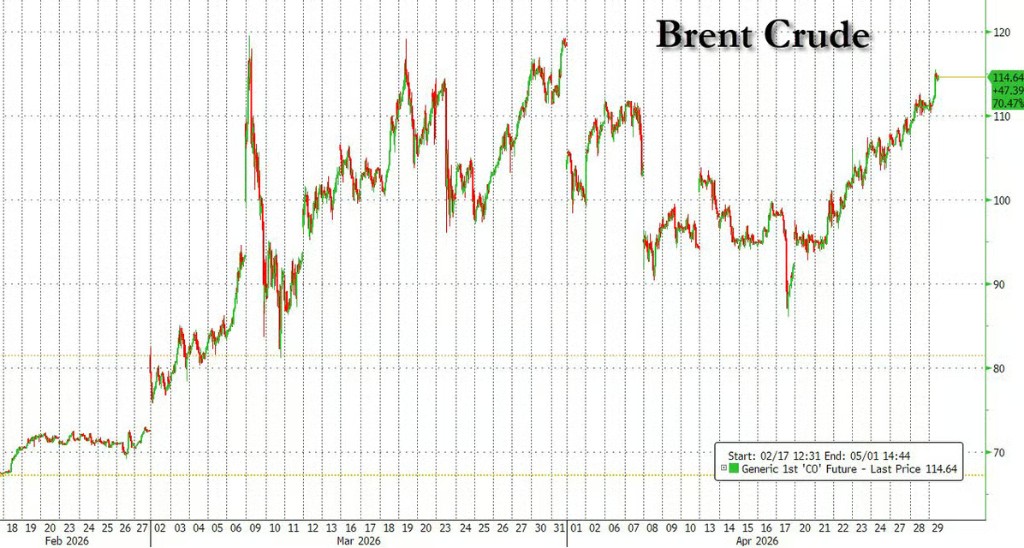
Meanwhile, the White House stated that negotiation channels remain open but insisted on the stance that "Iran must never possess nuclear weapons." For its part, Iran insists that the blockade must be lifted before any discussion on nuclear issues can take place, highlighting a clear divergence between the two sides. U.S. Treasury Secretary Bessent revealed that the U.S. Treasury Department has targeted Iran's financial infrastructure, disrupting tens of billions of dollars in revenue. Crude storage on Kharg Island is nearing capacity, forcing Iran to cut oil production.
Trump Posts Early Morning Pressure; Military Options Remain on the Table
According to Xinhua News Agency, U.S. President Trump posted on social media in the early hours of the 29th: "Iran just doesn't get it; they don't know how to sign a denuclearization deal. They better wise up quickly!" Trump also shared an image featuring him holding a gun with the caption "No more Mr. Nice Guy."
This is not the first time Trump has used such language—he issued a similar warning on April 19.
Citing a U.S. official and a person familiar with the matter, NBC News reported that Trump's national security team presented several options during a Situation Room meeting this week, including whether to increase or decrease the size of the U.S. military presence in the Strait of Hormuz and whether to adopt a more aggressive military posture.
On Tuesday, Trump also stated that the U.S. is "doing well" in the Middle East and claimed that King Charles III of the United Kingdom also agrees with the position that Iran must not possess nuclear bombs.
Negotiation Channels Remain Open, but Divergent Positions Are Hard to Bridge
Despite the tense situation, the White House indicated that diplomatic contacts are continuing. White House spokesperson Anna Kelly stated that Trump will only agree to deals that "put U.S. national security first," reiterating that "Iran must never possess nuclear weapons."
On the Iranian side, Alaeddin Boroujerdi, Vice Chairman of Iran's National Security Council, stated that negotiations are being directly led by Mohammad Bagher Ghalibaf. Iran's latest position is: demanding that the U.S. lift the blockade of the Strait of Hormuz first, leaving nuclear issues to be negotiated separately after the war—a stance that fundamentally conflicts with the U.S. requirement for Iran to transfer enriched uranium first.
A senior Pakistani official stated that mediation efforts are ongoing, with all parties working to narrow the differences between the U.S. and Iran.
Economic Pressure Intensifies; Iran's Oil Exports Hit Hard
Treasury Secretary Scott Bessent stated that the U.S. Treasury Department has systematically targeted Iran's financial infrastructure, disrupting sources of revenue worth tens of billions of dollars. Storage volumes at Kharg Island—Iran's primary crude export hub—are approaching capacity, forcing Iran to proactively cut oil production.
Additionally, citing officials, Fox Business reported that the U.S. Treasury Department has frozen $344 million in cryptocurrency assets linked to Iran.
The Islamic Revolutionary Guard Corps of Iran issued a stern warning, stating it is ready with new capabilities to counter any new U.S. attacks, and threatened to "burn huge U.S. ships at sea if the U.S. side misjudges the situation again."
