


Alphabet Q1 delivers a stunning report card: revenue growth of 22%, Google Cloud explosive growth of 63% to $20 billion, $70 billion buyback plus a 5% dividend increase to reward shareholders
In the first quarter of fiscal year 2026, Alphabet achieved revenue and profit growth that exceeded expectations, with total revenue reaching $109.9 billion, a year-on-year increase of 22%. Net profit surged 81% to $62.6 billion, with diluted earnings per share of $5.11, surpassing analyst expectations. Google Cloud's quarterly revenue exceeded $20 billion for the first time, growing 63.4% year-on-year, and operating profit increased from $2.18 billion to $6.6 billion. The backlog of cloud business orders rose from $240 billion to $462 billion, indicating strong market demand
According to Zhitong Finance APP, Alphabet (GOOGL.US), Google's parent company, submitted a shocking Q1 2026 earnings report after the market close on April 29 (Wednesday) Eastern Time. The report shows that Alphabet achieved a dual leap in revenue and profit this quarter, with total revenue soaring to $109.9 billion, a year-on-year increase of 22%, significantly surpassing the market's previous forecast of $107.2 billion.
What caught investors' attention even more was the optimization of operational efficiency and a non-operating income of $37.7 billion—mainly from unrealized gains on non-public equity investments—resulting in a net profit surge of 81% year-on-year to $62.6 billion, compared to just $34.5 billion in the same period last year. Correspondingly, diluted earnings per share (EPS) recorded $5.11, an 82% increase from $2.81 in the same period last year, far exceeding analysts' general expectations of $2.63 to $2.68, while the consolidated operating profit margin expanded from 33.9% to 36.1%.
As the most dazzling growth segment in the financial report, Google Cloud's performance officially announced its entry into a mature profit phase, with quarterly revenue first reaching the $20 billion mark, a year-on-year growth rate of 63.4%, far exceeding last year's $12.26 billion. The operating profit of this segment also saw remarkable growth, soaring from $2.18 billion in the same period last year to $6.6 billion, with the operating profit margin significantly increasing from 17.8% to 32.9%.
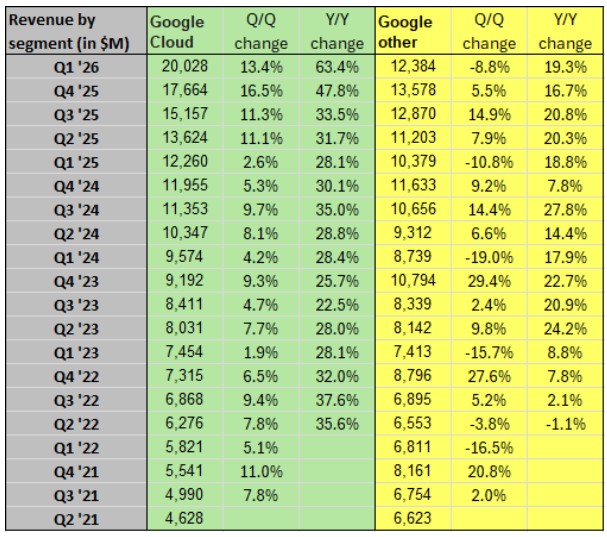
Market analysis indicates that the explosion in Google Cloud is mainly due to strong demand from enterprise-level customers for generative AI infrastructure and customized TPU chips. More forward-looking, the company disclosed that its cloud business backlog has nearly doubled from approximately $240 billion in the previous quarter to $462 billion, demonstrating the strong commercial appeal and customer stickiness of its AI solutions in long-cycle markets.
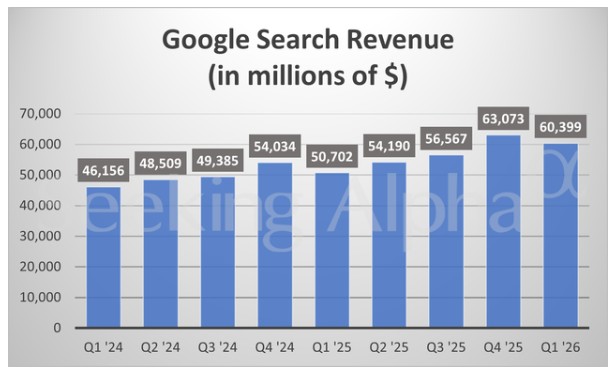
In terms of traditional core business, the Google Services segment performed steadily, with total revenue reaching $89.6 billion, a year-on-year increase of 16%. Among them, revenue from core search and other related businesses was $60.4 billion, with a growth rate of 19.1%, setting a historical high for query volume; CEO Sundar Pichai particularly emphasized that the deep integration of AI-generated search experiences (AI Overviews) significantly enhanced user engagement and usage frequency.
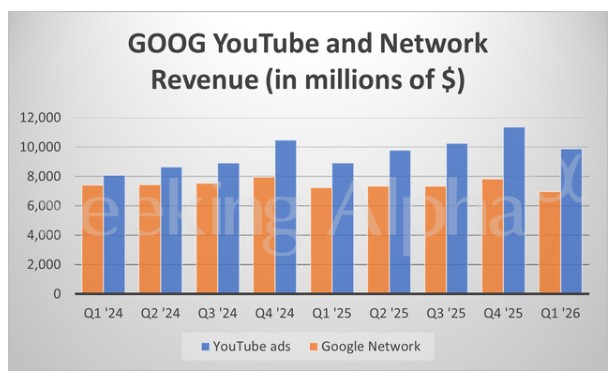
 At the same time, YouTube's advertising revenue contributed $9.88 billion, an increase of 10.7%; while the revenue from business segments covering subscriptions, platforms, and devices rose to $12.38 billion, a year-on-year increase of 19.3%, with the total number of paid subscribers reaching 350 million. These figures indicate that while Google is ramping up AI innovation, its traditional advertising and subscription ecosystem still maintains a strong defensive barrier.
In the face of aggressive capital expenditure demands, Alphabet has demonstrated a prudent yet ambitious balancing strategy, soothing shareholders with substantial returns. The company's capital expenditure for this quarter was $35.67 billion, primarily used to build the next generation of AI data centers and underlying computing hardware, and it reaffirmed its full-year capital expenditure guidance for 2026 to be between $175 billion and $185 billion, even hinting that it could reach $190 billion. To reward investors, the board announced a 5% increase in the quarterly dividend to $0.22 per share and authorized a new stock repurchase plan of up to $70 billion.
It is worth mentioning that on the eve of the earnings report, Google further solidified its leading position by investing an additional $40 billion in Anthropic and releasing the eighth generation TPU. It is understood that TPU is one of the best alternatives to NVIDIA chips, and as companies compete for computing power to meet AI demands, TPU has become a hot resource.
CEO Sundar Pichai stated in the investor conference call that Google will begin offering Tensor Processing Units (TPUs) to some customers for use in their own data centers, which will expand the potential market.
It is understood that in previous quarters, Alphabet's profits also benefited from the revaluation of its equity investments in private companies, including SpaceX, which plans to go public later this year. Alphabet is also a major investor in Anthropic PBC, which just announced last week that it will receive up to $40 billion in new funding from Google.
However, these two companies heavily backed by Google are now forming an increasingly tense competitive relationship: SpaceX has its own AI and chatbot company, xAI, founded by Elon Musk, which directly threatens Google's core territory; meanwhile, within Google, leadership is increasingly concerned that Anthropic's Claude Code, which suddenly became a phenomenal hit, is leaving the company behind in this critical area of AI programming
