


"Quantum Nvidia" Rigetti Q1 Revenue Triples, but Losses Widen: How Long Until Quantum Computing Commercialization?
Rigetti Computing's Q1 revenue tripled year-over-year to $4.4 million, but operating losses widened to $26 million. The stock fell 1.5% in after-hours trading following the earnings release. The company's flagship system, Cepheus-1-108Q, has been integrated into platforms such as Amazon and Microsoft. Rigetti also announced a $100 million investment in the UK, with plans to deploy a system with over 1,000 qubits, though the timeline remains three to four years away
Revenue tripled, but shares of "Quantum Nvidia" Rigetti fell in after-hours trading.
On May 11, quantum computing company Rigetti Computing released its Q1 2026 financial report after the U.S. market close.
In terms of revenue, Rigetti's Q1 revenue was $4.4 million, tripling year-over-year, surpassing the $4.09 million expected by FactSet analysts. The Adjusted Loss per share was 4 cents, in line with analyst expectations. Meanwhile, quarterly losses widened. Q1 operating losses reached $26 million, higher than the $22 million in the same period last year. Of this, R&D expenditures were nearly $20 million, accounting for the vast majority of the operating loss.
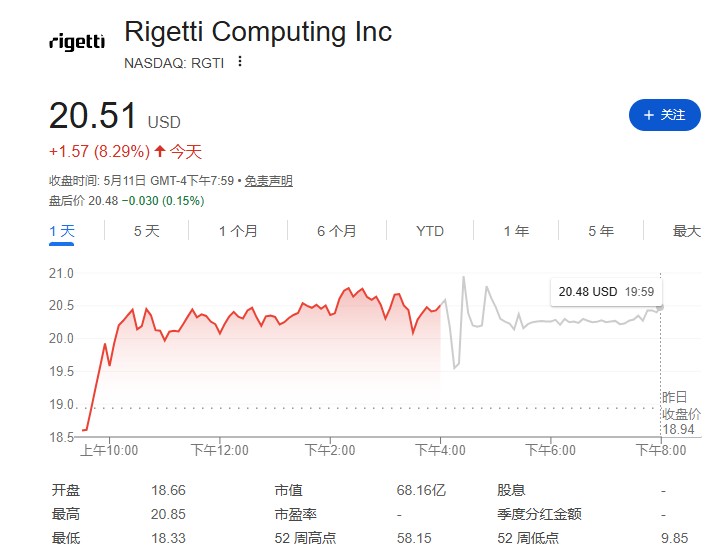
Following the earnings release, Rigetti's stock initially dropped 1.5% in after-hours trading, but the decline later narrowed to about 0.2%. Prior to this, the stock had surged 8.3% during the regular trading session. During the same period, quantum computing peers IonQ and D-Wave Quantum rose 15% and 6.5%, respectively, with the entire sector strengthening collectively on the eve of earnings week.
The market reaction was relatively calm, with no significant sell-off. Analysts believe this stability may stem from the fact that the earnings report contained few surprises and met market expectations.
New System Launch, but Limited "Surprise"
The core highlight of the earnings report was the official launch of Rigetti's previously announced Cepheus-1-108Q quantum system.
According to CEO Subodh Kulkarni, the system has now been integrated into Amazon Braket, Microsoft Azure Quantum, and Rigetti's own cloud service platform. The system went live in April this year, ending several months of uncertainty—Rigetti had previously delayed the original release schedule in January, citing the "need for further technical optimization."
In terms of performance, the company expects the system to achieve a median two-qubit gate fidelity of 99.5% within this year. Fidelity is a core metric for measuring the accuracy and stability of quantum operations; a higher value indicates a lower error rate for the quantum computer.
However, since the news of the system launch had already been made public, the market reaction was limited.
Widening Losses, Cash Burn Remains the Main Theme
Behind the revenue growth, Rigetti's losses are also expanding.
Q1 operating losses reached $26 million, higher than the $22 million in the same period last year. Of this, R&D expenditures were nearly $20 million, accounting for the vast majority of the operating loss.
For a company that has not yet achieved annual profitability and whose revenue scale is still measured in millions, cash reserves are crucial. As of the end of Q1, Rigetti held a total of $5.69 million in cash, cash equivalents, and available-for-sale investments, accounting for 87% of total assets. The company described this as a "strong cash position," with zero debt on its books. In comparison, this figure was $5.9 million in the same period last year, accounting for 88% of total assets.
Simply put: Rigetti's quarterly spending far exceeds its income, relying on cash on hand to sustain operations. This model is common in the quantum computing industry, but it also means the company has a high dependence on external financing and capital markets.
Betting on the UK, Thousand-Qubit System on the Agenda
While burning cash, Rigetti is also increasing its long-term investments.
The company announced a $100 million investment in the UK to "accelerate the development of quantum computing," with plans to deploy a quantum computer locally within the next three to four years.
The planned system will feature more than 1,000 physical qubits, over nine times that of the existing Cepheus system (108 qubits). The 1,000-qubit mark has always been an important milestone in Rigetti's roadmap.
However, Rigetti's roadmap has historically been subject to variability. The company initially planned to launch a thousand-qubit system between 2024 and 2025, but the timeline was forced back due to technical challenges and supply chain issues.
More notably, the company's strategic focus has quietly shifted—from purely pursuing qubit count to focusing on "fidelity-driven scaling," which means ensuring hardware reaches specific performance benchmarks before expanding system scale.
Kulkarni clearly stated in the previous quarter's earnings conference call: "Our focus is on achieving truly commercially meaningful quantum advantage, rather than pursuing superficial milestone numbers."
