


Samsung Electronics Faces Strike, Micron Tech Surpasses $900 Billion Market Cap
Over 50,000 Samsung workers announced a strike, unexpectedly igniting a market cap surge for Micron Tech—up 4.8% in a single day, breaking the $900 billion mark for the first time and jumping to become the 12th largest company in the US. If the strike proceeds, it could impact approximately 3% of global memory production capacity. Amid rising demand driven by the AI wave, Micron may benefit from both increased demand and higher prices, bringing it within striking distance of the top ten largest US companies
The breakdown in labor negotiations at Samsung has unexpectedly become a catalyst for Micron Tech's market capitalization to break through a historic threshold.
On May 13 local time, negotiations between the Samsung Electronics union and management failed, with over 50,000 workers threatening to launch an 18-day comprehensive strike starting May 21. Following the news, Micron Tech's stock closed up 4.8% at $803.63 that day, with its market capitalization exceeding $900 billion for the first time, reaching $906.28 billion, and ranking as the 12th largest company by market cap in the United States.
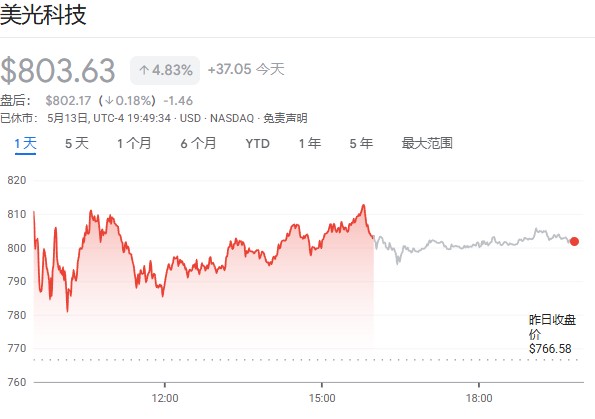
If the Samsung strike materializes, it is expected to impact approximately 3% of global memory chip production capacity, further exacerbating the already tight supply situation. For Micron, this means a double benefit on both the demand and price fronts—its chip products are already in short supply due to the wave of investment in AI infrastructure, and damage to competitors' production capacity will directly amplify this advantage.
Negotiations Break Down, Strike Imminent
According to a Reuters report on the 13th, Samsung union representative Choi Seung-ho told reporters outside the negotiation room in Seoul, "None of the issues raised by the union were addressed, which I deeply regret." He also stated that there are currently no plans to resume negotiations before the strike, but he would be willing to consider it if the company presented "a formal proposal."
The negotiations, mediated by the South Korean government, lasted two days and ultimately ended in failure. The core disagreement between labor and management centered on the bonus distribution scheme: the union demanded that 15% of operating profits be used for bonuses with the cap abolished, while Samsung only offered a 10% scheme, marking a significant disparity in their positions. Samsung stated it would continue efforts to prevent the strike, while the union is seeking to clear legal obstacles to launching the strike.
If the strike proceeds as scheduled from May 21 to June 7, more than 50,000 people will participate. Investors are closely monitoring developments, as any production disruption could affect the global semiconductor supply chain.
Widening Supply Gap, Direct Benefit to Micron
The memory chip market was already in a state of historic supply shortage, with the explosive construction of AI data centers making memory chips a bottleneck in the entire industry chain. Micron is the world's third-largest memory chip manufacturer, with market share trailing only Samsung and SK Hynix.
According to Jefferies estimates, the Samsung strike could affect approximately 3% of global memory chip production capacity. Once Samsung's output is impaired, customer orders will accelerate their shift to Micron. Coupled with expectations of further chip price increases, Micron's revenue outlook will improve significantly.
SK Hynix also benefited from market sentiment, with its stock rising 7.7% in the local South Korean market that day. Sandisk, which competes with Samsung in the NAND flash memory chip sector, saw its stock dip slightly by 0.3% to close at $1,440.
Market Cap Surge, Approaching Top Ten in the US
This stock price increase pushed Micron's market capitalization above $900 billion for the first time, leaving it only about $50 billion behind Eli Lilly, which ranks 11th. Currently, the top ten largest companies by market cap in the US are Nvidia, Alphabet, Apple, Microsoft, Amazon, Broadcom, Tesla, Meta, Berkshire Hathaway, and Walmart.
Over the past 12 months, Micron's stock price has cumulatively risen more than eightfold, with the core logic being the expansion of memory demand driven by AI. Samsung's labor crisis has added fuel to this upward trend, keeping the market highly attentive to the reshuffling of the memory chip supply landscape.
