


With a market value approaching 3 trillion, why is Amazon becoming "cheaper as it rises"?
Amazon's stock price has soared due to its success in the field of artificial intelligence, with its market capitalization approaching $3 trillion. Since the end of March, the stock price has risen by 36%, with a monthly increase of 27% in April, marking its best performance since 2007. Amazon's cloud computing and AI businesses have shown strong performance, driving this growth. If the upward trend continues, Amazon will triple its market capitalization in about six years
After several years of relative silence, e-commerce and cloud computing giant Amazon (AMZN.US) is making a powerful return to the center of the global technology stage. Investors hold highly optimistic expectations for Amazon's increasingly solid position in the field of artificial intelligence, a sentiment that is driving its stock price to soar and pushing the company's market value past key milestones. From strategic investments to self-developed hard technology, from deeply binding large model companies to fully empowering core businesses, Amazon is staging a comprehensive value reassessment drama centered around "AI+".
According to Zhitong Finance APP, the optimistic sentiment among investors regarding this e-commerce and cloud computing giant's layout in the field of artificial intelligence continues to heat up, driving its stock price to soar since the end of March, with its market value approaching the historic threshold of $3 trillion. The latest data shows that Amazon's stock price is around $270, with a market value of approximately $2.91 trillion, just about 2% away from joining the elite club of trillion-dollar companies, which includes only Microsoft, Apple, Nvidia, and Alphabet.
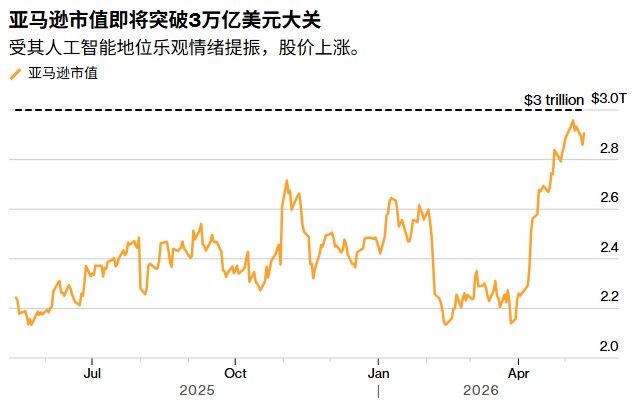
Since hitting a low on March 27, Amazon's stock price has risen by 36%, becoming the fourth largest contributor to the S&P 500 index, accounting for 7.4% of the index's 17% increase during the same period. In April, the stock price surged by 27% in a single month, marking the best monthly performance since 2007. From the beginning of 2026 to the present, the stock has accumulated an increase of approximately 18.7%, significantly outperforming the Roundhill Magnificent Seven ETF, which tracks the "seven tech giants," and the broader market index.
It is worth mentioning that Amazon previously experienced a low-return period lasting five years. If this round of gains continues and successfully breaks through $3 trillion, Amazon will achieve a threefold increase in market value in about six years and three months—becoming a trillion-dollar company in February 2020, surpassing $2 trillion in June 2024, and the speed of crossing the third trillion-dollar mark is far faster than the first two.
Strong Fundamental Support: AWS Returns to High Growth, Chip Business Shines
This round of explosive growth is not without reason, as it is backed by the core business of the company—especially the cloud computing and AI-related businesses delivering solid results. The first-quarter financial report for 2026, released on April 29, became a key catalyst.
AWS Growth Hits 15-Quarter High
The financial report shows that Amazon's net sales in the first quarter reached $181.5 billion, a year-on-year increase of 17%, exceeding market expectations. Among them, the most notable cloud computing business, AWS, achieved revenue of $37.6 billion, a staggering year-on-year increase of 28%, marking the fastest growth rate in 15 quarters. AWS's operating profit reached $14.2 billion, accounting for nearly 60% of the company's total operating profit, highlighting its strong profitability.
In the earnings call, CEO Andy Jassy used a set of striking comparative data to illustrate the explosive growth of the AI business: "Three years after AWS launched, its annualized revenue was $58 million In the first three years of this wave of AI, AWS's annualized AI revenue has exceeded $15 billion, expanding nearly 260 times.
AWS's order backlog also provides room for sustainable growth. As of the end of the first quarter, AWS's backlog reached $364 billion, and this figure does not yet include the recent agreement with Anthropic worth over $100 billion, significantly up from $244 billion at the end of 2025. Andy Jassy emphasized that the backlog is not concentrated among one or two large clients, but has "a considerable breadth of customer composition."
Custom Chips and Advertising Dual-Drive
Even more exciting for the market is that Amazon's self-developed AI chip business has systematically disclosed its scale for the first time. CEO Andy Jassy revealed that the company's chip business (covering Graviton, Trainium, etc.) has annualized revenue exceeding $20 billion and is expected to achieve triple-digit percentage year-on-year growth. At the same time, the advertising business has also surpassed $70 billion in revenue over the past 12 months, becoming another strong growth engine for Amazon.
In the past 12 months, Amazon has deployed over 2.1 million AI chips, more than half of which are self-developed Trainium chips. Jassy presented a striking data point: "If our chip business existed as an independent company, selling the chips produced to AWS and third parties like other leading chip companies, our annualized revenue would be $50 billion."
The Trainium series products are progressing rapidly: Trainium 2 has improved the price-performance ratio by about 30% compared to similar GPUs and is currently nearly sold out; Trainium 3 is set to ship in early 2026. Amazon has secured over $225 billion in revenue commitments for Trainium chips, primarily from deep collaborations with Anthropic and OpenAI, with most of the chip production capacity already booked.
In the e-commerce sector, AI is also initiating a profound transformation. On May 13, Amazon announced the termination of the independently operated Rufus shopping chatbot, opting instead to deeply integrate AI shopping features into the Alexa assistant, launching the new "Alexa for Shopping." This integration means that Amazon's search box will transform into a Q&A engine, allowing users to obtain product information, compare items through natural language conversations, and even automatically place orders when a specific price is reached.
Daniel Rausch, head of Amazon Alexa, commented on this: "Shopping is not something you can treat as a side job." He emphasized that Amazon's unique customer reviews, vast product catalog, inventory status, and estimated delivery dates constitute competitive advantages that other AI shopping tools cannot replicate.
The strategic significance of this move lies in the fact that AI not only enhances AWS's growth momentum but is also reconstructing the user experience and commercial monetization logic of Amazon's core e-commerce business. Search behavior is shifting from keyword matching to intent understanding, advertising placement is transitioning from bidding rankings to contextual embedding, and the way millions of third-party sellers acquire traffic will undergo fundamental changes Dual-Line Betting: Deep Ties with Anthropic and OpenAI
In the field of AI large models, Amazon has adopted a "double betting" strategy, with increasing stakes on both sides.
On April 20, Amazon announced an additional investment of $5 billion in Anthropic, a competitor to OpenAI, with the potential for up to $20 billion more based on business milestones in the future. This, combined with the $8 billion it has invested since 2023, represents a significant total investment commitment. In exchange, Anthropic has committed to investing over $100 billion in AWS technology over the next decade, covering current and future generations of Trainium chips and tens of millions of Graviton CPU cores. Anthropic will receive Trainium chips with a total computing power of up to 5 gigawatts for training and powering its AI models.
While securing a future supply source for AI models through Anthropic, Amazon also announced a multi-year strategic partnership with OpenAI in February of this year, investing $50 billion in the latter. Thus, the two most influential AI model companies in the world have been incorporated into the AWS ecosystem.
At the end of April, Amazon Web Services announced a deepened partnership with OpenAI, introducing the latest flagship models such as GPT-5.5 and GPT-5.4 to the Amazon Bedrock platform, and launching products like the OpenAI-based programming assistant Codex. This series of strategic moves breaks the long-standing exclusive cloud service arrangement between Microsoft Azure and OpenAI, bringing a richer model ecosystem and developer resources to AWS.
Stephen Lee, founding partner of Logan Capital Management, commented: "All of Amazon's businesses are interconnected. Mastering artificial intelligence not only benefits AWS but also brings significant advantages to its e-commerce logistics and advertising targeting. Amazon is likely to become a dual winner in AI infrastructure construction and AI applications, which is a highly attractive combination."
Computing Power Arms Race: A $200 Billion Gamble and a "Once-in-a-Lifetime Opportunity"
Amazon's ambitions go far beyond the current cooperation. In the arms race for AI infrastructure, it is making an exceptionally rare massive bet in the history of technology. Amazon expects its capital expenditures for the full year 2026 to reach approximately $200 billion, a year-on-year increase of over 50%, a figure that far exceeds Wall Street's previous expectations, making it the company with the highest capital expenditure among S&P 500 constituents. CEO Andy Jassy took a firm stance in the face of Wall Street's skepticism, stating in his annual shareholder letter: "We will not take a conservative approach on this matter—we want to invest to become a truly significant industry leader." He even defined AI as a "once-in-a-lifetime opportunity."
The vast majority of this enormous expenditure will be directed towards AI infrastructure, with the commercial prospects of the custom AI chip Trainium being the core of this investment logic. According to Jassy's latest disclosure, Amazon plans to not only use Trainium for its own cloud services within two years but also to sell it directly to external customers, directly challenging NVIDIA's dominance in this field The latest generation of Trainium 3 chips has officially entered commercial use, with performance improved twofold compared to the previous generation, while the more advanced Trainium 4 has almost been fully booked by customers.
Price-to-Earnings Ratio Below 25 Times, Valuation Low Point? Wall Street's Bullish Consensus and Concerns
With earnings expectations raised, Amazon's valuation has become more attractive. Over the past month, the market has raised its general expectation for Amazon's earnings per share in 2026 by 14%, and revenue expectations have also increased. This has resulted in Amazon's current price-to-earnings ratio being less than 25 times, far below its 10-year average of 46 times. In late March, its price-to-earnings ratio briefly fell to the lowest point since the end of 2008.
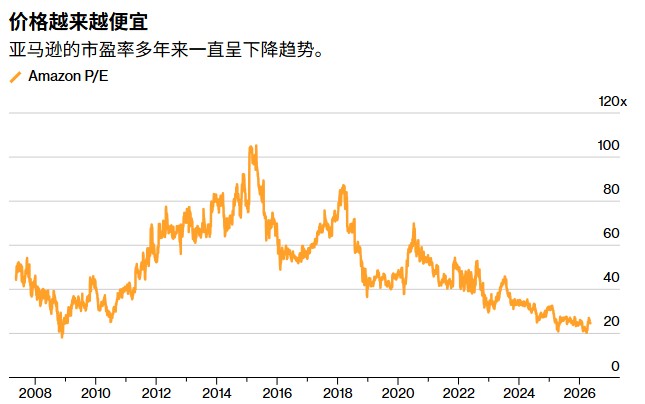
This "cheaper as it rises" valuation characteristic largely explains why Wall Street has given Amazon the highest proportion of "buy" ratings among large-cap stocks. Among the 83 analysts tracked by institutions, 79 have given "buy" ratings, with no one giving a "sell" rating. The average target price is $313, indicating about a 16% upside potential over the next 12 months.
In the face of such an aggressive investment strategy, the mainstream voice on Wall Street currently acknowledges it. Among the analysts tracked by institutions, bullish sentiment is extremely high, with an average target price of about $313, suggesting about a 15% upside potential for the stock price over the next 12 months. Several investment banks, including JP Morgan, Piper Sandler, Canaccord, and UBS, have intensively raised their target prices for Amazon following the Q1 earnings report. TD Cowen reiterated its buy rating, maintaining a target price of $350. Over the past month, the market's general expectation for Amazon's earnings per share in 2026 has been raised by 14%, and its revenue expectations have also increased. This makes Amazon's current price-to-earnings ratio of less than 25 times look quite attractive—this figure is far below its average level over the past 10 years, having previously set a record low since the end of 2008 in late March.
However, behind the soaring market sentiment, a core question remains unresolved—how much return can Amazon's capital expenditure plan of approximately $200 billion in 2026 actually bring?
In the first quarter, Amazon's capital expenditure reached $44.2 billion, primarily for AWS and generative AI computing power construction. The direct consequence of this large-scale investment is a sharp deterioration in free cash flow—over the past 12 months, free cash flow has only been $1.2 billion, a 95% drop from $25.9 billion in the same period last year. Amazon expects its total capital expenditure for 2026 to be about $200 billion, far exceeding $131 billion in 2025, and is expected to further rise to $226 billion in 2027 Amazon, Microsoft, Google, and Meta are expected to have a combined capital expenditure exceeding $700 billion by 2026. According to Goldman Sachs' estimates, nearly all free cash flow of the "Tech Seven Giants" will be consumed by capital expenditures at that time.
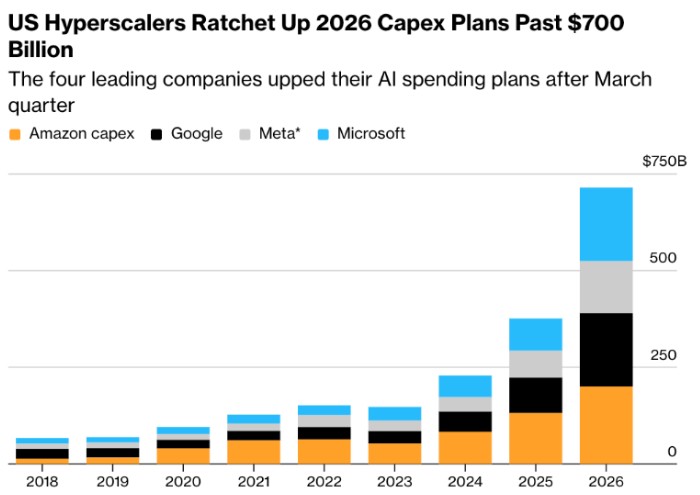
Jassy attempted to soothe market sentiment in his April 9 letter to shareholders: most of the capital expenditures in 2026 will start to generate returns in 2027 to 2028, and "a significant proportion already has customer-committed orders." In other words, this is not a blind gamble; buyers are already in line waiting.
Not everyone is confident about this gamble. Tom Graff, Chief Investment Officer at Facet, expressed a cautious viewpoint. Although his institution still holds Amazon stock, he believes "there is still a huge question about how much return all this artificial intelligence spending will ultimately bring." He pointed out that as long as capital expenditures continue to soar, the company's valuation multiples may come under pressure, as it will no longer have the strong free cash flow it once did. "Ultimately, I think there are more scenarios where it underperforms than where it excels," Graff added, "Many factors have to align perfectly, and in this world where I'm trying to balance risk and return, I see more risk."
