


Amazon's "burning money" faces scrutiny: $200 billion AI gamble backfires on free cash flow, July financial report may become a battleground for bulls and bears
Amazon's Q2 financial report faces a critical test, with the market focusing on whether AWS monetization can offset the $200 billion impact of AI capital expenditures on free cash flow. Analysts believe that the current upside potential for the stock price is limited; if AWS grows significantly and cash flow recovers, it could boost the stock price, otherwise, it will be under pressure. The July financial report will validate the rationale for AI investments
According to Zhitong Finance APP, Amazon (AMZN.US) is set to face a critical test with its upcoming Q2 earnings report, as market attention focuses on whether the monetization process of AWS can keep pace with the massive capital expenditure (CapEx) expansion driven by AI. Despite strong revenue and AWS income growth momentum, Amazon's free cash flow (FCF) has sharply shrunk under the pressure of a $200 billion capital expenditure plan, raising concerns about its future cash conversion efficiency.
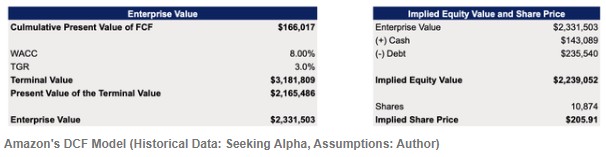
Financial analyst Bohdan Kucheriavyi expressed his views on this quarterly report, stating that according to his updated discounted cash flow (DCF) model, Amazon's fair value per share is approximately $205.91, below the current market price, indicating limited short-term upside potential, but the downside risk is not sufficient to support a "sell" rating. He believes that the Q2 performance is crucial: if AWS continues to grow rapidly and free cash flow shows signs of recovery, it could provide justification for the current high expenditures and boost stock price momentum; conversely, if free cash flow turns negative alongside rising debt levels, it could exert significant pressure on the stock price.
Kucheriavyi noted that two years ago, he believed Amazon had limited upside potential. However, thanks to the outstanding performance of its cloud business (AWS) and the continued surge in computing demand, the company's stock price has risen approximately 35% since then. The company's business foundation is solid, and there are optimistic factors for the future. However, the AI investment cycle has profoundly changed Amazon's cash flow structure.
For this reason, the next earnings report, expected to be released in late July, is crucial. It will provide the market with clearer answers: can the monetization process of AWS begin to catch up with the current capital expenditure (CapEx) cycle? Before this, it may be quite challenging for Amazon's stock price to regain upward momentum after experiencing a significant recent pullback.
Next Month is the Real Test
The upcoming quarterly report is critical not only because of the earnings disclosure itself. The real question is whether the company can prove that its massive AI infrastructure investments have begun to release sufficient growth momentum to support free cash flow (FCF).
Looking ahead to Q2, Amazon has provided guidance for net sales of $194 billion to $199 billion, a year-on-year increase of 16% to 19%; operating profit of $20 billion to $24 billion. The recently concluded Q1 performance was also strong: net sales increased by 17% year-on-year to $181.5 billion, AWS revenue surged by 28% year-on-year to $37.6 billion, and operating profit rose to $23.9 billion.
The problem is that free cash flow over the past twelve months has plummeted from $25.9 billion in the same period last year to just $1.2 billion. Amazon itself explained that the decline was mainly due to a $59.3 billion year-on-year increase in property and equipment purchases (after deducting proceeds and incentives), which reflects investments in the AI sector. While growth exists, cash conversion efficiency is concerning.
Even more worrying is that considering Amazon has set its 2026 capital expenditure target at around $200 billion to expand AI capabilities, the annual free cash flow could even turn negative. Earlier this year, reports indicated that Amazon was seeking to raise $37 billion to $42 billion through bond issuance to support its capital expenditure plans. Recently, foreign media also reported that Amazon has secured a $17.5 billion loan facility to continue advancing its AI infrastructure construction This is likely to become a significant hidden danger. After all, market sentiment towards AI stocks is turning cautious. If Amazon records negative free cash flow in its second-quarter report while its debt situation worsens, the difficulty of the stock price returning to its highs in the short term will greatly increase.
Where is Amazon's stock price headed?
Another issue is valuation. Nearly two years ago, the discounted cash flow (DCF) model built by Kucheriavyi indicated a fair value of $169.33 per share. At that time, it was assumed that revenue growth for fiscal years 2024 and 2025 would be approximately 11% and 12%, respectively, which is largely consistent with actual results. Looking ahead, revenue is still expected to maintain double-digit growth, which is not far off from current market expectations.
In terms of EBIT profit margin, due to strong demand for cloud services, it is expected to continue improving the company's bottom-line performance, thus the EBIT expectations in the new model have also been raised, closely aligning with market consensus.
The model also assumes that capital expenditures this year will reach approximately $200 billion. Given that CapEx in the first quarter has already reached $44.2 billion, and management guided for total expenditures of about $200 billion at the beginning of the year, this figure is reasonable. As a result, the assumptions for depreciation and amortization have also been adjusted upwards.
The assumptions for changes in net working capital and tax rates are similar to those in previous years, with the weighted average cost of capital (WACC) set at 8%.
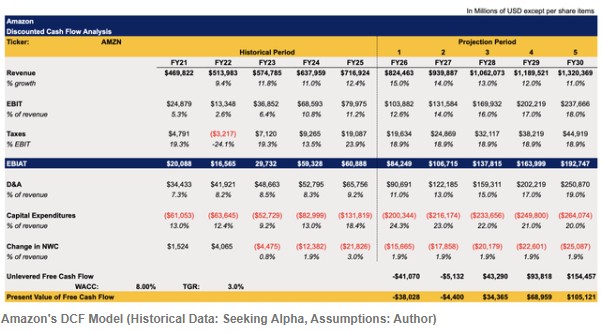
The model results show that Amazon's fair value is approximately $205.91 per share. The current stock price is around $234, indicating a slight downside implied by the model. Kucheriavyi believes this is not enough to warrant a "sell" rating—AWS remains a high-quality business, advertising revenue continues to grow, and operating cash flow remains substantial. However, the model also does not make the stock sufficiently attractive before the quarterly report. The current capital expenditure cycle has made the free cash flow outlook too chaotic.
Other points of interest
On the other hand, Amazon remains one of the most powerful companies in the world. Selling stocks solely due to short-term pressure on free cash flow may be overly hasty. A more reasonable attitude is to wait for more validation signals.
However, it can be reasonably expected that the cloud business will continue to grow well in the coming years. Despite increasing pressure from Microsoft and Google, Amazon still holds a leading position in the cloud market with a 28% market share at the end of the first quarter. If AWS can maintain a growth rate similar to that of the first quarter in the second quarter, the current relatively aggressive spending will be more easily accepted by the market.
Additionally, Amazon's self-developed chips (such as Trainium and Graviton) are expected to optimize the cost structure over time, reducing reliance on NVIDIA (NVDA) At the same time, if its circular transaction with Anthropic (Amazon's investment in exchange for the AI lab's commitment to acquire more computing power) is successful, the current expenditure scale will also be supported.
Another important fact is that Amazon's operating cash flow remains quite substantial. Over the past twelve months, operating cash flow reached $148.5 billion, indicating its strong cash generation capability. Once the growth rate of capital expenditures slows down, or AWS revenue growth catches up, free cash flow can quickly recover. Therefore, giving a "sell" rating at this stage is not appropriate.
Conclusion
Amazon's business possesses all the elements for sustained double-digit growth, but this does not mean that its stock price can significantly rise in the foreseeable future. As investors begin to question the massive investments in the AI sector, if free cash flow does not grow, it may further exacerbate market concerns about the stock price returning to its peak.
For this reason, the second-quarter report expected to be released in late July will have a significant impact on Amazon's future stock price trend. If AWS continues to grow rapidly, profit margins stabilize, and management provides a positive outlook for the recovery of free cash flow, the fair value may be far higher than my current model estimates, and the stock price is expected to regain momentum and rise.
Conversely, if capital expenditure guidance is raised again, AWS growth slows down, debt structure deteriorates, and free cash flow shows no improvement, then under the current market conditions, a rebound in the stock price may become increasingly distant
