


IBM Plunges to Record Low; Goldman Sachs Warns: Shift in AI Capex May Confirm "Software Bear Market"
IBM's stock plummeted by as much as 26% during U.S. trading hours, marking a record decline. IBM's CEO pointed to a "sudden shift" in customers' capital expenditure priorities, noting that amid the AI boom, corporate clients redirected substantial budgets toward snapping up hardware infrastructure, causing several major contracts to fail to close on schedule. Goldman Sachs subsequently warned that this IBM incident would fully validate the "software bear market scenario," predicting widespread selling across the software and services sector
IBM issued an unexpected second-quarter earnings warning on Tuesday, sending its stock to its largest single-day drop on record. This has triggered deep-seated market concerns that enterprise IT budgets are shifting en masse toward AI infrastructure, squeezing traditional software and services spending.
IBM's stock skidded by as much as 26% during U.S. trading hours, a drop exceeding the single-day losses seen during the burst of the internet bubble and the 1987 stock market crash. According to Bloomberg data tracing back to 1968, if the decline holds until the close, this will be IBM's most devastating trading day on record.
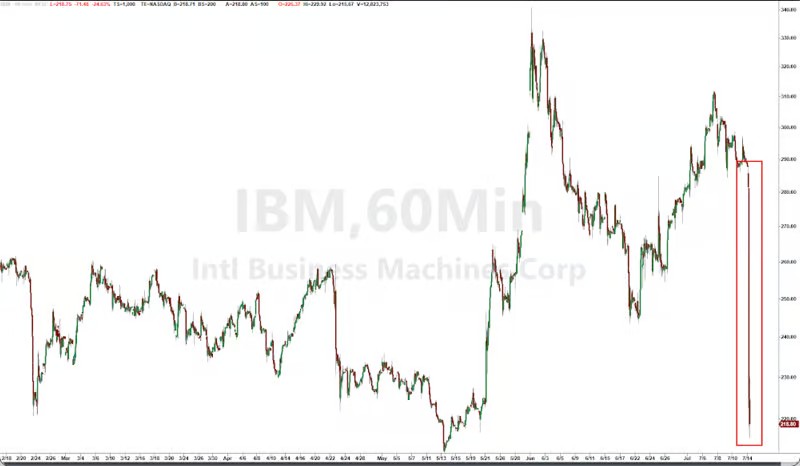
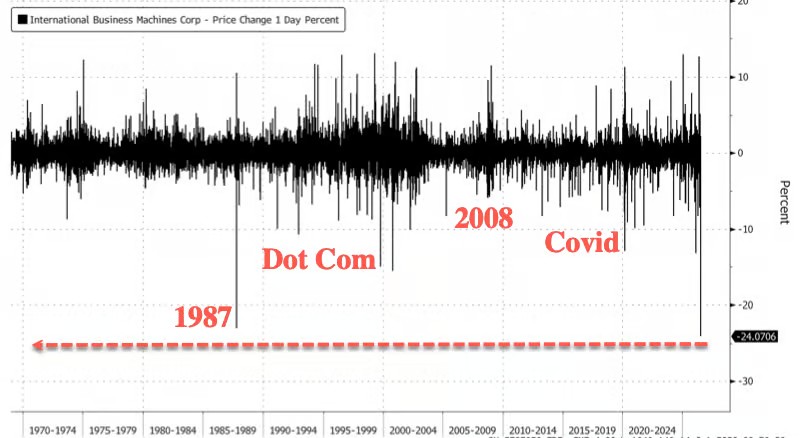
IBM CEO Arvind Krishna attributed the miss to a "sudden shift" in customers' capital expenditure priorities—against the backdrop of the AI boom tightening supply for servers, storage, and memory, corporate clients temporarily redirected large portions of their budgets to snap up hardware infrastructure, causing several major contracts to fail to close on schedule.
Goldman Sachs promptly warned that this IBM incident will fully validate the "software bear market scenario," with widespread selling expected in the software and services sector.
Core of the Earnings Warning: Revenue and Profit Both Miss; Mainframe Business Hit Hardest
According to IBM's preliminary second-quarter data, the company's total revenue was $17.2 billion, below the market expectation of $17.9 billion; Non-GAAP earnings per share were $2.93, also missing the expected $3.02.
In terms of segment performance, software business revenue grew only 5% year-over-year, significantly below the market-expected growth rate of 11%; infrastructure business declined 7% year-over-year, worse than the expected 3% decline; and the consulting business remained flat, falling short of the expected 2% increase.
According to UBS analysts Robert Ruple and Goldman Sachs analyst James Schneider:
The primary driver of this earnings gap was weakness in IBM's mainframes (zSeries), which severely impacted the high-margin Transaction Processing (TP) business.
Transaction Processing revenue is estimated to have fallen by mid-double digits year-over-year, and this business accounts for nearly 30% of IBM's software division revenue.
In contrast, Red Hat achieved an 11% growth rate at constant currency, and recently acquired assets such as HashiCorp and Confluent performed in line with expectations, but none could offset the sharp decline in the TP business.
IBM management admitted in a letter to shareholders:
"In the last few weeks of June, we saw customers shift quarterly capital expenditures toward server, storage, and memory purchases to lock in supply-constrained infrastructure ahead of expected price increases. We anticipated some supply chain impacts but failed to predict the magnitude of the capital expenditure reprioritization."
Goldman Sachs Issues "Software Bear Market" Warning; Sector-Wide Ripple Effects Emerge
In its immediate research report, Goldman Sachs directly stated that this IBM incident "will fully validate the software bear market scenario," and predicted "quite broad" downward pressure at the software and services level.
Barclays analyst Andrew Keches pointed out that this update is testing IBM's investment thesis. Previously, management repeatedly emphasized that AI had an "additive" rather than disruptive effect on the software stack. However, this earnings gap concentrated on mainframes and their associated Transaction Processing software, while customers are shifting spending toward supply-constrained servers, storage, and memory—a reality that makes the previous narrative unsustainable.
He believes the core debate in the market now is: Is this merely a temporary misalignment in corporate procurement pacing, or an early signal that AI infrastructure investment is beginning to systematically crowd out traditional software spending?
BNP Paribas analyst Stefan Slowinski also noted that IBM has not yet shown any signs of improvement.
Regarding sector linkage, Andrew Keches believes the most direct potential beneficiaries are server and storage-related hardware manufacturers, including Dell, HP, and Micron in the memory space; whereas consulting and IT service firms like ACN and KD, as well as the software sector as a whole, face greater sentiment pressure.
Analysts: IBM Has Idiosyncratic Factors; Caution Advised in Interpreting Industry Spillover
Despite spreading market anxiety, several analysts cautioned against simply equating IBM's situation with a broader industry signal.
Andrew Keches explicitly stated that IBM has acknowledged company-level execution issues, including the failure to complete several major contracts on time.
He also pointed out that IBM's choice to disclose this more than a week before the official earnings release date itself suggests that this gap may be more of an isolated case rather than an industry-wide trend. He wrote:
"We understand this is a 'sell first, ask questions later' market, but caution is needed in mapping IBM's results 1:1 to every software and services company."
Goldman Sachs analyst James Schneider also noted that the weakness in IBM's Data & Automation software business stemmed partly from internal execution issues, and stated that he would not adjust his valuation model until further clarification on 2026 guidance and remedial measures is provided during next week's earnings call.
UBS analyst Robert Ruple characterized this IBM warning as a potential "harbinger," possibly signaling that other software, IT services, and hardware companies will issue similar signals sequentially during the Q2 earnings season, thereby creating cumulative pressure on overall market sentiment.
Huge Gap in Wall Street Expectations; Rating System Faces Reassessment Pressure
Prior to this earnings warning, Wall Street expectations for IBM were generally optimistic, forming a stark contrast with the day's market reaction. According to analyst data tracked by Bloomberg, IBM's average target price over the past 12 months was $300. Among the 25 covering analysts, 17 gave buy ratings, 6 held neutral positions, and only 2 recommended sell.
UBS's David Vogt pointed out that this result may prompt investors to reassess IBM's long-term software growth prospects, especially the outlook for 2027 and beyond—as the dual pressures of rising infrastructure costs and tightening IT budgets continue to suppress demand.
He believes that faster-growing businesses like Red Hat may no longer be sufficient to hedge against the continued weakness in the Transaction Processing business, and IBM will face greater pressure to maintain its software growth trajectory through large-scale M&A or other initiatives.
Barclays' Andrew Keches cautioned that IBM had explicitly mentioned M&A intentions in the previous quarter's earnings call, stating that current valuations were attractive and acquisition appetite might be higher than in normal years. While the earnings miss itself does not directly point to M&A activity, the weak performance undoubtedly adds more uncertainty to this topic.
