


SK Hynix ADR Premium Exceeds 50%, Surging 27% in a Single Day! Option Listing Stimulates Trading as Capital Bets on Short-Term Gains
Just three trading days after its listing, the premium of SK Hynix ADR over its South Korean local shares has sharply widened to 51%. Conversion restrictions between South Korean local shares and ADRs make traditional arbitrage difficult to implement at low cost. On Tuesday, major U.S. options exchanges officially launched SK Hynix ADR option products, further stimulating trading enthusiasm, with short-term call options becoming the primary focus of capital inflows
Just three trading days after its listing, the premium of SK Hynix American Depositary Receipts (ADR) over its South Korean local shares has sharply widened to over 50%. This reflects strong demand from U.S. investors for this leading global memory chip stock and highlights the inherent limitations of arbitrage mechanisms between ADRs and South Korean local shares.
On Tuesday, SK Hynix ADR surged 27% in a single day, not only fully recovering the previous day's 9.3% decline but also pushing the ADR premium over Seoul-listed ordinary shares to 51%. This premium level far exceeds the approximately 3% spread at the time of last week's issuance, when the company raised $26.5 billion through this ADR offering.
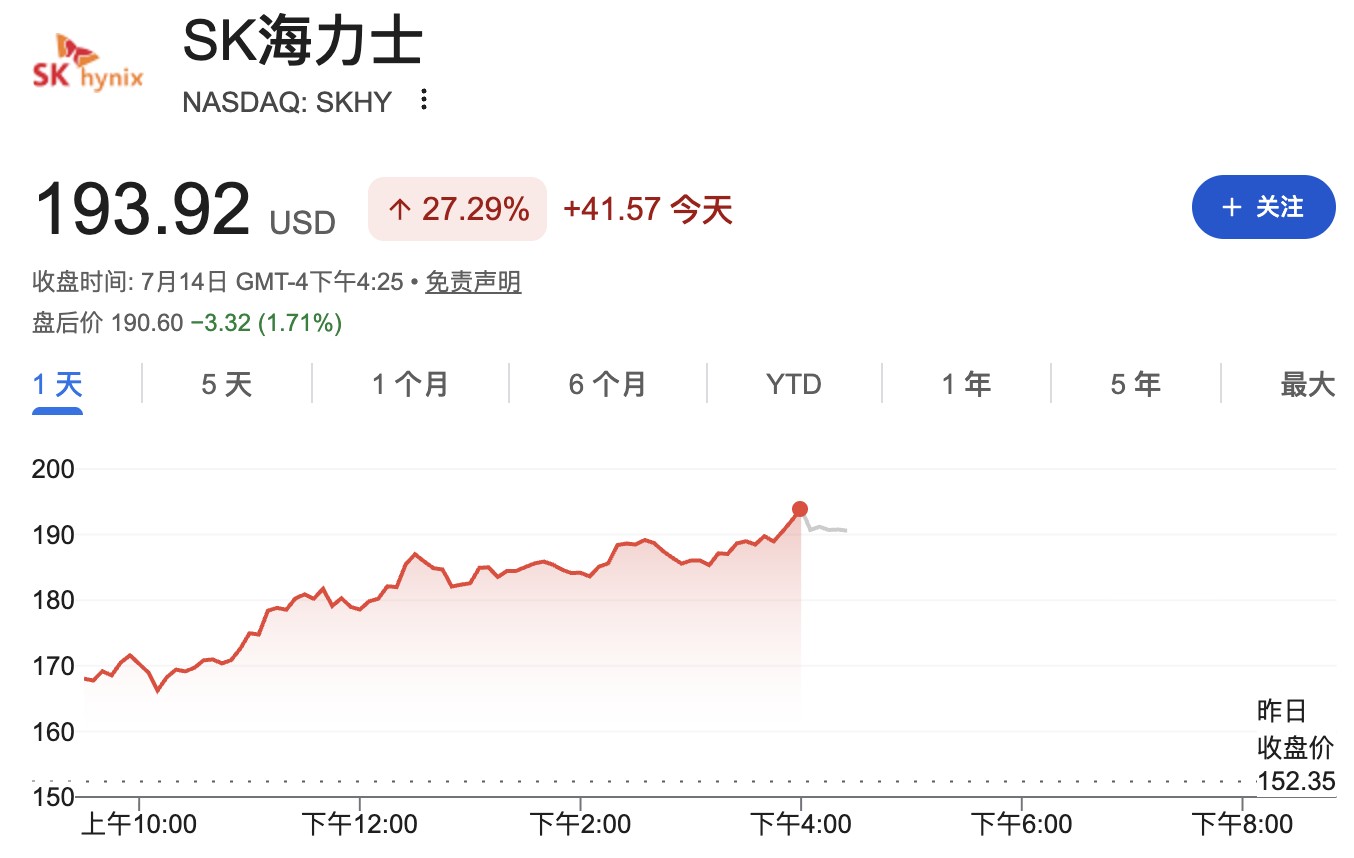
The sudden expansion of the premium is partly due to conversion restrictions between South Korean local shares and ADRs, which hinder smooth arbitrage operations. Meanwhile, on Tuesday, major U.S. options exchanges officially began offering SK Hynix ADR option products, further stimulating trading enthusiasm, with short-term call options becoming the primary focus of capital inflows.
Structural ADR Premium: Conversion Restrictions Lay the Groundwork
According to documents filed by SK Hynix with the U.S. Securities and Exchange Commission (SEC), each ADR is equivalent to one-tenth of an ordinary share. At the inception of the ADR issuance, the market generally expected its trading price to be higher than the corresponding share price in Seoul. The fundamental reason lies in the conversion restrictions between South Korean ordinary shares and ADRs, making traditional arbitrage difficult to implement at low cost.
It is precisely this structural constraint that allowed the ADR premium to expand freely in the short term without being quickly compressed back to reasonable levels by arbitrage forces. The current 51% premium indicates that the marginal pricing of the stock in the U.S. market has significantly diverged from the South Korean local market.
Behind the Volatility: AI Valuation Concerns and the Launch of Options Trading
The intense volatility of SK Hynix ADR since its listing reflects current market concerns about the overall high valuation of the AI ecosystem and whether semiconductor capital expenditures have reached a phase-specific peak. These two factors exerted significant pressure on the ADR in the early stages of its listing, triggering a sharp single-day correction of nearly 10% last week.
With ADR options officially listing on U.S. options exchanges on Tuesday, investors in the world's largest derivatives market were provided with new tools to speculate on this AI memory leader. On the first day of listing, early trading volume quickly reached approximately 33,000 contracts, with short-term call options becoming the primary focus of capital inflows.
From the perspective of trading structure, more than two-thirds of option trading volume was concentrated in short-term contracts expiring within the week, reflecting investors' preference for betting on short-term market movements. The most actively traded were call options with a strike price of $185, with approximately 2,900 contracts; put options with a strike price of $145 followed closely, indicating that some capital was also configuring downside protection.
In addition, over 1,500 call options with a strike price of $200 expiring in August were traded, reflecting investor confidence in the stock breaking through $200 in the medium term.
Daniel Kirsch, Head of Options Business at Piper Sandler, pointed out that investors are expected to primarily position for short-term opportunities of continued rises in SK Hynix ADR this week. With the launch of options tools, retail investors are expected to flock in rapidly, and short-term call options expiring within the week may become the most popular trading instruments.
Bellwether Amidst Volatility: ASML and TSMC Earnings Reports
Amidst the heated options trading, the chip sector will see important catalysts this week. Dutch lithography giant ASML and TSMC will sequentially announce their latest quarterly results, and the performance of these earnings reports is expected to further influence the price trend of the entire semiconductor sector and SK Hynix ADR.
Notably, Lisa Shalett, Chief Investment Officer of Morgan Stanley Wealth Management, issued a cautious signal regarding chip stocks, believing that the AI data center technology stack is being redesigned, with an increasing number of lower-cost self-developed chips being incorporated, and that the growth rate of AI capital expenditures may have entered the "initial stage of slowdown."
SK Hynix's South Korean shares have fallen about 25% from their historical highs in June, but have still accumulated a gain of approximately 235% year-to-date, with volatility significantly intensifying.
