


U.S. Stock Market Outlook | Three Major Index Futures Rise Together, Federal Reserve's July Rate Hike Probability Halved, Apple Smart Devices to Integrate Alibaba and Baidu AI
On July 15th, before the US stock market opened, the three major stock index futures rose together. Affected by the unexpected cooling of the US June CPI data, the probability of a Federal Reserve rate hike in July dropped to about 15%, and market risk appetite rebounded. In addition, Trump convened a meeting to discuss plans for a large-scale offensive against Iran
Pre-Market Market Trends
- As of July 15 (Wednesday) pre-market, U.S. stock index futures are all up. As of the time of writing, Dow futures are up 0.10%, S&P 500 futures are up 0.17%, and Nasdaq futures are up 0.47%.

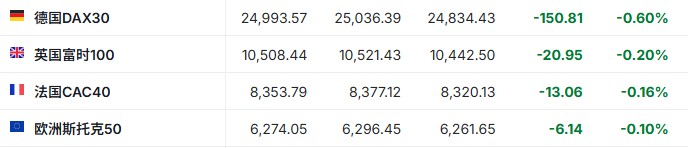
- As of the time of writing, Germany's DAX index is down 0.60%, the UK's FTSE 100 index is down 0.20%, France's CAC 40 index is down 0.16%, and the Europe Stoxx 50 index is down 0.10%.
- As of the time of writing, WTI crude oil is up 0.05%, priced at $79.38 per barrel. Brent crude oil is up 0.09%, priced at $84.81 per barrel.

Market News
U.S. June CPI unexpectedly cools! Probability of Fed rate hike in July halved, U.S. stocks may welcome a "timely rain." Data released on Tuesday showed that the U.S. Consumer Price Index (CPI) in June rose 3.5% year-on-year, lower than the market expectation of 3.8%, and significantly down from the previous value of 4.2%; it fell 0.4% month-on-month, marking the first month-on-month decline in six years. The core CPI, excluding energy and food, rose 2.6% year-on-year, also below the market expectation of 2.8%; the month-on-month increase was 0%, significantly slowing from the previous value of 0.2%. This better-than-expected inflation data has cooled market expectations for a Fed rate hike. Traders have lowered their bets on a Fed rate hike in July. Currently, the market estimates that the probability of a 25 basis point rate hike at the Fed's meeting on July 28-29 has dropped from the previous 35% to about 15%. Meanwhile, expectations for a rate hike in September have also decreased, currently around 70%, down from over 90% previously. Market analysts believe that weakening inflation reduces the urgency for the Fed to tighten monetary policy further in the short term, boosting market risk appetite.
Trump convenes a meeting to discuss large-scale attack plans against Iran. According to informed sources, U.S. President Trump held a meeting in the White House Situation Room on the 14th to discuss plans for a large-scale attack on Iran, stating that "the scale will be broader than the current operations around the Strait of Hormuz." Reports indicate that the meeting discussed strikes against Iranian targets in the Strait of Hormuz, with the core topic being "a new plan for devastating strikes on Iran's strategic targets." "Trump seems willing to escalate the war to cause enough destruction to force Iran to open the Strait of Hormuz and accept Trump's demands on nuclear issues." Attendees of the meeting included Vice President Pence, Secretary of State Rubio, Defense Secretary Esper, Chairman of the Joint Chiefs of Staff Milley, CIA Director Ratcliffe, and U.S. Special Envoy to Iran Hook "Dr. Doom" Nouriel Roubini warns: Inflation remains the biggest risk to the market, and U.S. Treasury yields may rise to a 30-year high. Renowned economist Nouriel Roubini, known for his pessimistic forecasts and dubbed "Dr. Doom," warned that inflation remains the biggest risk facing the market. Key factors driving inflation include geopolitical tensions, de-globalization, and increased government spending. Roubini cautioned that if the inflation trend continues to rise, long-term bond yields could experience significant changes. He stated that if the U.S. Consumer Price Index (CPI) reaches 5%-6%, the yield on 10-year U.S. Treasury bonds could be "close to" 8%. This would be the highest level since 1994, a substantial increase from the current level of about 4.58%. He noted that, in addition to market factors, other structural factors could also drive yields higher. For example, the increasing level of government debt means the Treasury needs to issue more bonds. If demand does not grow in tandem, the increase in bond supply will lead to higher yields.
"ChatGPT entity" is coming! OpenAI's first hardware emerges: a screenless smart speaker positioned as an "AI companion." According to reports, the highly anticipated first product from AI giant OpenAI entering the consumer device market will be a portable, screenless smart speaker. This device, still in development, is internally positioned as a "home AI companion with human traits," capable of controlling smart home devices, playing media, answering questions, responding to messages, and fully utilizing all functions of ChatGPT, aiming to become a new type of home computer in the AI era. OpenAI's hardware division is developing about five different products but plans to start with this speaker. Longer-term plans include creating "a mobile AI device that can replace smartphones." The company is also exploring wearable products, including a pendant-style device, and has shown strong interest in home robots.
Japanese retail investors are crazily shorting the dollar! Net shorts soar to 2.79 trillion yen, a record high since 2008. The net short positions held by Japanese retail investors in dollars surged to the highest level in nearly two decades last month, with widespread speculation that Japanese authorities may intervene again to boost the yen's exchange rate. According to data from the Financial Futures Association of Japan, the net short positions of retail traders in dollars skyrocketed more than threefold from the previous month to 2.79 trillion yen (approximately 17.2 billion USD), marking the largest scale recorded since the end of 2008. Although these bearish bets may also involve other currency pairs, the large scale of open positions related to the yen indicates that they are primarily concentrated in the dollar-yen pair.
Individual Stock News
Apple (AAPL.US) Apple Smart approved for domestic use, with support from Alibaba (BABA.US) and Baidu (BIDU.US). On July 15, the Weixin China public account announced the registration information of seven generative AI services for mobile terminals, among which the "Apple Smart" large model developed by Apple Technology Development (Shanghai) Co., Ltd. was registered on July 8, 2026, applicable to Apple phones, indicating that the AI features of the domestic version of Apple phones are expected to be launched soon According to reports, the partners for this AI feature include Alibaba and Baidu. Alibaba stated that Ali Qianwen will be integrated as an AI capability into Apple products; additionally, sources revealed that Apple will collaborate with Baidu to develop an AI-based search function.
SK Hynix (SKHY.US) ADR surged 27% overnight! Barclays: Expected to soar another 70%, "storage shortage" will last for years. On Tuesday, Barclays initiated coverage of SK Hynix's newly listed American Depositary Receipts (ADR) with an "overweight" rating and set a target price of $330, citing ongoing memory shortages, pricing power, and a strong position in the high bandwidth memory (HBM) sector. Compared to the latest closing price, this implies about a 70% upside for SK Hynix. Analyst Simon Coles believes that the supply tightness in the storage industry will worsen by 2027, with limited improvement expected in 2028, supporting the potential for "significant growth" in SK Hynix's stock price from now on. Barclays' global DRAM model indicates that bit supply (the total DRAM storage capacity available in the market) will grow by 20% year-on-year by 2027, but this will not keep pace with the growth in bit demand—Barclays expects the growth rate of bit demand to accelerate to 35%, leading to "supply tightness that will last for years."
Rumor has it that Samsung (SSNLF.US) is secretly researching the feasibility of going public in the U.S., although the company previously denied such plans. According to reports, sources revealed that Samsung Electronics has begun internal research on various options for issuing ADRs in the U.S. and is assessing the related operational processes. On July 14, it was reported that Samsung Electronics had preliminary discussions with several investment banks about going public in the U.S. through ADRs, but Samsung Electronics responded that it was not considering going public in the U.S. market through ADR issuance. However, market participants believe that Samsung Electronics' denial does not completely rule out the possibility of issuing ADRs in the future. Despite the company's denial of this plan, relevant business departments have begun evaluating the potential costs, benefits, and required procedures for issuing ADRs under management's direction. Semiconductor industry sources revealed on July 15 that the company's management recently requested relevant departments to study whether a feasible structure could be designed for the company to issue ADRs. As part of the research, personnel from Samsung Electronics have reached out to SK Hynix, which recently completed an ADR issuance and listed on NASDAQ, to gather information.
Stripe and Advent propose to acquire PayPal (PYPL.US) for over $53 billion. According to two informed sources, payment company Stripe and private equity firm Advent International have jointly proposed to acquire PayPal at a price of $60.50 per share, which would value the payment company at over $53 billion. Sources indicate that the offer was submitted earlier this month and has received approximately $50 billion in committed financing support from banks, representing a premium of about 28% over PayPal's closing price on Tuesday. This proposal follows up on initial contact made in early April. Stripe and Advent have yet to receive a response from PayPal and hope to advance negotiations in the coming weeks According to the proposal, Stripe and Advent will jointly hold PayPal, each holding half of the shares, rather than splitting the company.
AI "money printer" is roaring! ASML (ASML.US) Q2 performance exceeded expectations, and the full-year guidance was raised again, with Intel (INTC.US) being the first to use the next-generation lithography machine. On July 15, global lithography giant ASML announced its Q2 2026 financial report and announced the second upward revision of its full-year performance guidance for the year. The quarterly net sales reached €9.33 billion, far exceeding the average analyst expectation of €8.85 billion; net profit was €2.92 billion, also higher than the market expectation of €2.64 billion; gross margin recorded 54.0%, better than the expected 52%. The shipment of new lithography machines in the quarter surged from 67 units in the first quarter to 86 units, while the shipment of second-hand lithography machines dropped from 12 units to 5 units. Based on strong performance momentum, ASML raised its full-year net sales expectation for 2026 to €43 billion to €45 billion, and the gross margin expectation was raised to 54% to 56%. This is the company's second upward revision of the year, following the increase in April from €34 billion-€39 billion to €36 billion-€40 billion. On the same day the financial report was released, ASML announced a key technological breakthrough—Intel's foundry has utilized ASML's High Numerical Aperture Extreme Ultraviolet (High NA EUV) lithography technology to mass-produce some Intel Core Ultra Series 3 (code-named Panther Lake) processors at its Intel 18A process node, becoming the world's first company to achieve high-volume shipments of High NA EUV logic chips.
BlackRock (BLK.US) Q2 assets under management exceeded $15 trillion, with profits soaring. Thanks to strong inflows into exchange-traded funds (ETFs) and an overall favorable market, BlackRock delivered quarterly results that surpassed Wall Street expectations. In its Q2 financial report, BlackRock disclosed that net inflows for the quarter reached $192 billion, driving the total net inflows for the first half of the year to a record high of $321 billion. As of the end of Q2, BlackRock's assets under management reached $15.3 trillion, significantly higher than $12.5 trillion in the same period last year. In terms of revenue, Q2 achieved $7.084 billion, a year-on-year increase of 31%. The adjusted earnings per share for Q2 were $13.91, a year-on-year increase of 15%, far exceeding the analyst expectation of $12.69. Additionally, BlackRock announced plans to increase its quarterly stock repurchase scale from $450 million this quarter to $550 million.
Morgan Stanley (MS.US) Q2 revenue and profit hit record highs, with stock trading income surging 69%. Morgan Stanley announced its Q2 financial report on Wednesday, with both revenue and profit reaching record highs, mainly due to a significant increase of 69% in stock trading income. The company stated that net profit for the quarter soared 58% compared to the same period last year, reaching $5.58 billion, with earnings per share of $3.46, higher than the analyst expectation of $2.94; revenue increased 27% year-on-year to $21.35 billion, exceeding the market expectation of $19.64 billion. Similar to peers Goldman Sachs and JPMorgan Chase, the strong performance of the stock trading business was a key driver of the significant increase in quarterly performance Driven by the global artificial intelligence boom, Morgan Stanley's stock trading revenue for the quarter reached $6.3 billion, exceeding analyst expectations by approximately $1.9 billion.
Johnson & Johnson (JNJ.US) Q2 results exceeded expectations, with the pharmaceutical business leading growth. Johnson & Johnson reported on Wednesday that its second-quarter sales and profits surpassed Wall Street expectations, primarily due to strong growth in the immunology drug Tremfya and the cancer blockbuster Darzalex. The outstanding performance of these two products not only compensated for the decline in sales of older products but also offset the impact of reduced revenue from heart pump products due to the acquisition of Abiomed in 2022. Data shows that Johnson & Johnson achieved sales of $25.31 billion in the second quarter, a year-on-year increase of 6.6%, higher than the analyst average expectation of approximately $25.05 billion. The adjusted earnings per share were $2.90, a year-on-year increase of 4.7%, exceeding the market expectation of $2.85. The company currently expects a full-year sales median of approximately $101.1 billion, up from the previous expectation of $100.8 billion; at the same time, it raised the full-year adjusted earnings per share median to $11.68, up from $11.55. Johnson & Johnson stated that its pharmaceutical division contributed $16.38 billion in sales this quarter, better than the analyst expectation of $16.1 billion.
Important Economic Data and Event Forecast
Beijing time 20:30: U.S. July New York Fed Manufacturing Index, U.S. June PPI year-on-year.
Beijing time 20:45: FOMC permanent voting member and New York Fed President John Williams speaks.
Beijing time 21:45: Bank of Canada announces interest rate decision and monetary policy report.
Beijing time 22:00: Federal Reserve Chairman Christopher Waller attends the Senate Banking, Housing, and Urban Affairs Committee "Federal Reserve Semiannual Monetary Policy Report" hearing.
Beijing time 22:30: U.S. EIA crude oil inventory change for the week ending July 6.
Beijing time next day 01:00: Federal Reserve Governor Lisa Cook speaks on economic outlook.
Beijing time next day 02:00: Federal Reserve releases the Beige Book on economic conditions.
Beijing time next day 06:30: 2028 FOMC voting member and St. Louis Fed President James Bullard speaks.
Earnings Forecast
Thursday morning: United Airlines (UAL.US)
Thursday pre-market: Taiwan Semiconductor Manufacturing Company (TSM.US), UnitedHealth Group (UNH.US), GE Aerospace (GE.US), Abbott Laboratories (ABT.US)
