


IBM's 'Shock' Just the Beginning? Bernstein: Major Shift in Industry Budgets as Capital Accelerates Exit from Traditional IT
IBM's Q2 2026 results fell significantly short of expectations due to collapsing mainframe demand and a shift in IT budgets toward generative AI and cybersecurity. A Bernstein survey shows CIOs are accelerating cuts to mainframe investments, causing IBM's stock to drop over 26% year-to-date. Despite overall weakness in the software business, Red Hat maintained growth, standing out as a rare bright spot
IBM issued an early earnings warning for the second quarter of 2026, with both revenue and earnings per share (EPS) falling significantly short of market expectations, triggered by an unexpected collapse in mainframe demand.
Bernstein's latest Chief Information Officer (CIO) survey reveals that this shock is not an isolated incident but a concentrated manifestation of a structural trend: the accelerated shift of corporate IT budgets toward generative AI and cybersecurity.
IBM's preliminary Q2 revenue came in at $17.2 billion, approximately 4% lower than Bernstein's estimate of $17.961 billion and the market consensus of $17.858 billion. Preliminary non-GAAP EPS was $2.93, also missing Bernstein's estimate of $3.09 and the market consensus of $3.03.
In a letter to investors, IBM attributed the shortfall to a shift in customer purchasing patterns, with enterprises rushing to redirect budgets toward supply-constrained infrastructure such as servers, storage, and memory to avoid anticipated price hikes. However, Bernstein's CIO survey data points to a more concerning long-term trend:
In the May 2026 survey, 33% of CIOs planned to reduce mainframe MIPS capacity over the next five years, a significant increase from 23% in November 2025. Meanwhile, the proportion of CIOs planning to completely migrate away from the mainframe platform rose to 14%. These figures indicate that customers' strategic retreat from mainframes is accelerating, rather than being merely a fluctuation in purchasing rhythms.
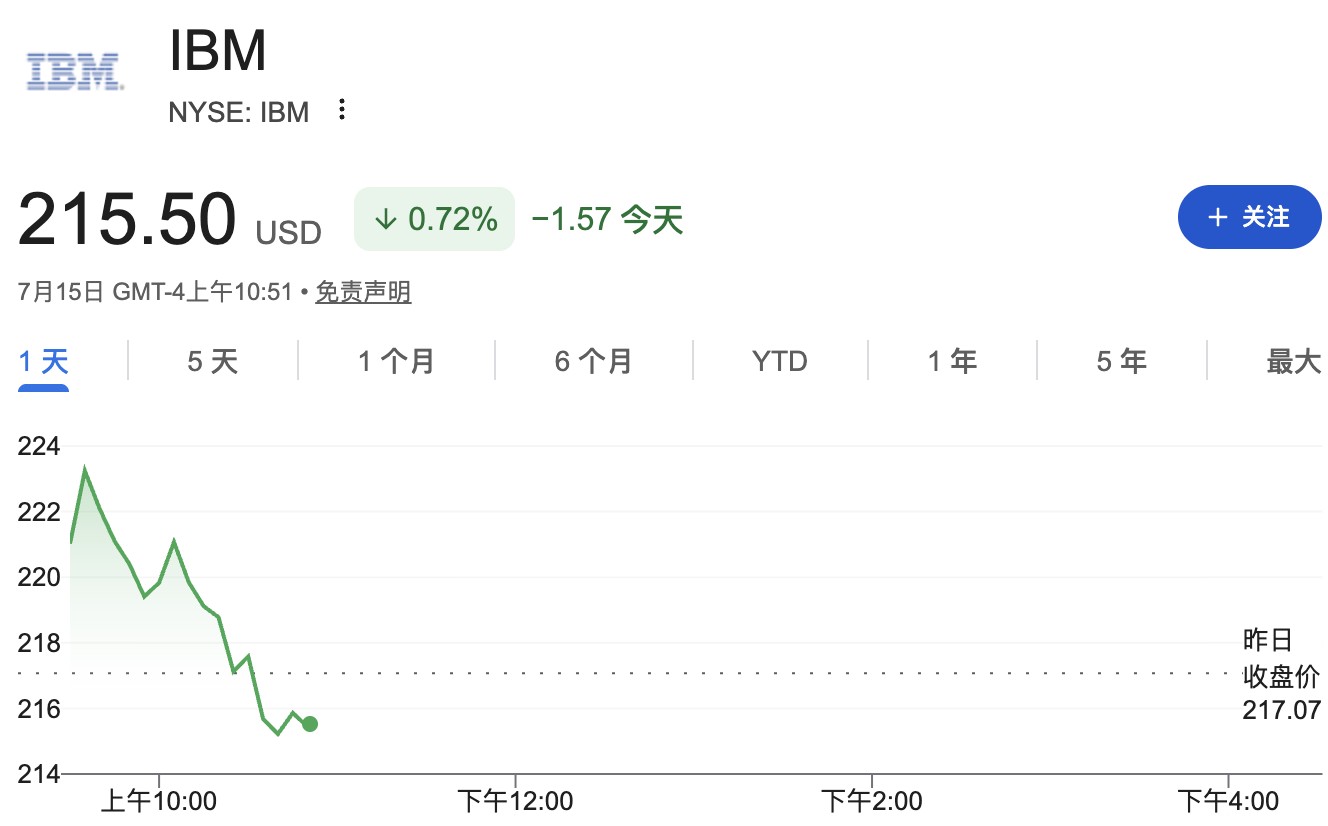
IBM's stock closed at $217.07 on Tuesday. As of press time, it fell another 0.72% during Wednesday's trading session. The year-to-date cumulative decline has reached 26.7%, underperforming the S&P 500 Index by a substantial 36.9 percentage points.
Software Business Divergence: Red Hat Emerges as a Rare Bright Spot
Although the overall growth rate of the software business disappointed the market, Bernstein believes that this weakness is highly concentrated in specific business lines rather than signaling a comprehensive deterioration.
IBM management explicitly pointed out that the gap in the software segment was primarily driven by transaction processing software directly linked to the underperformance of the Z17 mainframe, rather than stemming from the broader software portfolio.
In contrast, Red Hat is expected to achieve revenue growth of approximately 11%, maintaining a healthy trajectory. Bernstein therefore characterizes this software shortfall as a cyclical fluctuation in transaction processing business, rather than a precursor to a systemic setback in IBM's hybrid cloud and AI software strategy.
Investors need to distinguish between the essential differences: the contraction of traditional software revenue tightly bound to mainframe sales, versus whether IBM's core software growth engine remains sustainable.
Consulting Business Stagnates as CIOs Accelerate Shift to AI Automation
The consulting business also failed to provide support. IBM's preliminary Q2 consulting revenue was approximately $5.338 billion, flat year-over-year and below Bernstein's estimate of $5.508 billion and the market consensus of $5.433 billion.
Bernstein's CIO survey data reveals structural pressures behind this stagnation. In the May 2026 survey, a net -15% of CIOs expected to increase their use of third-party IT consultants within the year—meaning opponents significantly outnumbered supporters, a marked deterioration compared to previous surveys.
The survey also showed that enterprises are redirecting budgets originally allocated for external consulting toward internal AI and Large Language Model (LLM) deployments. Willingness among CIOs to engage consultants for assisting in the development and deployment of AI/LLMs also declined in recent surveys, further compressing the demand space for IBM's consulting business.
CIO Spending Intent Hits Record Low in Survey History; Pressure May Continue to Spread
Among all negative signals, the most profound long-term impact on IBM may be the continued deterioration in overall CIO spending intent.
Bernstein's May 2026 CIO survey showed that a net 54% of CIOs plan to reduce spending on IBM, marking the worst record in the survey's history and further deteriorating from the net 49% recorded in the November 2025 survey. Among all major hardware vendors tracked by Bernstein, IBM ranked last in customer spending intent.
Bernstein pointed out that these trends reflect investors and corporate customers systematically moving away from traditional IT expenditures such as mainframes, legacy infrastructure, and IT consulting, while accelerating the concentration of budgets into generative AI products and cybersecurity fields.
In this context, IBM faces not only the issue of repairing single-quarter performance in the short term but also the deeper strategic challenge of redefining its positioning within an accelerating shifting IT budget landscape.
Bernstein currently maintains a "Market Perform" rating on IBM, with a target price of $280, implying a potential upside of approximately 29% from the current stock price. However, further downside risks cannot be ignored.
Risk Disclosure and Disclaimer
The market involves risks; investment requires caution. This article does not constitute personal investment advice, nor does it take into account the specific investment objectives, financial status, or needs of individual users. Users should consider whether any opinions, views, or conclusions in this article align with their specific circumstances. Investment decisions made based on this content are the sole responsibility of the investor.
