


Morgan Stanley: Both Sides of the Pacific Are "Grabbing for Copper"
Morgan Stanley's latest report reveals a rare pattern in the copper market: the U.S. has over-imported 335,000 tons ahead of tariff implementation, while China has increased refined copper imports despite high prices. Simultaneous buying from both ends is compressing global circulating inventories, bringing LME spot premiums back for the first time in six months. Morgan Stanley lists copper as its top commodity pick with a target price of $14,250/ton for LME copper, but warns that if Middle East tensions push up oil prices and trigger rate hike expectations, macro pressures may temporarily overshadow fundamentals
The most critical change in the copper market right now is not a sudden explosion in any single demand story; rather, both the United States and China are simultaneously absorbing spot supply. The U.S. is stockpiling in anticipation of potential import tariffs, while China continues to increase refined copper imports despite high copper prices. Global available inventories are being compressed from both ends, and the term structure is beginning to show signs of tightness.
According to Zhuifeng Trading Desk, Amy Gower, Commodities Strategist at Morgan Stanley, wrote in a July 24 report that copper is flowing to both China and the United States simultaneously, tightening global inventories and driving up prices and term spreads. Against a backdrop of constrained supply, copper prices still have room to rise. If China's power grid investments materialize in the third quarter, they will provide further support.
Morgan Stanley lists copper as its current top commodity pick, maintaining its target price of $14,250 per ton for LME copper and $6.85 per pound for COMEX copper by the fourth quarter of 2026. The U.S. has over-imported approximately 335,000 tons of copper year-to-date, which annualized equals about 2.3% of global demand; China's net imports of refined copper in June grew 10% year-on-year, and the Yangshan copper premium rose to $115 per ton, the highest since 2022, providing direct support for this bullish thesis.
However, the upside for copper is not without boundaries. If the U.S. explicitly abandons plans to impose import tariffs on refined copper, the motivation for stockpiling will weaken. If tensions in the Middle East push up oil prices and drive expectations for Federal Reserve rate hikes, copper's fundamental advantages may be temporarily overshadowed by macroeconomic pressures.
Refined Copper Not Yet Taxed, U.S. Already Moving Goods Early
The U.S. market is currently trading on expectations of import tariffs on refined copper.
The White House signed an announcement in July 2025 imposing a 50% tariff on semi-finished copper products and derivatives, but refined copper was temporarily excluded. In a report submitted in June 2026, the U.S. Department of Commerce recommended imposing a 15% tariff on refined copper starting in 2027, rising to 30% in 2028. Although no formal decision has been announced, the market has already acted in anticipation of "potential future tariffs."
The three-month spread between COMEX copper and LME copper has reached 6%, expanding to 11% for contracts maturing in December 2027. This premium provides a clear incentive for importers to ship copper into the U.S. early before tariffs take effect.
Calculations show that the U.S. has over-imported approximately 335,000 tons of copper year-to-date. Annualized, this represents about 2.3% of global demand, even exceeding the estimated copper consumption by data centers this year. For markets outside the U.S., this portion of copper is effectively locked up in advance.
Inventory migration is also occurring within the U.S. Since early June, LME inventories in the U.S. have decreased by 29,000 tons, while COMEX inventories increased by 44,000 tons during the same period. The copper has not disappeared; it has merely flowed from one pricing system to another.
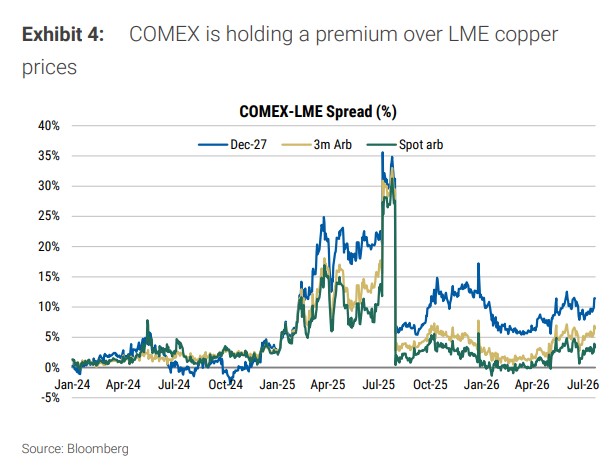
Policy timing remains uncertain. Morgan Stanley believes subsequent announcements may come in the second half of 2026, but there is currently no rigid deadline. If the U.S. announces future tariff implementation in advance, especially if announced but delayed in execution, it will give importers a clear window for stockpiling, creating the most bullish scenario. If the U.S. explicitly excludes tariffs, the initial logic supporting excessive U.S. imports will be weakened. If decisions continue to be delayed, the status quo may persist, with the U.S. continuing to import more and markets outside the U.S. continuing to face spot shortages.
China Buying Copper at High Prices, Abnormal Demand Intensifies Competition
Typically, rising copper prices suppress Chinese imports. But this time, China is still buying copper despite high prices.
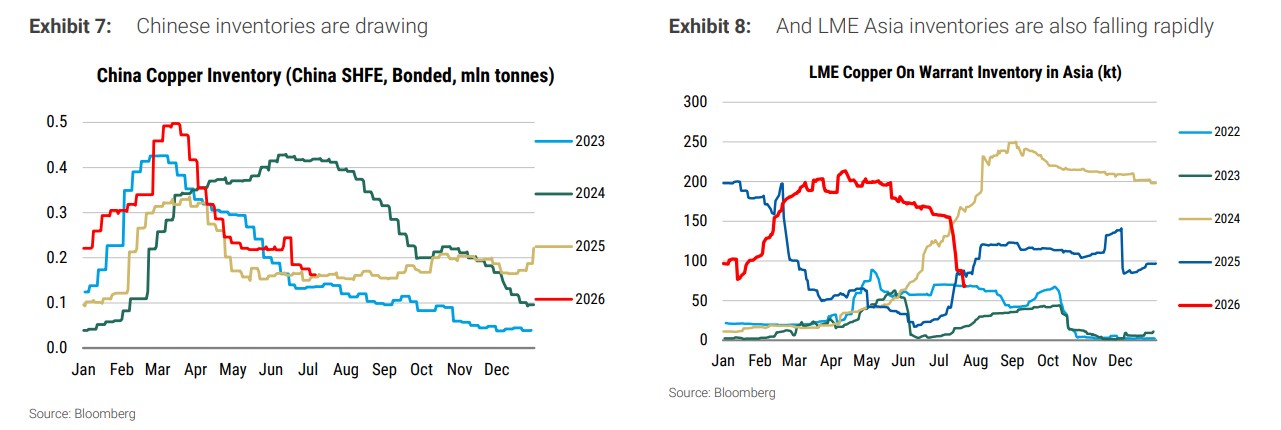
In June 2026, China's net imports of refined copper grew 10% year-on-year. Meanwhile, the Yangshan copper import premium rose to $115 per ton, the highest since 2022. More notably, the import arbitrage window has opened intermittently despite high copper prices. Historically, peaks in the Yangshan premium often occurred near low copper price levels, but this time prices and premiums are rising in tandem.
This indicates that high prices have not yet suppressed Chinese demand. LME Asian registered warrant inventories are falling rapidly, with available metal dropping to 74,000 tons, and the rate of inventory depletion in China is faster than normal seasonal patterns.
The report attributes the resilience of Chinese demand to three factors.
First is restocking. Chinese end-users of copper may have destocked during the price rise from August 2025 to February 2026, with apparent consumption significantly weaker than end-demand indicators during this period. Now that copper prices are relatively stable, restocking has begun.
Second is the tightness of scrap copper. Strengthened regulations in China on reverse invoicing and circular invoicing have increased VAT, documentation, and audit requirements, reducing the supply of compliant scrap copper and disrupting some trade and recycling networks, causing small-scale recyclers and processors to suspend operations. Semi-finished product companies based on scrap copper cannot obtain sufficient raw materials, so they turn to refined copper.
This trend is already reflected in the data: domestic scrap copper production has declined from its 2025 peak, and scrap copper imports have grown 8.4% year-to-date, but still struggle to fully fill the gap; meanwhile, China's copper concentrate imports have fallen 1.2% year-to-date, and refined copper production growth slowed in the second quarter. With both concentrates and scrap tight, demand for refined copper is being pushed higher.
Third is potential infrastructure and power grid demand. The report predicts that there is still about 2 trillion yuan of unused budgetary and quasi-fiscal stimulus remaining in the second half of the year, likely concentrated in computing power and power grids. If domestic activity and policy implementation remain weak in July and August, stronger measures may emerge in September.
Inventories Are Not Just "Low," Term Structure Is Also Flashing Warning Signs
Whether the copper market is tight cannot be judged by total inventories alone; one must also look at where deliverable and circulating metal is located.
Currently, the U.S. is absorbing supply, China is also absorbing supply, LME Asian available inventories are declining, and domestic inventory depletion in China is faster than seasonal norms. The LME cash-to-three-month spread has re-entered backwardation (spot premium), marking the first time since January.
A spot premium means buyers are willing to pay higher prices for immediate delivery. For base metals, this indicates spot tightness more effectively than simple price increases.
Copper is also outperforming aluminum. The LME copper-to-aluminum ratio has risen to a new high, showing that capital is still assigning a higher scarcity premium to copper. Looking only at copper prices might suggest the gains are already significant; but compared within the base metals complex, copper's relative strength remains prominent.
Positioning structures do not show excessive crowding. Net long positions in COMEX copper appear high, but the main reason is a lack of short positions rather than extreme expansion of long positions. Observing the total open interest of longs and shorts combined for COMEX and LME, COMEX is near the bottom of its recent range, while LME is at its lowest level since 2023. This means the current rise in copper prices is not entirely driven by speculative positioning.
No Buffer on the Mining Side, Weather Risks Amplify Supply Gap
The supply side is also failing to cool down the market.
ICSG data shows that global copper mine production fell 1.9% from January to May 2026, with copper concentrate production down 3.4%, partially offset by a 3.5% growth in SX-EW production. The full-year model assumes 0% mine production growth, meaning production needs to improve in the second half of the year to meet the annual assumption.
However, corporate production in the second quarter has frequently missed consensus expectations. Antofagasta's Q2 copper production was 141,900 tons, below the market expectation of 151,900 tons, mainly affected by pipeline maintenance at Los Pelambres; Ivanhoe's Kamoa-Kakula produced 61,100 tons in Q2, below the expected 67,100 tons, dragged down by reduced ore availability; Rio Tinto's Q2 production was 168,300 tons, below the expected 184,300 tons, impacted by safety shutdowns at Kennecott at the start of the quarter. South32, BHP, and Vale also slightly missed expectations.
Currently, there have not been many downward revisions to mining company guidance, but such adjustments typically occur later in the year.
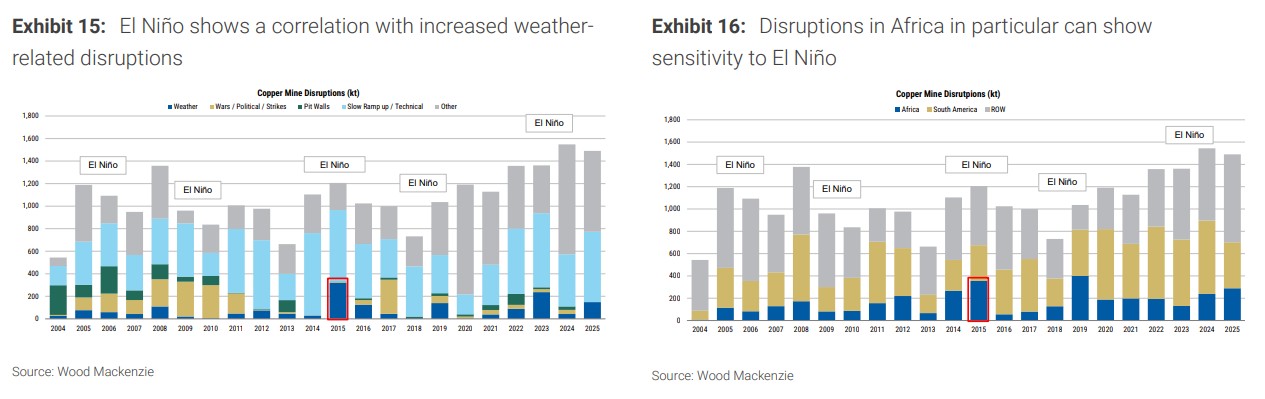
Weather risks are also accumulating. NOAA has raised the ENSO alert system status to an El Niño watch, with the latest intensity distribution showing an 81% probability of a "very strong" El Niño occurring from October to December. The last very strong El Niño occurred in 2015/16.
The impact path of El Niño on copper mines is direct: key copper mining areas in Chile may experience abnormal heavy rainfall, flash floods, and mudslides, potentially affecting mines, roads, electricity, and water infrastructure; Zambia may face drought, reduced reservoir inflows, and limited hydropower supply. Some miners have already taken buffer measures, but the risk has not disappeared.
From July 14 to 21, an "atmospheric river" weather system appeared in central and northern Chile, bringing record rainfall and heavy snowfall at high altitudes. Codelco suspended surface activities at Andina and stopped ore transport at El Teniente; Antofagasta cut non-essential activities at Los Pelambres; Lundin Mining's Caserones suspended operations due to heavy snow and power outages, and Candelaria was also affected, although the concentrator continued to operate using existing ore stocks. This disruption serves as a preview of weather risks for the second half of the year.
Tariff Announcement Could Be the Strongest Catalyst, True Bearish Variable Lies in Macro
Morgan Stanley's price framework offers a clear conclusion: copper remains the top pick. By the fourth quarter of 2026, the target price for LME copper is $14,250 per ton, and for COMEX copper, $6.85 per pound.
This judgment relies on three conditions holding simultaneously: U.S. import demand continues to absorb supply, Chinese import demand is not crushed by high prices, and mine-side supply continues to miss expectations. Currently, none of these three lines have broken.
U.S. tariffs are the most important event variable. The most bullish scenario is not immediate tariff imposition, but rather an early announcement of future import tariffs with delayed implementation. This would give the market a clear stockpiling window, pushing more copper to flow into the U.S. in advance.
The most bearish scenario is if the U.S. explicitly excludes refined copper from tariffs. If so, the logic of U.S. stockpiling, equivalent to about 2.3% of global copper demand, would weaken, putting pressure on prices. If policy decisions are merely delayed, uncertainty itself may continue to drive importers to buy early, maintaining tightness in markets outside the U.S.
Copper fundamentals are currently tight, but the biggest risk is not a sudden loosening of inventories, but rather a macro shock knocking out demand expectations. Escalation in the Middle East is the most direct external variable. Recently, oil prices have approached $100 per barrel again, and copper has come under pressure. Rising oil prices bring two layers of impact: first, growth concerns, and second, expectations of rate hikes amid inflationary pressure.
The Federal Reserve's path has already begun to change. The implied number of rate hikes within the year has risen from 1.35 times at the beginning of this week to 1.8 times currently. Historically, base metals usually perform worse in the two months following Fed rate hikes than after rate cuts: rate hikes suppress construction activity and may push up the U.S. dollar, and a stronger dollar is typically unfavorable for metal prices.
Therefore, copper trading is divided: at the micro level, inventories, imports, scrap copper, and mine supply all support higher prices; at the macro level, if Middle East conflicts push up oil prices and force the market to reprice rate hikes, copper will be dragged into a framework of "growth concerns + stronger dollar." The boundary to watch most closely for current copper prices is this: as long as U.S. tariff expectations are not completely negated, Chinese imports continue, and mine supply continues to miss expectations, there is still reason for prices to rise; but if tariffs are excluded, or if the Middle East situation brings the market back to rate hike trading, copper's fundamental advantages will be temporarily overshadowed by macro volatility.
