


US Treasury Market "Forces" Waller's Hand: Hawkish Rhetoric Is Not Enough, Market Demands Rate Hike
The US-Iran conflict has triggered a surge in oil prices, exacerbating inflation concerns and leading to a sell-off in US Treasuries, with yields approaching ten-year highs. The market believes that Federal Reserve Chair Waller's tough stance alone is insufficient to soothe investors, with strong expectations for a rate hike in this week's policy decision. Although the probability of holding rates steady remains dominant, expectations for a rate hike have risen significantly, reflecting market concerns about inflation and the Fed's consistency between words and actions
The US Treasury market is sending a clear signal to Federal Reserve Chair Waller: tough rhetoric on fighting inflation is far from enough to soothe investors.
The new round of military conflict between the US and Iran that erupted in July caught Wall Street off guard. International oil prices briefly broke through $100 per barrel, triggering another large-scale sell-off in the $30 trillion US Treasury market. The benchmark 10-Year Treasury Yield has cumulatively risen by more than 30 basis points since the end of June, reaching around 4.678%, approaching its highest level in nearly a decade. Meanwhile, the yield on the 2-year US Treasury note, which is most sensitive to monetary policy, also climbed to approximately 4.328%, breaking through the Fed's current interest rate ceiling of 3.75%, reflecting strong market expectations for a rate hike.
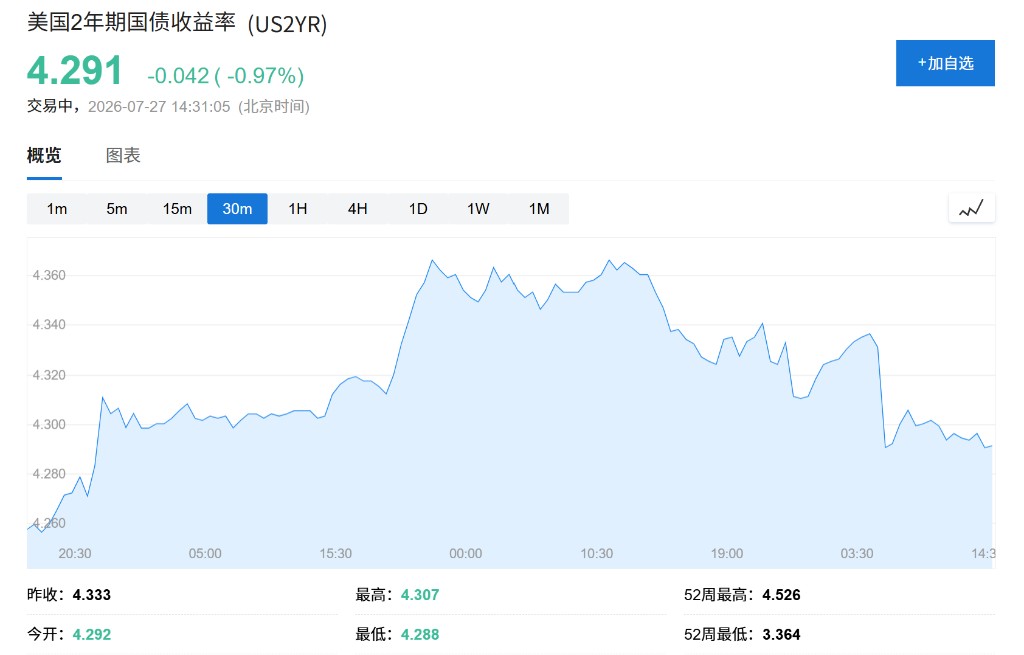
On Wednesday, the Federal Reserve will announce its latest policy decision. According to the CME FedWatch tool, as of last Friday, the market estimated a 62% probability of keeping interest rates unchanged at this meeting, but the probability of a rate hike surged from about 13% a week ago to around 38%.
"This shows how worried the market is about inflation, and also how concerned it is about whether the Fed can match its words with actions," said Gennadiy Goldberg, Head of US Interest Rate Strategy at TD Securities, referring specifically to Waller's series of public statements on bringing inflation back to the 2% target.
Oil Price Shock Combined with Bond Market Pressure Pushes US Treasury Yields Near Ten-Year Highs
The US-Iran conflict was the direct trigger for this round of rising US Treasury yields. The surge in oil prices exacerbated market fears of a resurgence in inflation, prompting traders to heavily sell off US Treasuries. According to GasBuddy data, US retail prices for regular gasoline and diesel have recently returned to above $4 and $5.20 per gallon, respectively.
After Waller held his first press conference as Federal Reserve Chair in June, the US Treasury market rebounded briefly, but this gain quickly vanished. The yield on the 30-year US Treasury note stubbornly remained above 5%, causing heavy losses for investors who had previously bet on long-term bonds.
David Rosenberg, Founder and President of Rosenberg Research & Associates, wrote in a report last Friday: "We did not anticipate this latest chapter in the US-Iran war, which is a complicating factor for any duration assets at present." He also pointed out that the continued expansion of corporate bond issuance by technology-related companies is also putting pressure on the US Treasury market. Rosenberg stated that he has adjusted his portfolio, shifting his long position in 30-year US Treasuries, which had underperformed, to short-duration US Treasuries.
Paul Christopher, Head of Global Investment Strategy at Wells Fargo Investment Institute, said: "The Fed needs to hear this signal clearly. Uncertainty is accumulating," and bond market investors are demanding corresponding compensation.
Controversy Over the Rate Hike Window: The Dilemma of Cost and Timing for Policy Action
The Federal Reserve is not monolithic. It is reported that some members of the interest rate decision-making committee lean towards raising rates to curb inflation. However, the issue lies in the fact that the timing of any rate hike implementation is extremely sensitive.
Inflation itself erodes the real value of fixed-income assets, while rate hikes further depress bond prices and drag down other financial assets such as stocks. Meanwhile, Barclays analysts expect the US fiscal deficit in 2026 to be around $2 trillion, and the continued large-scale issuance of US Treasuries will be an important way to fill the gap, meaning that supply pressure in the bond market will be difficult to alleviate in the short term.
Furthermore, large-scale borrowing by the technology sector is amplifying pressure on the bond market. Large technology companies, represented by "hyperscale cloud providers," are racing to issue corporate bonds to support artificial intelligence infrastructure construction, pushing up overall market borrowing costs. In a report last Wednesday, Moody's Ratings projected that capital expenditures for these hyperscale cloud providers would approach $1 trillion in 2027, soaring further after nearing $800 billion this year, and warned that "soaring capital expenditures, rising leverage, and off-balance-sheet commitments" would threaten the credit quality of this group.
Stock Market Suffers Another Heavy Blow, Led by Tech Stocks
The shadow of high interest rate expectations also looms over the stock market. Last week, semiconductor stocks led the declines, with the Philadelphia Semiconductor Index dropping more than 4% for the week. The Dow Jones Industrial Average fell 0.4% for the week, the S&P 500 Index dropped 0.6%, and the Nasdaq Composite Index plummeted by as much as 2.1%. The closing price of the Nasdaq Index has cumulatively fallen 7.8% from the historical high set in early June.
Higher interest rate levels tend to suppress corporate and consumer spending, thereby dragging down economic growth and eroding corporate earnings expectations. Wells Fargo's Christopher suggested that investors might wait for this round of tech stock rotation to conclude, at which point "there may be a better entry opportunity," and cautioned that "holding some cash reserves might not be a bad idea."
Risk Warning and Disclaimer
The market involves risks; investment requires caution. This article does not constitute personal investment advice, nor does it take into account the specific investment objectives, financial status, or needs of individual users. Users should consider whether any opinions, views, or conclusions in this article align with their specific circumstances. Investors bear full responsibility for their own decisions.
