


Prominent Silicon Valley VC Warns: Banning Open-Source AI Could Trigger a Market Crash in US Stocks Due to Cost Pressures
Prominent investor Chamath Palihapitiya warns that if the US restricts corporate use of open-source AI and forces a shift to closed-source models, AI costs could surge 50 to 100 times. This would severely impact corporate profits and valuations, potentially causing a systemic shock to the US stock market. The regulatory battle over open-source AI is continuing to escalate
Prominent venture capitalist Chamath Palihapitiya has issued a stark warning that if the US government bans companies from using open-source AI, it will severely damage corporate earnings through cost transmission mechanisms, thereby dragging down the entire stock market. This statement comes as debates in Washington over the regulation of open-source AI intensify sharply.
Palihapitiya stated bluntly on the "All-In" podcast aired last weekend: "If the US government intervenes, the US stock market will crash, without a doubt."
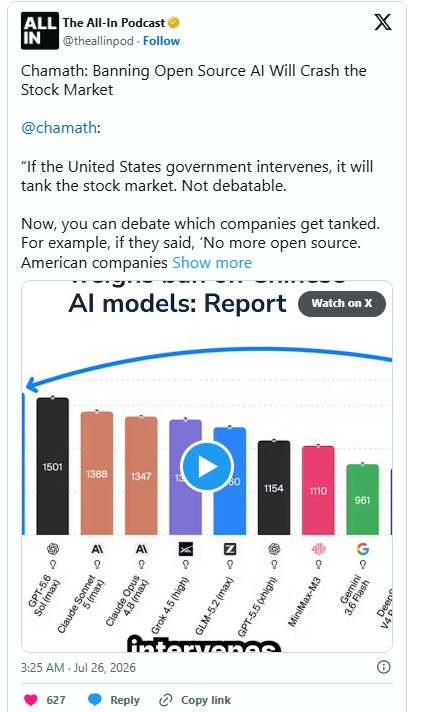
Citing Coca-Cola as an example, he pointed out that once companies are forced to use closed-source AI, their AI usage costs will be 50 to 100 times higher than the current best alternative solutions. This cost pressure will ultimately force the market to revalue these companies. Meanwhile, his co-host and former head of AI and cryptocurrency affairs, David Sacks, directly named Anthropic, criticizing its lobbying efforts to restrict competitors as "disgraceful."
These remarks come against the backdrop of Chinese startup Moonshot AI releasing its open-source model, Kimi K3. This model defeated Anthropic's Fable 5 and OpenAI's GPT-5.6 Sol in blind tests for front-end programming tasks, triggering high alert in the US regarding competition from Chinese AI and prompting some calls for restrictions on open-source models.
The Logic of Cost Transmission: Why Banning Open Source Would Devastate US Stocks
Palihapitiya's core argument centers on the distortion of cost structures.
He pointed out that AI has become a key input factor for corporate operations. Once the government mandates that companies can only use closed-source commercial models, related costs will be an "order of magnitude" higher than open-source alternatives.
"You are forced to bear costs that are neither reasonable nor market-driven," he said. "Meanwhile, your competitors outside the US are not subject to such constraints, which will directly harm the competitiveness of US companies."
Using Coca-Cola as an example, he described a scenario where soaring AI costs squeeze corporate profit margins, forcing the market to lower valuation expectations for such companies. This logic applies to almost all traditional companies undergoing AI transformation, implying a potentially widespread market impact.
Targeting Anthropic: Regulatory Arbitrage or Market Competition
Palihapitiya further directed his criticism at AI labs themselves. He warned that if the government truly bans open-source AI, the valuations of Anthropic and OpenAI would instead "collapse," because their current revenue is not derived from genuine market competition but is artificially supported by regulatory barriers.
"All this revenue is artificially propped up, not driven by market demand under competitive pressure, but obtained through regulatory arbitrage under artificial constraints," he said. "But such constraints are only effective in one market."
David Sacks' wording was even sharper.
He pointed out that Anthropic, as "one of the most successful tech companies in history," is running to the government for protection, targeting not only Chinese competitors but also domestic US rivals. "Frankly, it's disgusting," he said.
Sacks also warned that declaring that US companies cannot use open-source results from the public domain would be like "stabbing a dagger into the heart of the entire US open-source ecosystem."
Industry Unites in Voice, Tech Giants Back Open Source
As regulatory pressure heats up, the tech industry has begun to push back collectively.
According to CNBC, more than 20 companies, including NVIDIA, Microsoft, Meta, and Palantir, jointly signed a letter last Friday urging policymakers to avoid "premature restrictions" on open-weight models, warning that such restrictions would "stifle competition or drive innovation overseas."
NVIDIA CEO Jensen Huang also expressed his views on social media, stating that open-source models help strengthen security and cyber defense, accelerate the diffusion of innovation, and safeguard technological sovereignty.
Notably, Anthropic did not sign this joint letter.
Divisions Within the White House: Sanction Threats Coexist with Protection Promises
Positions within Washington are not unified.
White House Science Director Michael Kratsios publicly accused Moonshot AI last Wednesday of stealing technology from Anthropic's Fable model through "distillation," claiming the company obtained restricted NVIDIA GB300 chips via Thai servers to train its model. Treasury Secretary Scott Bessent also posted on social media, clearly stating that sanctions and entity list placements would be options when Chinese companies' distillation activities "cross the line into intellectual property theft."
However, over the same weekend, the open-source camp seemed to receive positive signals. Luther Lowe, Head of Public Policy at Y Combinator, posted that he spoke with Commerce Secretary Howard Lutnick at the White House Correspondents' Dinner on Saturday, who told him directly: "This White House will protect open-source AI."
This statement suggests that despite the loud voices advocating toughness on Chinese AI competition, there are still clear divisions within the administration regarding a comprehensive ban on open source, and the policy direction has not yet been finalized.
