


Apple's Market Cap Breaks $5 Trillion for the First Time to Reclaim Global Top Spot: Its Capital-Efficient AI Strategy Is Becoming a Scarce Safe Haven Attribute
On Tuesday, Apple's market capitalization surpassed $5 trillion for the first time during intraday trading, closing with a market cap of $4.99 trillion. Apple has consistently adopted a restrained approach to AI infrastructure investment, avoiding large-scale construction of self-owned data centers. Analysts pointed out: "Apple was previously criticized for insufficient AI investment, but it has now successfully avoided the capital expenditure trap."
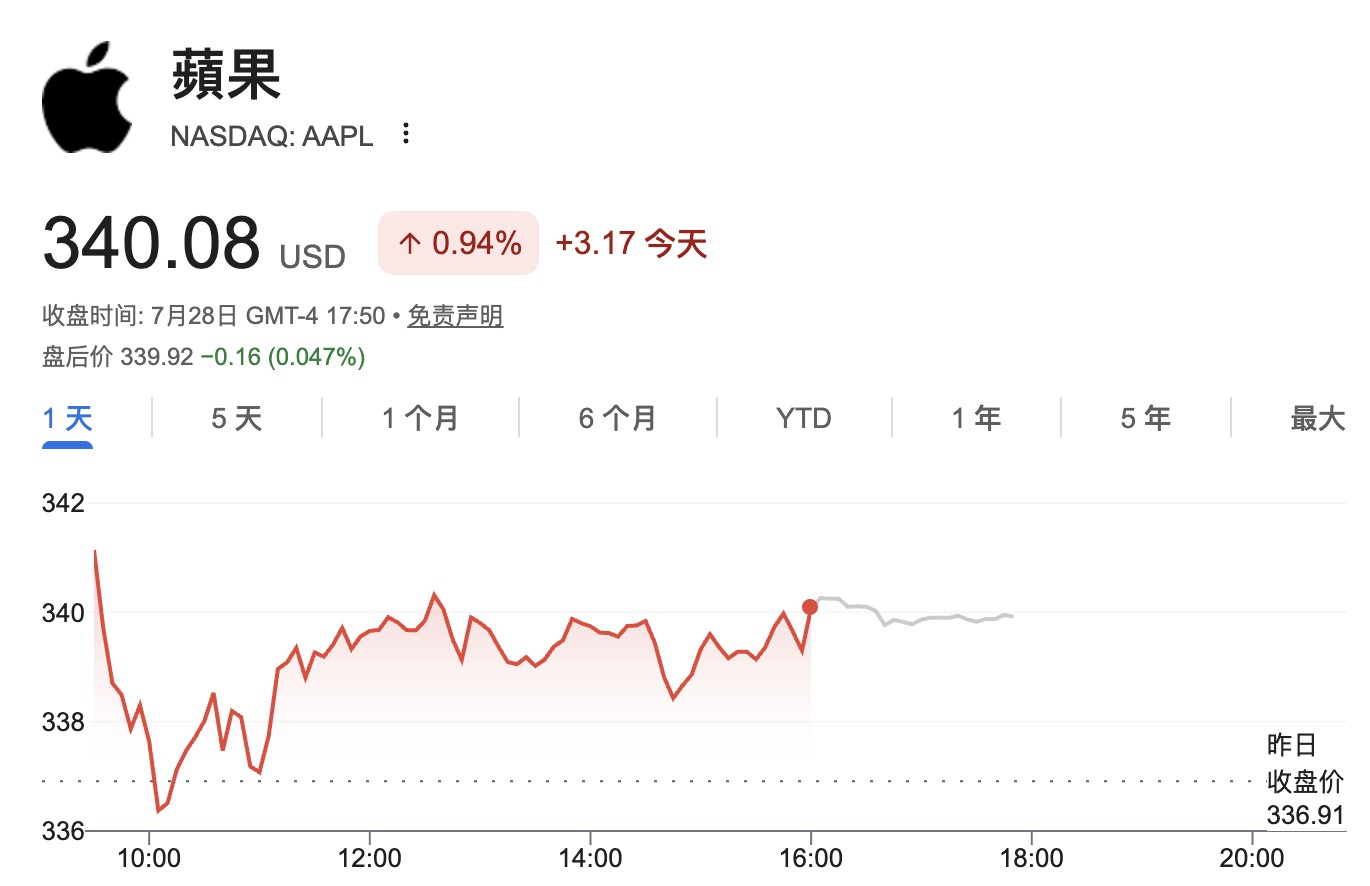
On Tuesday, Apple's market capitalization surpassed $5 trillion for the first time during intraday trading, becoming the second listed company globally to reach this milestone after Nvidia.
Apple has consistently adopted a restrained approach to AI infrastructure investment, avoiding large-scale investments in self-built data centers or chips, and instead preferring to meet demand through methods such as leasing computing power. Over the past three quarters, Apple's capital expenditures have even continued to decline. As peers struggle between spending discipline and growth commitments, the market is repricing Apple's relative restraint.
Jay Woods, Chief Market Strategist at Freedom Capital Markets, commented: “Apple was previously criticized for insufficient AI investment, but it has now successfully avoided the capital expenditure trap.”
On Tuesday, Apple's stock price hit an intraday high of $342.89, pushing its market capitalization briefly to $5.036 trillion. It ultimately closed up 0.94% at $340.80, corresponding to a market capitalization of $4.99 trillion, slightly below the $5 trillion threshold—but this intraday milestone is sufficient to constitute a key turning point in market narrative.
This breakthrough occurred just one day after Apple's market capitalization surpassed Nvidia's, reclaiming the title of the world's most valuable company for the first time since last May. So far this year, Apple has accumulated a gain of approximately 25%, while Nvidia has retreated significantly from its May highs, with year-to-date gains of only about 7%.
The Chain Reaction Triggered by Alphabet's $205 Billion Capital Expenditure
As Apple's market capitalization broke through $5 trillion, the technology sector was experiencing a round of structural selling. The trigger came from Alphabet, which announced last week that it would raise its capital expenditure for this year to a maximum of $205 billion, while recording a negative free cash flow of $5.9 billion for the same period—turning negative for the first time in over twenty years since its listing.
This figure triggered a collective reassessment by investors of the return on investment for AI infrastructure. Since ChatGPT ignited the AI arms race at the end of 2022, the four major hyperscale cloud service providers—Microsoft, Amazon, Google, and Meta—have competed to increase their stakes, with combined capital expenditures expected to reach $700 billion this year.
Regarding Nvidia, the total scale of potential AI infrastructure transactions involved has exceeded $750 billion, and its five-year CDS spiked to a historical high of 82 basis points the day before yesterday.
Apple has consistently adopted a restrained approach to AI infrastructure investment, avoiding large-scale investments in self-built data centers or chips, and instead preferring to meet demand through methods such as leasing computing power. Over the past three quarters, Apple's capital expenditures have even continued to decline. As peers struggle between spending discipline and growth commitments, the market is repricing Apple's relative restraint.
From AI Laggard to Safe Haven: Completing a Narrative Reversal in Two Months
During WWDC in June, when Apple launched its new Siri and Apple Intelligence, the market did not buy in, and the stock price once fell by more than 3%. The core concern was whether Apple had fallen behind in the AI race.
In less than two months, this narrative has been completely overturned. According to the FT, the revamped Siri virtual assistant received widespread positive feedback in early testing before its full rollout, and Apple is gradually shedding the label of "AI laggard."
Against the backdrop of peers like Alphabet and Meta facing dual scrutiny from credit markets and shareholders due to massive capital expenditures, Apple's strategy is being reinterpreted as a shareholder-friendly choice.
Jay Woods, Chief Market Strategist at Freedom Capital Markets, commented: “Apple was previously criticized for insufficient AI investment, but it has now successfully avoided the capital expenditure trap.”
This Thursday's Earnings Report: Apple's Moment of Verification
However, there are still realities to be tested behind the $5 trillion market capitalization. Apple will release its latest quarterly earnings report after hours this Thursday (July 30), which will also be the last earnings call before Tim Cook steps down as CEO—hardware head John Ternus will officially take over on September 1.
Rising prices for memory chips are eroding Apple's hardware profits. Analysts currently expect Apple's gross margin to be around 47.5% to 48.5%, lower than the 49.3% in the previous quarter. In June, Apple raised the prices of Macs and iPads due to a shortage of memory chips. This earnings report will quantify for the first time the specific impact of the global memory chip shortage on Apple's finances.
The difference in AI competitive paths between Apple and Nvidia has become the focus of investor attention this summer. Nvidia is betting on the "shovel seller" logic—providing computing infrastructure for the entire AI industry; while Apple has chosen a low-capital-intensity path of ecosystem integration, embedding AI functions into its existing hardware and service flywheel.
