


Taobao Convenience Store Expansion: A "Counter-Intuitive" Breakthrough?
The significance of more shelves
A year into the food delivery war, the battlefield of instant retail is shifting from consumer-facing subsidies to warehouses and stores scattered across cities.
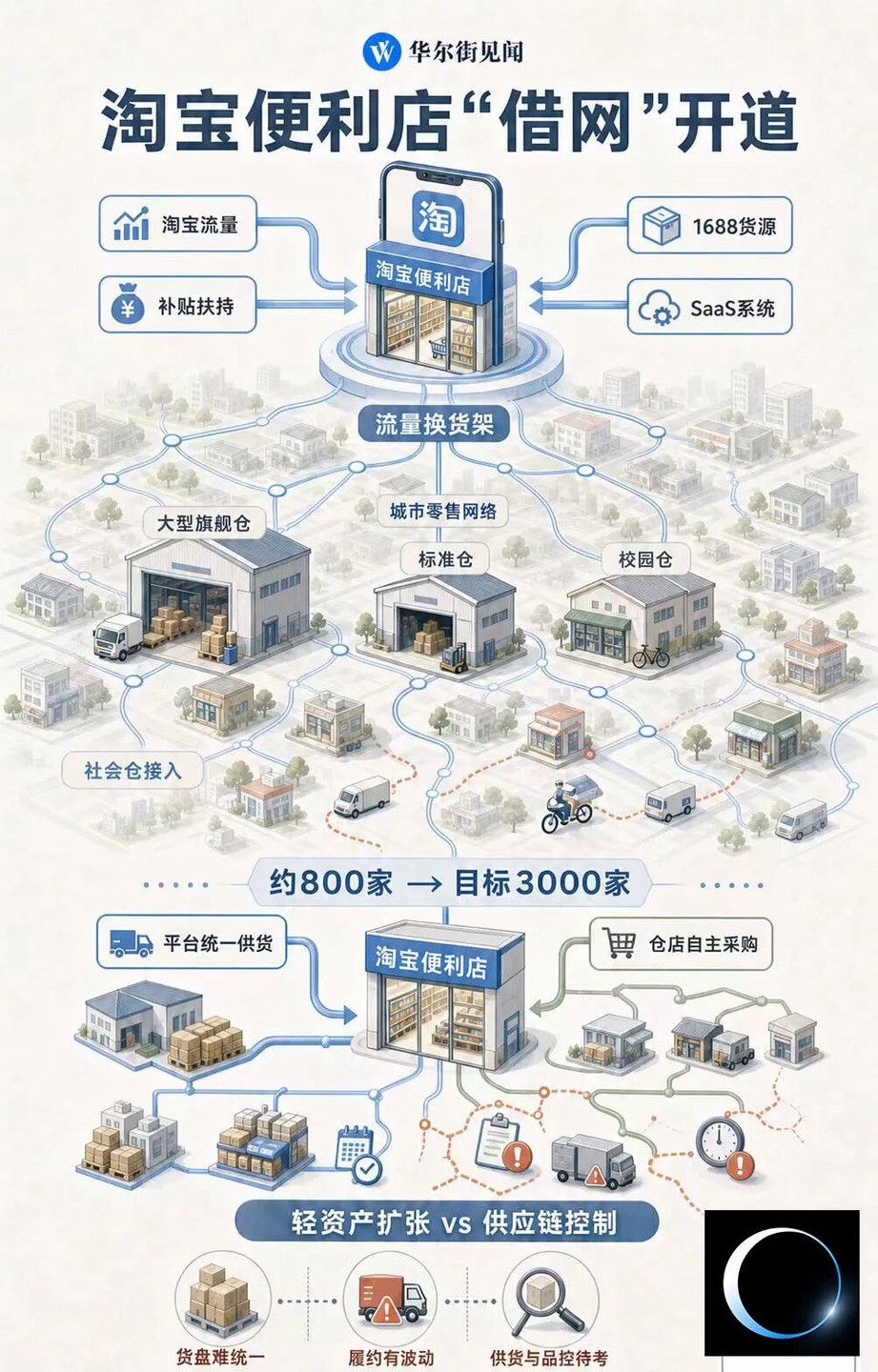
Including stores in their renovation and operational ramp-up phases, "Taobao Convenience Store," an online supermarket format launched less than nine months ago, has already established approximately 800 locations.
This scale is comparable to Meituan's lightning warehouse business, "Songshu Bianli" (Squirrel Convenience).
However, Taobao Flash Shopping’s ambitions do not stop there. The expansion target for "Taobao Convenience Store" by the end of the fiscal year in March 2027 is 3,000 stores.
But what Taobao Flash Shopping aims to build is not a traditional convenience store network relying on street foot traffic.
All-Tech has learned that "Taobao Convenience Store," as an online supermarket-style instant retail format under the Taobao Flash Shopping system, currently plans for an average of over 10,000 SKUs per main warehouse type, covering categories such as daily necessities, alcohol and snacks, and beauty and personal care.
These online supermarket-style flash shopping warehouses primarily handle online orders, achieving 30-minute delivery through dispersed locations within cities and forward-stocked inventory.
Compared to traditional convenience stores, their operations rely more heavily on product turnover, inventory management, and fulfillment efficiency.
However, Taobao Flash Shopping does not focus on handling operational tasks. Instead, it leaves site investment, stocking, and daily operations to partner merchants and service providers, accessing the existing socialized warehousing and distribution network for instant retail in an "asset-light" manner.
This model allows Taobao to quickly supplement nearby supply at a lower cost. However, whether a warehouse network operated by partners can form a stable product assortment and fulfillment capability remains to be verified.
Trading Traffic for Shelf Space
Although named "Convenience Store," Taobao Convenience Store is a different business from ordinary roadside convenience stores.
A source close to Taobao Flash Shopping revealed that Taobao Convenience Store was launched in October 2025, primarily expanding stores through collaboration with regional merchants. The platform provides category planning, pricing guidance, selection capabilities, and supply chain support, while service providers handle merchant recruitment in certain regional cities and subsequent operational support.
Taobao Convenience Store does not have a fixed appearance.
In Beijing, it might be a flash shopping warehouse tucked away in a non-street-facing location, accepting only online orders; in county towns, merchants may open retail complexes spanning hundreds of square meters, adding freshly made categories like tea drinks and deli foods alongside packaged foods and daily necessities.
Behind the "thousand stores, thousand faces" approach is Taobao Flash Shopping's extremely open, even somewhat loose, cooperation model.
Taobao Flash Shopping currently mainly provides four types of resources: traffic entrances from the Taobao App and various ecosystem positions; sourcing from 1688 and brand collaborations; the Aoxiang SaaS system and dedicated operational liaison; and multiple support measures, including special funds.
Partners retain significant operational autonomy. They can not only "bring their existing stores into the partnership" but also simultaneously connect to competing platforms like Meituan and JD.com.
For merchants already operating lightning warehouses or supermarket convenience stores, once they meet Taobao Convenience Store's audit standards, they only need to integrate into the system, adjust part of their product structure, and add an online store entrance to complete the initial transformation.
Recruitment personnel use a more direct pitch to potential franchisees: "Friends who already operate other lightning warehouses or supermarket convenience stores can upgrade to Taobao Convenience Store for free and receive subsidies."
Taobao Convenience Store also reduces merchants' operational pressure through payment terms and fee waivers.
Recruitment information shows that some products can enjoy payment terms of up to 98 days, where merchants sell first and settle payments later; it also offers commission waivers, logistics discounts, and digital tool support.
Taobao Flash Shopping hopes to leverage 1688 and Tmall brand resources to provide warehouses and stores with a curated product pool, reducing operators' costs in finding suppliers and testing new products.
However, considering that the same product assortment may not suit all regions, service providers and warehouses/stores can still supplement with regional products based on local consumption habits.
The source close to Taobao Flash Shopping told All-Tech that Taobao Convenience Store's profitability relies more on the expansion of the entire ecosystem's transaction volume and the improvement of operational efficiency, rather than charging high fees to individual merchants or passing on costs.
For merchants, this is a low-threshold access solution.
From Taobao's perspective, it exchanges traffic and subsidies for shelf scenarios physically closer to consumers.
According to the platform's recruitment plan, Taobao Convenience Store currently plans three types of warehouses: flagship warehouses of over 800 square meters, standard warehouses of over 400 square meters, and campus warehouses of over 150 square meters.
According to "Retail Business Finance," standard warehouses need to reserve about 100 square meters, and flagship warehouses about 300 square meters, to accommodate 2,000 to 3,000 brand SKUs allocated by the platform.
All-Tech learned from sources close to Taobao Flash Shopping that in the brand leasing and consignment business model, partner merchants mainly provide storage and sorting services, earning service revenue thereby, without bearing the inventory risk for the corresponding products.
Taobao Flash Shopping has previously attempted more on-site brand products for nearby instant fulfillment.
In September 2025, Tmall launched the "Instant Purchase" service, with over 260 initial brands including Decathlon, Midea, and Purcotton accessing Taobao Flash Shopping through flagship stores or authorized specialty stores.
For example, Decathlon connected its Tmall flagship store with 208 offline stores nationwide, using the stores as fulfillment points for instant retail orders.
But not all brands have such dense offline networks. Taobao Convenience Store can play the role of such forward shelves.
Imagine this scenario: At 10 PM, a consumer discovers that the brand of diapers they regularly use at home has run out, and nearby supermarkets do not carry the same brand and size. This type of demand has clear brand and specification preferences, making it difficult to find substitutes on the spot.
If this product can be purchased instantly through the brand sourcing of lightning warehouses, consumers do not have to wait for next-day courier delivery.
The value of Taobao Flash Shopping to brand merchants thus increases, occupying a place in the instant retail fulfillment chain for brand products.
Differences in Offense and Defense
Taobao Convenience Store's ability to expand rapidly in a lighter way is, to some extent, leveraging the social warehouse network cultivated by Meituan over many years.
In the past few years, Meituan expanded its lightning warehouses to over 50,000 locations through traffic, delivery, and warehouse-opening support. However, most of these warehouses and stores are operated by third parties, limiting the platform's control over supply.
As subsidies recede and the industry shifts to stock competition, operators are more willing to join new platforms to share costs.
Several regional merchants told All-Tech that over the past year, influenced by food delivery subsidies, the order structure of Taobao Flash Shopping versus Meituan in some warehouses and stores has narrowed from roughly 20/80 to 30/70, approaching 40/60 in some areas.
For Meituan, relying solely on traffic and fulfillment makes it difficult to form stable, controllable supply. It is beginning to shift from expanding warehouse/store scale to strengthening control over product assortments, supply chains, and store operations.
In April this year, Meituan upgraded its supply chain service platform "Shandian Bangbang" (Lightning Help), proposing to improve the product quality, procurement efficiency, and operational capabilities of warehouses and stores;
At the same time, it increased direct control over store operations through strongly controlled brands like Songshu Bianli.
Meituan also provides independent search entrances and discounts for its own convenience brand "Songshu Bianli" on its main app, and strengthens the "Official Self-Operated" label on some store pages.
For Meituan, the value of entering the fray personally lies not only in increasing revenue.
Guo Ben, an early operator of lightning warehouses, told All-Tech that merely as a traffic and fulfillment platform, although Meituan can see user and order data, it is difficult to fully grasp the selection logic of third-party warehouses and stores, and the feedback loop from frontline store operations back to the platform is longer.
Through directly operated or strongly controlled stores, Meituan can directly verify selection and operational methods, then attempt to promote these experiences to a wider warehouse network.
Meituan has previously tested a similar path with its own alcohol lightning warehouse "Waima Songjiu": selecting high-frequency products based on order data, then jointly developing channel-exclusive products with liquor companies, extending control to procurement and production links.
However, alcohol SKUs are relatively limited and highly standardized, whereas the product assortment of comprehensive convenience stores is much more complex.
Guo Ben pointed out to All-Tech that part of Songshu Bianli's current product assortment still mainly references products already validated by other leading warehouses and stores, and its ability to independently discover new products and define assortments has not yet been fully proven.
Zhang Shukun, a FMCG supplier who has long supplied lightning warehouses, also stated that lightning warehouses develop private labels mainly to reduce brand premiums and increase channel gross margins. However, except for easily standardized categories like beverages, most players have not yet formed channel recognition and product development capabilities similar to Hema.
Deeper involvement in store operations will also change the relationship between Meituan and social warehouses.
As of the end of March this year, the number of Songshu Bianli stores exceeded 700. In the comprehensive convenience lightning warehouse market, where brands with thousands of stores are rare, Songshu Bianli has ranked among the industry leaders.
Third-party warehouse/store orders are highly dependent on the platform. Once Meituan develops its own strongly controlled brands, operators inevitably worry whether traffic, subsidies, and promotional resources will tilt towards Songshu Bianli.
Taobao Convenience Store is exploiting precisely this gap.
It does not need to directly catch up with or compete head-on with Meituan in warehouse network scale and fulfillment capability. By offering a lower entry threshold and a posture of "not directly engaging in operations," it can attract social warehouses to simultaneously join Taobao, thereby quickly supplementing retail supply.
For Taobao Flash Shopping at this stage, the expansion of warehouse/store supply relates to both the unit economic model and the retail landscape.
Compared to food delivery, retail orders usually have higher average ticket sizes and wider categories, helping to dilute fulfillment costs and improve UE (Unit Economics).
If instant retail can also increase the opening frequency of the Taobao App, driving advertising, e-commerce transactions, and member consumption, the investment per order also has the opportunity to be absorbed by other values created by users within the Taobao ecosystem.
Stability Yet to Be Tested
Today, Taobao can attract warehouses and stores originally serving Meituan through traffic and subsidies.
Tomorrow, competitors can adopt the same method, guiding warehouses and stores to allocate more inventory, manpower, and promotional resources to other platforms.
Non-exclusive cooperative relationships, opaque warehouse/store operations, and uneven operational capabilities—these are problems Meituan is trying to strengthen control over, and they are also tests that Taobao cannot bypass.
Although product loss in lightning warehouses is lower than in fresh food forward warehouses, it does not mean this is a business that can be managed extensively.
Currently, the third-party lightning warehouse market remains relatively fragmented, partly because consumer loyalty to warehouse/store brands is limited.
Users care more about whether needed products are available nearby, whether prices are low enough, and whether delivery is fast enough. "Having what others don't, and being cheaper when others have it" remains an important competitive rule.
This determines that warehouses and stores must not only pursue scale but also continuously optimize product selection, inventory depth, procurement prices, and replenishment speed. These links precisely require strong coordination capabilities, which are the hardest parts to supplement under Taobao Convenience Store's weak control model.
Guo Ben believes that the operational capabilities of different service providers vary, and store performance is prone to significant fluctuations. A rapid increase in signed contracts does not equate to forming stable, standardized supply.
"Warehouses and stores in different regions may adopt different product assortments and procurement channels, making it difficult to unify product prices, inventory depth, and replenishment efficiency. Some operators may still rely on subsidies to maintain orders and daily operations," Guo said.
The supply system is another test.
Zhang Shukun told All-Tech that lightning warehouses currently generally adopt a hybrid model coexisting with central warehouses, regional distributors, and courier shipments.
Central warehouses can aggregate the procurement needs of dispersed warehouses and stores, helping the platform negotiate directly with brands, and then complete replenishment through regional allocation.
"For Taobao Convenience Store, building large warehouses is the only option to reduce costs," Zhang said. If this link is missing, products often need to go through regional distributors or contracted logistics, and multi-layer circulation will push up procurement costs and lengthen replenishment cycles.
But under the open cooperation model, central warehouses cannot cover the entire product assortment of warehouses and stores.
In addition to brand products coordinated by the platform, warehouses and stores in various regions will still independently procure regional brands, local best-sellers, and temporarily out-of-stock items. Taobao Convenience Store actually faces two systems: unified platform supply and independent procurement by warehouses/stores.
These two systems ultimately appear under the same "Taobao Convenience Store" entrance, but consumers will not distinguish who procured the products.
For example, a milk product coordinated by the platform can have its unified supplier and product batch traced; for another product temporarily restocked by the same warehouse/store from a local wholesaler, its purchase vouchers, shelf life, and storage process need to be recorded by the operator themselves.
Once independently procured products have issues such as expiration or improper storage, the actual liability may belong to the partner merchant, but the first entity consumers see and complain to is still "Taobao Convenience Store."
For Taobao, which is eager to supplement its nearby network, 3,000 stores are just the starting point in terms of scale; how to uphold supply and quality control standards without significantly weighing down the model is the real test for the next stage.
