


Seagate Delivers a 'Shot in the Arm' Amid Storage Sector Plunge
Seagate's Q4 revenue surged 48% year-over-year to $3.6 billion, with earnings per share of $5.71 far exceeding expectations and gross margin hitting a record high of 52.7%. Even more striking: cloud data center capacity is locked in through 2028, with customer planning extending beyond 2029, as the supply-demand gap continues to widen. Driven by massive AI storage demand and the ramp-up of HAMR technology, Citigroup raised its price target to $1,300—this performance directly injected confidence into the storage sector, which had been facing sell-offs
Seagate provided critical support to the AI storage trade, which had been facing sell-offs, with an earnings report that beat expectations and stronger guidance: Cloud data center demand remains robust, tight supply continues to support prices, and customer planning cycles have extended to 2029 and beyond.
Seagate Tech reported fiscal fourth-quarter revenue of $3.6 billion on July 28 (U.S. Eastern Time), a 48% year-over-year increase, surpassing the FactSet consensus estimate of $3.5 billion. Adjusted earnings per share came in at $5.71, also beating the market expectation of $5.10.
More importantly, management released stronger forward-looking signals during the earnings call.
CEO Dave Mosley stated that revenue growth in fiscal 2027 is expected to exceed the 34% seen in fiscal 2026. CFO Gianluca Romano noted that the company expects quarter-over-quarter increases in both revenue and gross margin for every quarter of fiscal 2027.
The market quickly repriced the stock.
Seagate closed down 8.5% in regular trading on Tuesday but rose as much as 6.6% in after-hours trading. Western Digital rose 3% in after-hours trading, while SanDisk, Micron, and SK Hynix ADRs also followed with a rebound.
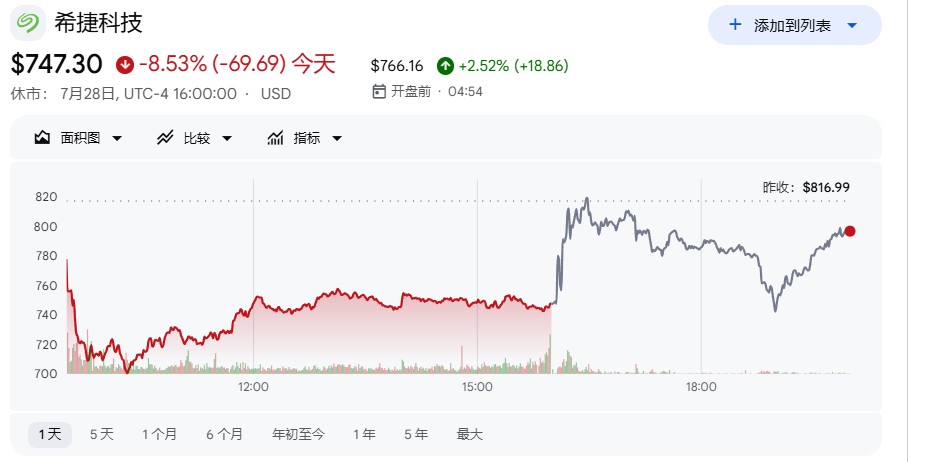
For the storage and semiconductor sectors, which had just experienced a sharp decline, Seagate's performance served as a "shot in the arm."
Better-than-Expected Results Directly Reverse After-Hours Sentiment
Seagate delivered not just a "beat" this quarter, but also stronger profitability metrics.
According to a Citigroup research note, the company's June-quarter revenue was $3.63 billion, up 48% year-over-year. Earnings per share were $5.71, a 121% year-over-year increase, exceeding the high end of previous guidance.
Gross margin reached 52.7%, an increase of 570 basis points quarter-over-quarter and 1,480 basis points year-over-year, higher than the market expectation of 50.0%. Operating margin was 44.6%, also above the market expectation of 42.0%.
In terms of shipment structure, Seagate's total capacity shipments this quarter were 218 EB, a 9% quarter-over-quarter increase and a 34% year-over-year increase, with approximately 90% shipped to data center customers. The company's full-year revenue grew 34% to $12.2 billion, higher than analysts' expectation of $12.0 billion, while full-year free cash flow hit a record $3.1 billion.
Guidance for the next quarter was also stronger than market expectations. Citigroup stated that the company expects fiscal 2027 Q1 sales of $4.1 billion, plus or minus $100 million, higher than the market expectation of $3.78 billion. Operating margin is expected to be around 50%, above the market expectation of 43.4%. Earnings per share are projected at $7.30, plus or minus $0.20, exceeding the market expectation of $5.85.
Demand Visibility Extends to 2029
The core message from Seagate's management was that there are no signs of slowing demand.
In a statement, Dave Mosley said the company's performance was driven by strong cloud data center demand and disciplined execution, and he expects this momentum to continue into 2027. He also stated that AI-driven data generation will bring "lasting long-term demand for massive capacity storage."
During the earnings call, management further indicated that most nearline hard drive capacity has already been allocated through long-term supply agreements through the 2028 calendar year. Customers are not shortening their planning cycles; instead, more customers are extending their plans to 2029 and beyond.
This is also the core reason for Citigroup's bullish stance. In its research note, Citigroup stated that hyperscale cloud customers, AI workloads, and data retention growth continue to support demand, and the company remains in an environment of "excess demand over supply."
Strong Pricing Power, Margins Continue to Rise
Pricing was one of the most closely watched topics of the call.
Management stated that the supply-demand gap is larger than it was a few quarters ago. Although Seagate has a small amount of additional capacity, this capacity can be sold at very favorable prices.
Dave Mosley explained that contracts are typically locked in for one year, but when additional capacity is released due to improved product yields, customers are often willing to pay prices above the contract rate to secure it.
This means that Seagate's price improvements come not only from contract repricing but also from premiums on incremental capacity amid tight supply and demand.
Gianluca Romano stated that the company's pricing strategy has been in place for 12 to 13 quarters, with no change in direction. Factors driving gross margin expansion include the continuation of pricing strategies, an increased proportion of high-capacity nearline hard drives, and cost improvements from the transition to the HAMR generation.
He also stated that the company's incremental gross margin is "well above 60%," and the gross margin implied by the September quarter guidance is already close to this level. Citigroup also attributed margin expansion to tight supply, a favorable product mix, and the ramp-up of Mozaic 4.
HAMR Ramp-Up Enters Critical Phase
The technology roadmap is another key driver of Seagate's profit elasticity.
According to Citigroup's research and management statements, Mozaic 3 has completed certification and deployment with major cloud customers. Mozaic 4 is currently ramping up among major cloud service providers, supporting hard drives of up to approximately 44TB, and is expected to account for 50% of HAMR shipments in EB by the end of 2026. Mozaic 5, based on a 5TB-per-platter HAMR platform, is expected to begin certification and shipments by the end of 2027, supporting hard drives of approximately 50TB, and will gradually contribute to sales volume in 2028.
Management stated that HAMR's share of nearline EB shipments has reached approximately 40%, with a target of increasing this to 50% by the end of 2026.
This also explains why Seagate needs to continue investing in manufacturing tools. Gianluca Romano noted that the number of heads and disks per complete unit increased by 15% to 20% over the past year, while the volume of complete unit shipments remained nearly unchanged. As products iterate from 3TB per platter to 4TB and 5TB, the manufacturing path becomes more complex, and tool occupancy time increases.
New AI Demand Is Still Early, But Direction Is Clear
Seagate's management remains cautiously optimistic about AI demand, emphasizing that many new scenarios are still in the early stages.
During the call, Dave Mosley discussed the relationship between KV Cache and hard drive storage. He stated that in agent-based AI applications, systems need to retain large amounts of context data for each user. As the number of users increases and interaction complexity rises, this context data expands. Enterprises do not want to recalculate this data every time, thus generating new storage demand.
He also mentioned physical AI. Compared to the robot terminals themselves, Mosley is more concerned with the underlying data issues: data generated by sensors is transmitted back to local clouds or larger-scale clouds, and large volumes of unstructured video data may become a significant source of demand for hard drive storage.
However, management also emphasized that even without considering physical AI, enterprise application trends are already favorable for Seagate.
Citigroup Raises Price Target, Maintains Buy Rating
In a research note on July 29, Citigroup maintained its Buy rating on Seagate and raised its price target from $1,240 to $1,300. Citigroup stated that Seagate continues to benefit from strong demand, margin expansion driven by the HAMR ramp-up, and pricing power supported by supply-demand fundamentals.
Meanwhile, the company's capital allocation is also improving. Management stated that Seagate's net debt leverage ratio had dropped to 0.4x by the end of fiscal 2026. The company will repay another $1.2 billion in debt in the September quarter, including $1 billion in high-yield senior notes that were repaid in July, with the remaining convertible bonds scheduled for repayment upon maturity in September. The company also stated that it is executing a larger-scale stock buyback this quarter and will continue to do so in the coming quarters.
For investors, the significance of Seagate's earnings report extends beyond a single company beating expectations; it provides clearer short-term validation for the three main themes of storage demand, pricing, and margins. Amid volatility in AI trades, this performance has temporarily stabilized market confidence in the storage cycle.
