


A Chain Reaction of Liquidations Triggered by an SK Hynix "Fat Finger" Trade: 960 Long Positions Wiped Out, $60 Million in Positions Vanish
An abnormally low sell order for SK Hynix on the Nextrade exchange was captured by Hyperliquid's oracle, causing a 20% plunge in its perpetual contract price. This resulted in the liquidation of 960 long accounts, involving positions worth approximately $57.4 million. The platform refused compensation citing decentralization, exposing the structural risks of on-chain derivatives relying on single, fragile data sources
A pre-market "fat finger" trade involving a single share of SK Hynix has triggered a bloodbath in the crypto world, wiping out nearly $60 million in value. Who would have thought that the abnormal sale of just one share would become the final straw that crushed nearly a thousand on-chain long players.
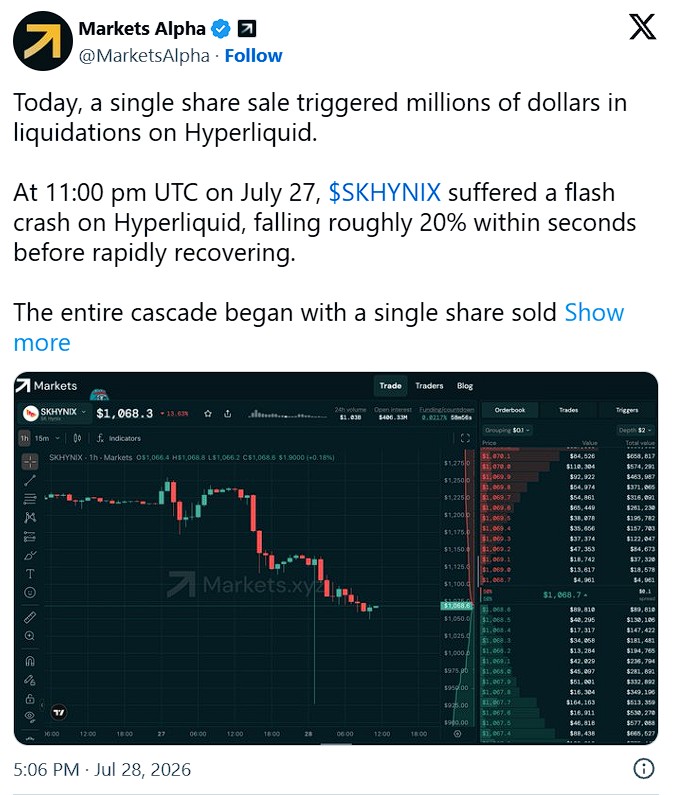
On the morning of July 28, as the Korean alternative exchange Nextrade opened its pre-market trading with extremely thin liquidity, a sell order at a price severely deviating from the market rate was accidentally executed. Immediately, this absurd price was "blindly" captured and transmitted by a third-party oracle used by the decentralized derivatives platform Hyperliquid. Within seconds, the on-chain SK Hynix perpetual contract (xyz:SKHYNIX) plummeted by 20%, leaving 960 long accounts no time to react before they were brutally "slaughtered."
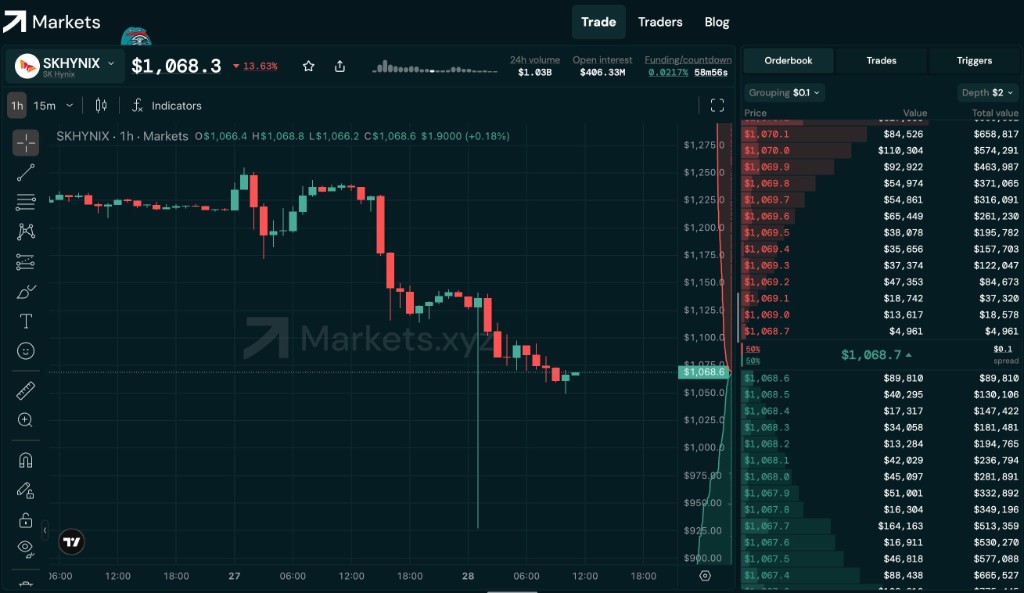
According to on-chain analysis account MarketsAlpha, 960 long accounts were liquidated, involving a total position size of approximately $57.4 million, with actual losses amounting to about $17.3 million.
However, what left victims more desperate than the flash crash itself was this: Faced with such an obvious systemic data transmission vulnerability, the platform distanced itself by citing "decentralization," rendering existing slashing mechanisms virtually useless. This tragedy, triggered by a single fragile data source, is tearing off the fig leaf covering the frenzy behind on-chain derivatives.
Hyperliquid emphasized that xyz:SKHYNIX was not deployed or operated by them, but independently operated by a third-party team, Trade.xyz, under the HIP-3 framework, with control over the price oracle also belonging to the latter. However, affected users now face the dilemma of being unable to receive compensation—even if the slashing mechanism against Trade.xyz is triggered, the burned staked tokens will not be distributed to the affected traders.
Analysts believe that this incident has brought the structural risks of perpetual contract products in the crypto market to the forefront—when the price anchoring of on-chain derivatives relies on a single or fragile external data source, an abnormal transaction during a period of extremely poor liquidity is enough to destroy tens of millions of dollars in leveraged positions within seconds.
Fat Finger: How a Single Sell Order Triggered a Chain of Liquidations
The starting point of this incident was an abnormal order on the Korean alternative stock exchange Nextrade (NXT).
NXT launched in March 2025, with trading hours from 8:00 AM to 8:00 PM local time. Compared to the main board trading hours of the Korea Exchange (KRX) from 9:00 AM to 3:30 PM, it offered a longer pre-market liquidity window. However, liquidity during pre-market hours is extremely thin.
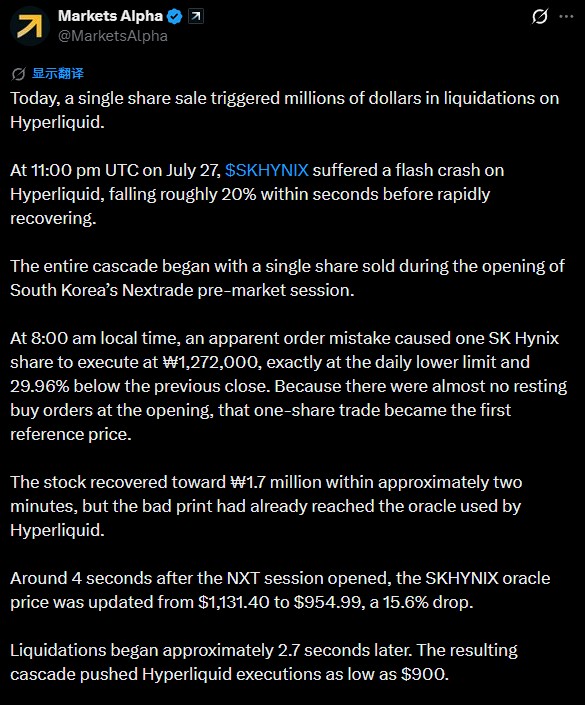
At 8:00 AM local time on July 28, the moment NXT opened, an SK Hynix stock order was executed at 1,272,000 KRW—exactly hitting the daily limit down, representing a drop of approximately 29.96% from the previous day's closing price of 1,785,000 KRW. Since buy orders were almost non-existent at the time, this trade, involving only one share, became the reference price for the exchange.
The price returned to the normal level of around 1.7 million KRW within about two minutes, but it was too late. The oracle used for the xyz:SKHYNIX contract had completed the price update about 4 seconds after NXT opened, lowering the reference price from $1,131.40 to $954.99, a drop of 15.6%. About 2.7 seconds later, the compulsory liquidation procedure was initiated, pushing the on-chain execution price as low as $900.
Notably, several hours after the incident, SK Hynix shares did indeed see a real drop of about 15% in the formally opened market, closely matching the magnitude of this flash crash—this coincidence made the abnormal price appear somewhat "reasonable" at the time.
Furthermore, SK Hynix was already amidst a wave of selling in AI storage stocks, with the Korea Composite Stock Price Index (KOSPI) closing down about 10% on Tuesday (July 28), adding to the confusion surrounding the price signal.
Full Picture of Liquidations: 960 Accounts, $57.4 Million
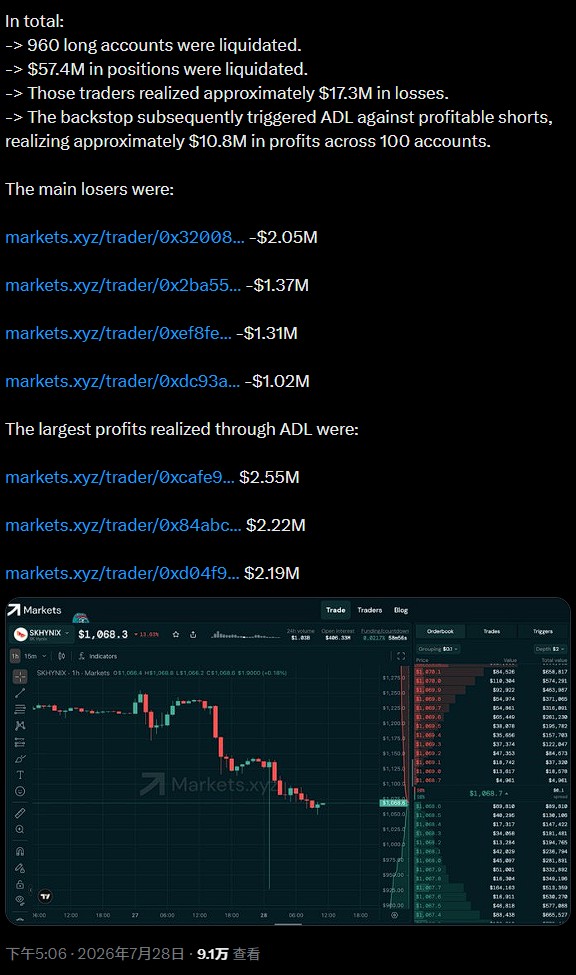
According to on-chain analysis by MarketsAlpha, the final profit and loss data for this incident are as follows:
-
960 long accounts were subject to compulsory liquidation;
-
The total size of liquidated positions was approximately $57.4 million;
-
Traders' actual losses amounted to about $17.3 million;
-
Liquidations triggered the Auto-Deleveraging (ADL) mechanism, with 100 profitable short accounts gaining a combined total of about $10.8 million;
-
The maximum profit for a single account was $2.55 million, and the maximum loss was $2.05 million.
It is worth noting that data from the enterprise blockchain data platform Allium largely aligns with these figures, estimating actual losses at approximately $17.4 million, affecting over 900 users. However, neither Hyperliquid nor Trade.xyz has officially confirmed these figures.
Price Guards: Why the Drop Was 17.9% Instead of 28.7%
Although the underlying price signal indicated a drop of nearly 29%, the actual drop in the xyz:SKHYNIX contract was about 17.9%. This was not accidental, but the result of the "price discovery boundary" mechanism in Trade.xyz's contract design.

According to Trade.xyz's public specifications, xyz:SKHYNIX has a 10% instantaneous price fluctuation cap, allowing for one reset. With two superimposed caps, the hard upper limit for the maximum drop in the mark price is approximately 19%. The final drop of 17.9% fell exactly within this limit, meaning the guardrail mechanism absorbed about 11 percentage points of the price shock.
However, while this mechanism protected the market, it also left sufficient room for the liquidation of leveraged longs—a maximum drop of 19% was enough to trigger the compulsory liquidation of a large number of leveraged long positions.
Another design factor that amplified losses was the margin mode. xyz:SKHYNIX uses a cross margin mode, whereas Samsung and Hyundai perpetual contracts on the same platform use isolated margin. The cross margin mode means that a losing position can utilize collateral from other positions in the account, thereby expanding the impact of a single event.
Attribution of Responsibility: Why Hyperliquid Distanced Itself
After the incident, a Hyperliquid team member, co-founder and core developer known as "iliensinc," responded to questions from affected users in the project's Discord, with their stance centered on structural arguments. iliensinc wrote:
"Hyperliquid is a permissionless blockchain. Different teams can deploy and operate markets on Hyperliquid, using it as an infrastructure layer... The XYZ team is investigating this matter and will share conclusions in a timely manner once available."
The key to this distinction lies in the HIP-3 framework. Under this framework, market operators (i.e., Trade.xyz) are responsible for pushing mark prices, oracle prices, and external price inputs, with Hyperliquid providing only one of the three price components. iliensinc illustrated this with a straightforward example:
If the median of the latest on-chain transaction price, best bid, and best ask is 100, but the operator pushes prices of 150 and 151, the final mark price will adopt 150—the operator's data has decisive weight.
This means that control over the price oracle in this incident rested entirely with Trade.xyz, and Hyperliquid could not intervene at the technical level.
Compensation Dilemma: Slashing Mechanism Virtually Useless
The reality facing affected traders is that even if existing mechanisms are fully executed, they are unlikely to receive any compensation.
According to HIP-3 rules, market deployers must continuously stake 500,000 HYPE tokens, worth approximately $27.4 million at Tuesday's prices. Validators can vote to burn these through staking weight. The clauses triggering slashing cover malicious behavior and operational errors, even including scenarios where "flawed contract specifications were faithfully executed."
However, slashed staked tokens are burned directly rather than distributed to affected users. Even if full slashing is triggered, the 960 liquidated accounts will receive nothing.
In addition, the validators' automatic review mechanism has a trigger threshold—it only starts automatically when the external price fluctuates by more than 50% from the day's opening price, and the price fluctuation in this incident far did not reach this threshold.
Currently, Trade.xyz has not released any post-incident analysis report, nor has it proposed any compensation plan.
Industry Warning: Structural Fragility of On-Chain Traditional Asset Derivatives
This incident has fully exposed the deep-seated contradictions of perpetual contract products in the crypto market.
Jordi Alexander, founder of digital asset hedge fund Selini Capital, compared users of such products to "people standing beside a blackjack table, betting on the table's trends," rather than players truly participating in the underlying market.
Tian Zeng, CEO of crypto hedge fund Third Eye, pointed out: "Typically, most exchanges use multiple pricing sources; relying on a single source can be very dangerous."
He also stated that even with multiple data sources, "considering the leverage multiples of some traders, liquidations could still be triggered," characterizing this incident as "part of the construction process of the emerging but rapidly growing market for on-chain traditional finance perpetual contracts."
Several timelines will determine the subsequent direction of the event: Contract deployers must continue to hold 500,000 HYPE in stake for at least 183 days after launch; staked tokens must go through a 7-day unstaking queue, and the window for validators to act currently remains open.
On the regulatory front, Trade.xyz met with SEC crypto regulators earlier this month together with the Hyperliquid policy team, and this incident may further attract regulatory attention.
This incident has also caused outsiders to re-examine Hyperliquid's previous controversial precedents.
In the JELLY token delisting controversy in March 2025, Hyperliquid was criticized for centralization tendencies after forcibly settling positions at self-determined prices; yet this time, facing user losses, the platform refused to intervene citing "permissionless infrastructure," taking a completely opposite stance.
Analysts point out that the core risk revealed by this incident is not a universal problem with the oracle mechanism itself, but a more specific design flaw:
For assets like SK Hynix, where reference prices can be formed during pre-market hours with extremely thin liquidity, is a 19% maximum allowable fluctuation reasonable?
A single-share transaction in a nearly empty market was enough to become the trigger for tens of millions of dollars in liquidations.
Risk Warning and Disclaimer
The market carries risks, and investment requires caution. This article does not constitute personal investment advice, nor does it take into account the specific investment goals, financial status, or needs of individual users. Users should consider whether any opinions, views, or conclusions in this article align with their specific circumstances. Investment based on this content is at the user's own risk.
