


Retail Margin Calls and Foreign Capital Outflows: Will Korea Face a Chain Reaction of Crises?
JPMorgan Chase believes that the core driver of the recent plunge in the South Korean stock market—deleveraging—is nearing its end. The size of leveraged ETFs has shrunk from $50 billion to $17 billion, hedge funds have completed approximately 90% of their deleveraging, and foreign selling pressure has eased due to the declining weightings of storage chip leaders. Although short-term volatility persists due to the Federal Reserve and tech earnings reports, the market lacks the foundation for further deterioration driven by "retail margin calls and foreign capital stampedes."
The South Korean stock market has undergone intense deleveraging over the past month, with the KOSPI falling nearly 40% from its June 22 peak. However, judging by the scale of leveraged products, hedge fund positions, retail margin balances, and foreign capital flows, the primary passive liquidation forces driving the decline have largely been released. The market currently shows no signs of continuous risk events triggered by retail margin calls and foreign capital withdrawal.
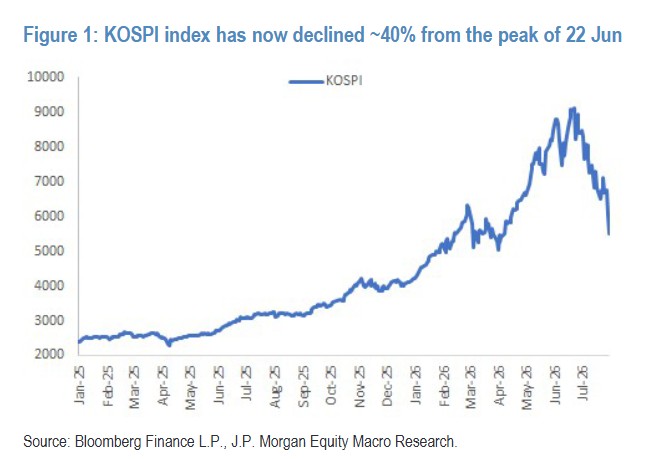
According to Zhuifeng Trading Desk, a report released by JPMorgan Chase on July 29 stated that the deleveraging process for South Korea-related leveraged ETFs is basically complete, and hedge funds have completed about 90% of their deleveraging adjustments. Previously, forced selling by highly leveraged funds during the market downturn amplified index volatility and prompted other investors to reduce positions simultaneously.
Foreign investors have cumulatively sold more than $110 billion worth of South Korean stocks year-to-date, a significant scale, but approximately 90% of the outflow was concentrated in two leading storage chip companies. As the weightings of these two stocks in the MSCI Emerging Markets Index dropped from 9.5% and 8.3% at the end of June to the current 6.5% and 4.5%, respectively, the passive selling pressure driven by allocation constraints is weakening.
In the short term, the South Korean market still faces uncertainties such as the Federal Reserve's interest rate decision, potential rate hike risks, and high expectations for the earnings reports of major cloud computing companies. Price losses this week may also trigger residual liquidations in the coming days. However, JPMorgan Chase believes that against the backdrop of valuations having fallen to low levels and earnings momentum remaining intact, the position structure of the South Korean stock market has become more attractive than before.
Nearly 40% Drop, Core Drivers Are Concentrated Holdings and Leveraged Liquidation
This round of adjustment began in mid-June. JPMorgan Chase pointed out that the initial triggers were routine fundamental concerns and capital rotation, but the highly concentrated structure of the South Korean market, combined with the amplification effect of leveraged ETFs, caused the decline to rapidly evolve into a deleveraging trade.
The drawdown in the KOSPI was highly consistent with the significant underperformance of storage chip stocks. Previously, a few large-cap stocks dominated the performance of the South Korean market, resulting in narrow market breadth on the upside. When these high-weighting stocks corrected, the pressure on the index was particularly evident.
However, during the market decline in July, the ratio of advancing to declining stocks remained relatively stable, indicating that losses were still mainly concentrated in a few heavyweight stocks rather than spreading comprehensively across the entire market. This weakens the judgment that a "widespread deterioration of balance sheets" is forming.
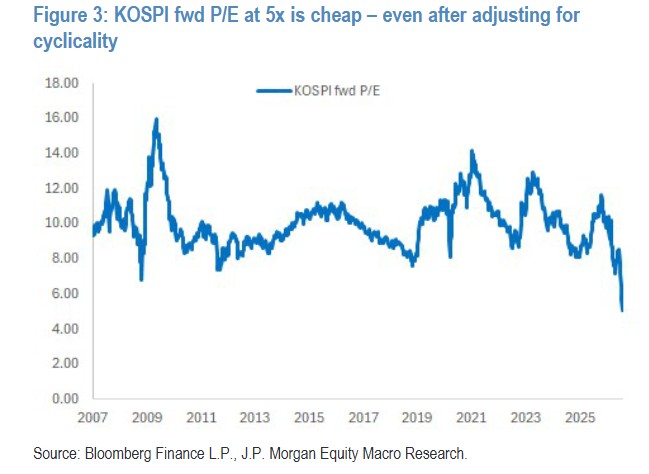
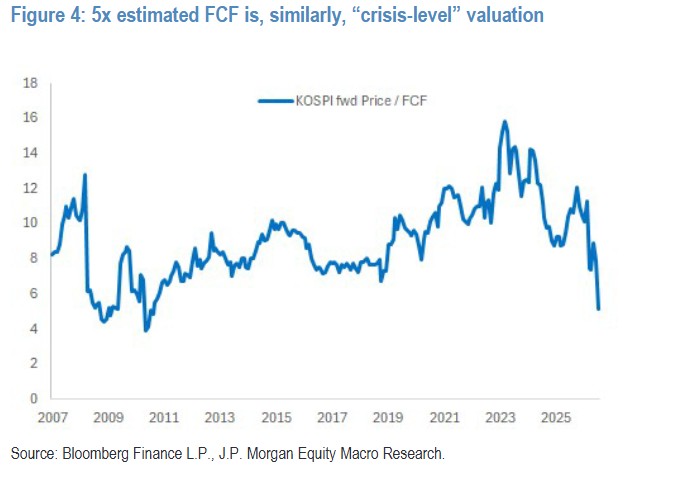
JPMorgan Chase's charts show that technical indicators for the KOSPI have currently entered oversold territory, with a forward P/E ratio of approximately 5x, and expected free cash flow valuations are also at what it calls "crisis levels." Low valuations do not mean volatility will end immediately, but they provide a buffer for the market to rebuild risk appetite after deleveraging nears completion.
Leveraged ETF Size Has Fallen from $50 Billion to $17 Billion
Leveraged ETFs were a key channel for amplifying volatility in this round. By the end of June, the assets under management (AUM) of leveraged ETFs linked to the South Korean market reached approximately $50 billion. Relative to the size of the South Korean market, this scale was about four times that of comparable levels in the United States.
During market declines, leveraged ETFs need to passively reduce risk exposure, creating a feedback loop of "price drop, forced selling, further price drop." Such trading not only impacts related stocks but may also force other investors with similar holdings to withdraw simultaneously.
As of now, the AUM of these products has dropped to approximately $17 billion. JPMorgan Chase believes that this scale has returned to a level that no longer poses a prominent risk. Meanwhile, recent inflows into leveraged products have stagnated significantly, with bottom-fishing activity remaining inactive.
The retreat of leveraged ETFs is also reflected in volatility indicators. The report states that the ratio of the South Korean Volatility Index (VKOSPI) to the US VIX has begun to decline, and open interest in single-stock futures continues to fall. For the market, this means that sharp volatility triggered by derivatives and passive rebalancing may be cooling down.
Hedge Fund Deleveraging Nears Completion
Hedge funds are another source of risk worth monitoring. According to JPMorgan Chase data, the long-short leverage ratio of hedge funds in their prime brokerage accounts once rose to 5.7x, before dropping to 3.2x on July 27.
The report pointed out that the significant retracement in price momentum factors on July 28 and 29 suggests that hedge funds may have further reduced leverage. Currently, their leverage level is not far from the upper end of the 2025 range, with the overall deleveraging process approximately 90% complete.
This does not mean that selling pressure has completely disappeared. If the market falls further, it may still trigger adjustments in some remaining positions, especially as macroeconomic events approach and investor risk appetite remains cautious. However, compared to when highly leveraged positions were still accumulating in large quantities, the probability of continued systematic forced liquidation is decreasing.
From the perspective of market transmission, the simultaneous contraction of leveraged ETF and hedge fund positions is an important explanation for the rapid short-term decline in the KOSPI. The reduction in both indicates that the previously most destructive trading structures are improving.
Retail Margin Balances Do Not Support the Judgment of "Widespread Margin Calls"
The retail risk mentioned in the title is one of the transmission links the market worries about most. However, JPMorgan Chase believes that the leverage established by South Korean retail investors through margin financing and securities lending is not high, nor did it expand rapidly this year.
Currently, the margin balance is approximately $20 billion, having retreated from previous levels. More importantly, the ratio of margin balance to total market capitalization has actually been on a downward trend this year.
Unlike leveraged ETFs, which may trigger mechanical deleveraging when spot prices fall, margin loans usually come with a certain buffer space and operational autonomy. The report believes that South Korean retail investors still have accumulated stock gains, cash balances, higher incomes, and overseas assets from previous periods to cope with potential margin calls, provided that investors choose to maintain their positions.
Therefore, while there is indeed retail leverage adjustment in the market, existing data do not support the conclusion that margin balances constitute a risk of large-scale, indiscriminate margin calls. The retail sector is more likely one of the amplifiers of volatility rather than the main source of current market risk.
Record Foreign Capital Outflows, But Selling Pressure Is Highly Concentrated
Foreign capital outflow is another signal that makes the market wary. Since the beginning of the year, foreign investors have cumulatively sold more than $110 billion worth of South Korean stocks, a considerable scale.
However, JPMorgan Chase pointed out that about 90% of the foreign capital outflow came from two storage chip stocks, primarily driven by long-term funds facing allocation constraints due to holding large-cap stocks. As these related stocks fell, their weightings in the MSCI Emerging Markets Index decreased significantly, from 9.5% and 8.3% at the end of June to 6.5% and 4.5%, respectively.
The decrease in weighting means that the pressure on passive or benchmark-constrained funds to continue reducing holdings has eased. The report states that as the South Korean market, particularly storage chip stocks, underperformed, the selling pressure from long-term funds has significantly eased.
At the same time, not all sectors in the South Korean market experienced foreign capital withdrawal. The report shows that even during the KOSPI adjustment since June 22, multiple industries still recorded foreign capital inflows. This indicates that capital flows are closer to rebalancing of concentrated holdings rather than a comprehensive retreat from South Korean assets.
Valuation and Earnings Provide Buffer, Short-Term Outlook Depends on External Events
After deleveraging nears completion, the next stage of the market will depend more on macroeconomic risks and corporate earnings expectations. JPMorgan Chase specifically highlighted that the Federal Reserve meeting carries the risk of a rate hike, and high expectations for the earnings reports of major cloud computing companies could affect global sentiment towards technology and risk assets.
The South Korean market is relatively sensitive to storage chip prices and supply chain expectations. The report states that spot storage chip prices are generally still rising, and contract prices for the third quarter continue to increase, although the month-on-month growth rate has slowed. This supports market earnings expectations, but it also means that once price trends or technology demand expectations change, highly concentrated sectors may still experience significant volatility.
From an allocation perspective, JPMorgan Chase believes that the South Korean market's current combination of low valuations, earnings momentum, and leverage clearance forms a relatively favorable setup. The bank remains bullish on sectors driven by the "wealth effect," such as department stores, cosmetics, tourism, securities firms, and construction, and is also paying attention to previously lagging sectors such as biopharmaceuticals, preferred shares, and banks.
For investors, the key to the South Korean market is no longer just whether the index decline widens, but whether passive selling continues to shrink, whether storage chip heavyweight stocks can stabilize, and whether external macroeconomic events will once again trigger widespread deleveraging of risk assets. At this stage, the South Korean stock market has not yet shaken off high volatility, but the chain of "retail margin calls – foreign capital flight – market chain reaction crises" lacks sufficient data support.
