


Apollo Chief Economist: AI Cash Burn Hits Record Highs; Beware of a "Subprime Crisis-Style" Reversal Shock
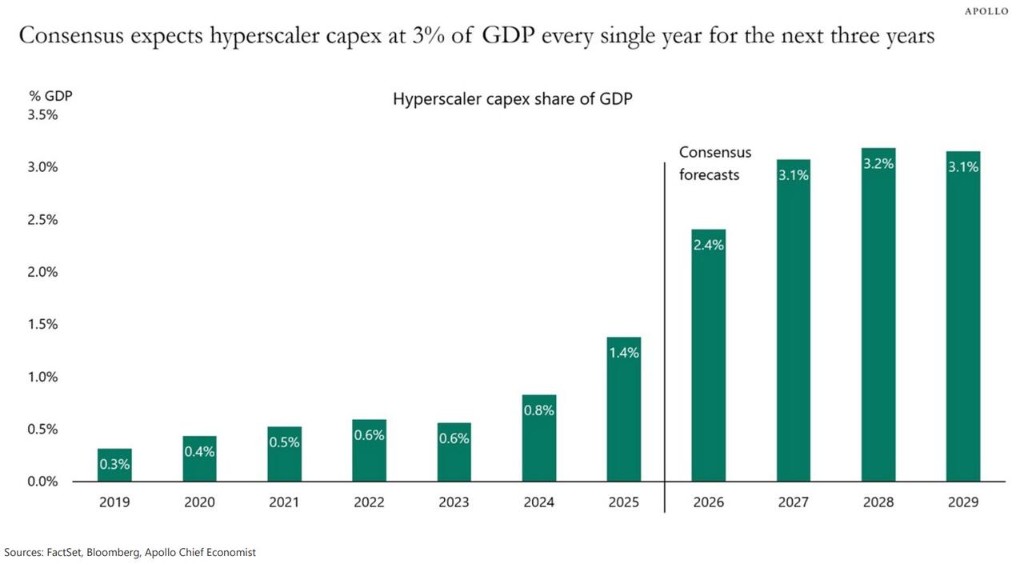
AI data center capital expenditure is projected to rise from 0.6% of GDP in 2023 to 3.1% in 2027, with a construction pace nearly double the peak of the housing boom, surpassing all historical capital expenditure cycles. Torsten Slok, Chief Economist at Apollo Global, warns that the faster investment rises, the greater the potential shock from a reversal. If commercial demand for AI fails to materialize, this round of investment could contract at a similar pace, posing significant macroeconomic downside risks
Investment in artificial intelligence infrastructure is reshaping the global capital expenditure landscape at a historically unprecedented pace, and its potential macroeconomic risks cannot be ignored.
According to an analysis this week by Torsten Slok, Chief Economist at Apollo Global, capital expenditure by major hyperscale cloud computing companies is expected to climb from 1.4% of GDP in 2025 to approximately 3% between 2027 and 2029. At that point, it will exceed more than twice the peak of the telecommunications and fiber-optic construction boom in the late 1990s.
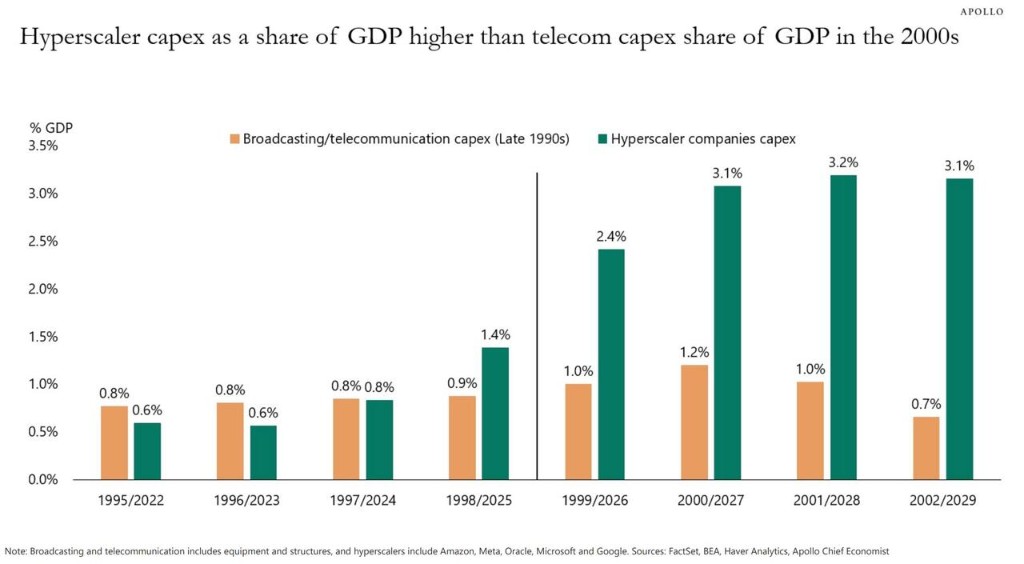
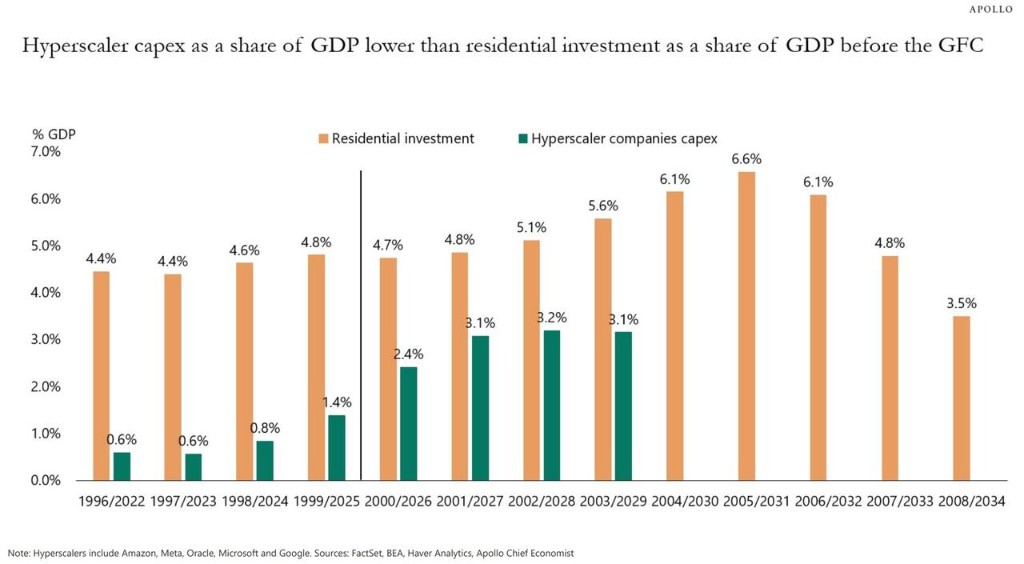
Although the absolute scale of this investment boom remains lower than the peak of the 2005 housing boom, it has surpassed any previous capital expenditure cycle in terms of both the cumulative increase in its share of GDP and the speed of construction.
Slok warns that it is precisely the speed of the investment cycle that determines the destructiveness of its reversal.
Historical data shows that the sharp decline in housing investment as a share of GDP was a core factor leading to that severe recession. In contrast, the bursting of the relatively smaller telecommunications bubble triggered only the mildest post-war recession. If AI demand fails to meet expectations, it could reverse at a similar pace, posing significant macroeconomic downside risks.
Construction Speed: Surpassing Any Historical Cycle
Examining this AI capital expenditure boom from three dimensions provides a clearer picture.
In terms of scale, data center construction investment lies between the two previous large capital expenditure cycles. It is more than double the peak of the late 1990s telecommunications and fiber-optic construction boom (approximately 1.2% of GDP in 2000) but less than half the peak of the 2005 housing boom (6.6% of GDP).
From the perspective of marginal change, the key metric is not the absolute share of investment, but the increase in its proportion of GDP, which directly constitutes the marginal contribution to GDP growth.
Data center capital expenditure will rise from 0.6% of GDP in 2023 to 3.1% in 2027, a cumulative increase of about 2.5 percentage points. In comparison, telecommunications investment in the late 1990s rose by only 0.4 percentage points, while housing investment rose by about 2.2 percentage points from the mid-1990s to 2005.
By this measure, AI data center investment is already the largest capital expenditure cycle to date.
In terms of construction speed, the disparity is even more pronounced. Data center capital expenditure is expected to rise from 1.4% in 2025 to 3.1% in 2027 in just two years, an average annual increase of about 0.85 percentage points.
During the fastest phase of the housing boom (2002 to 2005), the average annual increase was only about 0.5 percentage points, while the telecommunications construction boom saw an increase of about 0.15 percentage points. The construction speed of AI data centers is nearly double that of the fastest phase of the housing boom.
The Other Side of Risk: The Reversal Speed Is Equally Alarming
Slok's analysis reveals a symmetrical logic: the faster the construction, the more violent the potential reversal.
History provides two reference points:
- The reversal of the late 1990s telecommunications bubble was relatively limited in scale, resulting in a mild economic impact, with the US experiencing only the mildest post-war recession.
- In contrast, the rapid contraction of housing investment by about 3.2 percentage points from early 2006 to late 2008 was a major driver of that severe financial crisis and deep recession.
In the current cycle, data center capital expenditure is climbing at a rate of about 0.85 percentage points per year. Once the realization of commercial AI demand falls short of expectations, this investment scale could contract at a similar pace.
Slok explicitly pointed out that the true macroeconomic risk lies not in the construction itself, but in the impact on economic growth caused by the subsequent investment reversal if AI demand proves disappointing.
