


A belated slap in the face is still a slap in the face: A100 provides the perfect logic for Neocloud
CoreWeave announced that it has signed A100 contracts extending to 2029 at attractive prices, corroborating Jensen Huang's view that the A100 has an economic life of nearly 10 years. This move directly refutes the core bearish argument previously raised by Michael Burry against the Neocloud business model, which claimed that GPU depreciation periods (6 years) were overstated and that the actual economic life was only 2-3 years, leading to inflated profits
Last night’s CoreWeave (a representative emerging cloud infrastructure company in the U.S., a Neocloud) conference call was impressive. The most striking takeaway was neither the CFO’s remark that “we are seeing demand, pricing, and margin all expanding,” nor the fact that its Remaining Performance Obligation (RPO) had accumulated to $129 billion (more than 3.3 times the annual CapEx), but rather this statement:
“We recently signed an A100 contract that extends into 2029 at an attractive price.” For example, we recently signed an A100 contract with a term extending to 2029 at a highly attractive price.
This aligns perfectly with the open letter Jensen just published on X, in which he stated that the A100’s economic life is close to 10 years. As we know, the A100 was launched in 2020. A GPU released six years ago can still secure new contracts in 2026, with terms extending to 2029, and at a price that is still “attractive.”
This strikes at the very heart of the Neocloud business model.
CoreWeave clearly disclosed in its 2025 10-K filing that the depreciation period for GPUs and related technical equipment is six years. This depreciation schedule has been heavily questioned by the “Big Short” investor Michael Burry, forming the core of his bearish thesis on AI in November 2025.
Burry argued that the true economic life of GPUs is only about 2–3 years, whereas Hyperscalers depreciate equipment over 5–6 years, resulting in severely underestimated depreciation expenses and significantly overstated cloud business profits.
This skepticism was not absurd (which is why it shook the market so profoundly at the time). If GPUs truly generated economic value for only 2–3 years, then Neocloud’s high leverage would indeed be extremely dangerous:
Borrowing to buy GPUs → Rapid decline in GPU economic value → Asset residual value approaches zero → Assets stop generating profit before debts are repaid.
Now, CoreWeave has provided a direct counterexample, effectively slapping Michael Burry in the face. The A100, launched in 2020, will have completed its six-year depreciation cycle by 2026, yet new contracts can extend to 2029, with its economic value even increasing.
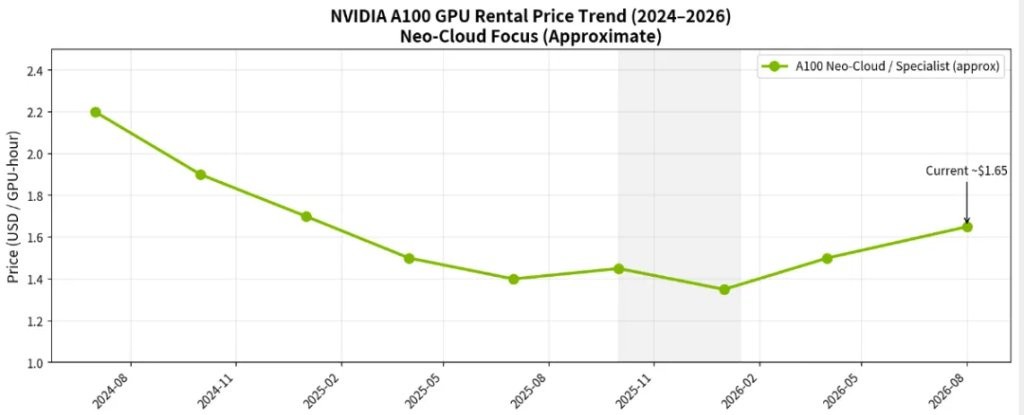
During the conference call, CoreWeave explicitly stated that after old GPU lease contracts expire, the hardware can be transitioned to other workloads such as inference, continuing to maximize asset value.
Then, CoreWeave offered a crucial statement:
“So when an initial contract ends, the cluster no longer has any leverage, and we are free to recontract that cloud infrastructure or offer it to the market.”
In plain language, this means:
When the first/initial contract ends, the financing obligations associated with this Cluster have typically been largely covered or repaid by the revenue from the initial contract. Therefore, CoreWeave can re-lease this highly deleveraged asset, with subsequent income no longer burdened by the heavy capital recovery requirements of the earlier phase.
This is precisely the most brilliant aspect of the Neocloud business model.
One can imagine a GPU Cluster having two life cycles: The first stage is the Initial Contract, where customers sign relatively long-term agreements, and the leasing revenue generated primarily covers the leveraged portion of CapEx. The second stage is entirely different: after the contract expires, the GPUs are not scrapped but can continue to be leased out. Regarding this phase, CoreWeave specifically noted:
“In a market where new capacity is supply-constrained and costs are rising, AI cloud infrastructure in production is a scarce, valuable asset…increasingly we are seeing longer utilization at higher prices, offering the potential for significant further upside.”
Simply put, this means:
After the initial contract ends, prices for new contracts will rise significantly.
This explains why CoreWeave’s business model, and the Neocloud model in general, is much more attractive than the market imagined. The most compelling aspect of Neocloud is not just how much profit the GPU generates from the first contract, but how much more it can earn and for how many years after completing its initial deleveraging.
Judging by the A100, a product launched six years ago (in 2020, when the world was still in the pandemic and the prospects of AI training had not even emerged), the “second life cycle” of GPU Clusters is evidently very long. Thus, the true Return on Invested Capital (ROIC) for Neocloud is unimaginable.
Clearly, Elon Musk, who plans to quadruple capacity to build an 8GW computing center by 2027, understands this. SpaceX is already becoming akin to a Neocloud company (note, this is not meant as a mockery of Musk).
Risk Warning and Disclaimer
The market involves risks; investment should be approached with caution. This article does not constitute personal investment advice, nor does it take into account the specific investment objectives, financial status, or needs of individual users. Users should consider whether any opinions, views, or conclusions in this article are suitable for their specific circumstances. Investment decisions made based on this content are the sole responsibility of the investor.
