


iOS 27 Reveals Apple AI Pricing: Want a Smarter iPhone? You’ll Have to Pay More
iOS 27 Beta 5 has exposed Apple’s pricing strategy for its AI services. Usage of Apple Intelligence will be tied to iCloud+ plans, with different tiers (such as 2TB and 12TB) corresponding to different caps on AI feature usage, such as the number of AI summaries for home cameras. This move implies that users need to upgrade their subscriptions to access more AI service quotas, confirming earlier WWDC statements that certain server-side features would have limits that could be lifted through upgrades
Domestic users in China have been waiting for Apple Intelligence for two years. In July this year, “Apple Intelligence” completed the filing for on-device generative AI services in China, bringing the official launch of the Chinese version one step closer.
But before it has even been officially launched, news about its pricing has already emerged.
Stephen Robles, a content creator who closely follows the Apple ecosystem, discovered that the Home app in iOS 27 Beta 5 has added an Apple Intelligence page, which already shows AI usage limits tied to iCloud+ plans.
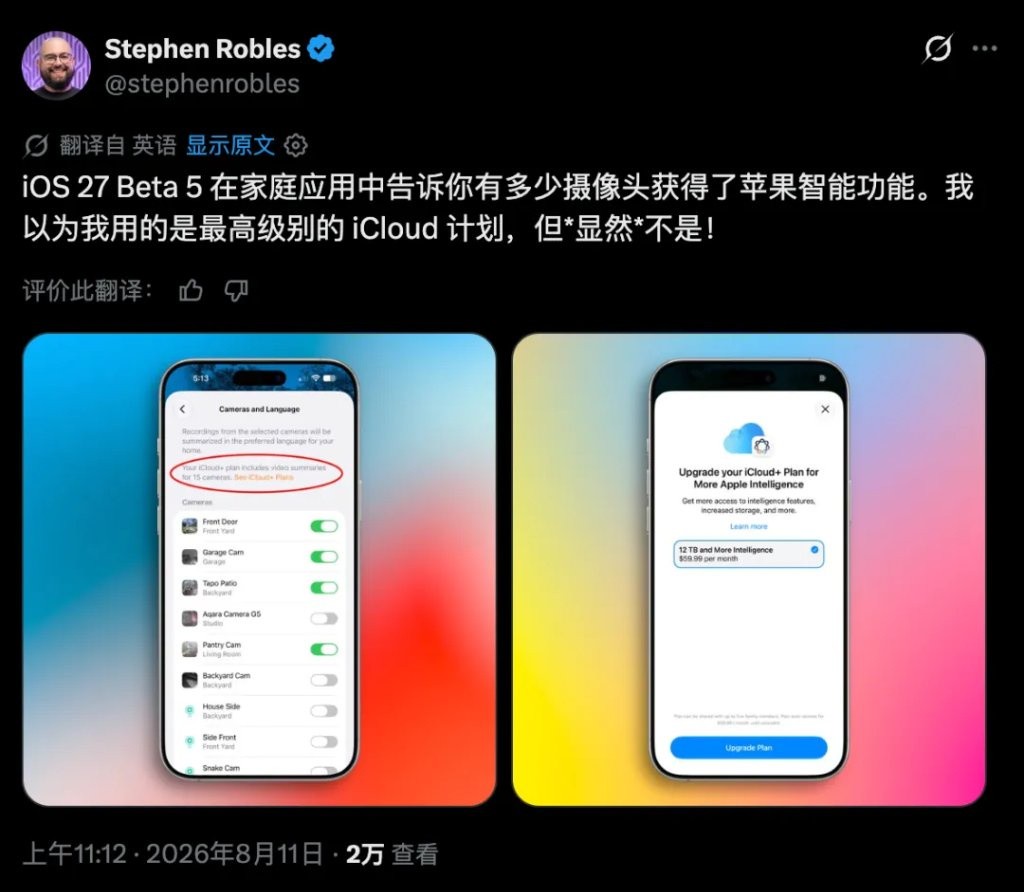
In the current beta version, the 2TB iCloud+ plan supports AI summaries for five cameras, while the 12TB tier increases this limit to 15. There is also an upgrade option at the bottom of the page stating, “Upgrade iCloud+ to get more Apple Intelligence usage.”
In fact, the 2TB iCloud+ plan has long supported connecting an unlimited number of HomeKit Secure Video cameras, and surveillance footage does not consume iCloud storage space. With the same 2TB plan, you can connect a large number of cameras, but only five can use AI summaries.
To put it plainly, Apple’s message is clear: you need to pay more.

When Apple introduced the new generation of Apple Intelligence at WWDC in June this year, it actually confirmed that certain features relying on server-side models, including image generation, would have daily usage limits, and upgrading the iCloud+ plan would grant higher usage quotas.
Beta 5 takes this a step further by differentiating AI usage quotas based on specific iCloud+ tiers. At least for home cameras, the number of cameras that can use AI summaries differs between 2TB and 12TB users. Whether other features, such as image generation, will adopt a similar tiered approach remains to be seen in future versions.
2TB Is Not Enough; AI Also Depends on Your Plan
Discussions about charging for Apple Intelligence actually began as early as its initial release in 2024. Bloomberg journalist Mark Gurman reported at the time that Apple might launch “Apple Intelligence+” in the future, keeping basic AI features free while offering advanced capabilities through a premium subscription.
Two years later, Apple does not seem inclined to create a separate “Apple Intelligence+” product. Instead, it is directly leveraging the existing iCloud+ service.
Opening the iCloud+ plan page now, the numbers 50GB, 200GB, 2TB, 6TB, and 12TB remain the most prominent. In the past, the reason for upgrading iCloud+ was simple: as photos accumulated and device backups grew larger, the original storage space became insufficient, prompting users to buy the next tier up.
Later, Apple gradually added features to iCloud+, such as Hide My Email, Private Relay, and HomeKit Secure Video. However, for most users, there remained a very intuitive correlation between price and storage space. But with AI, it is difficult to find a unit of measurement as easy to understand as “GB.”
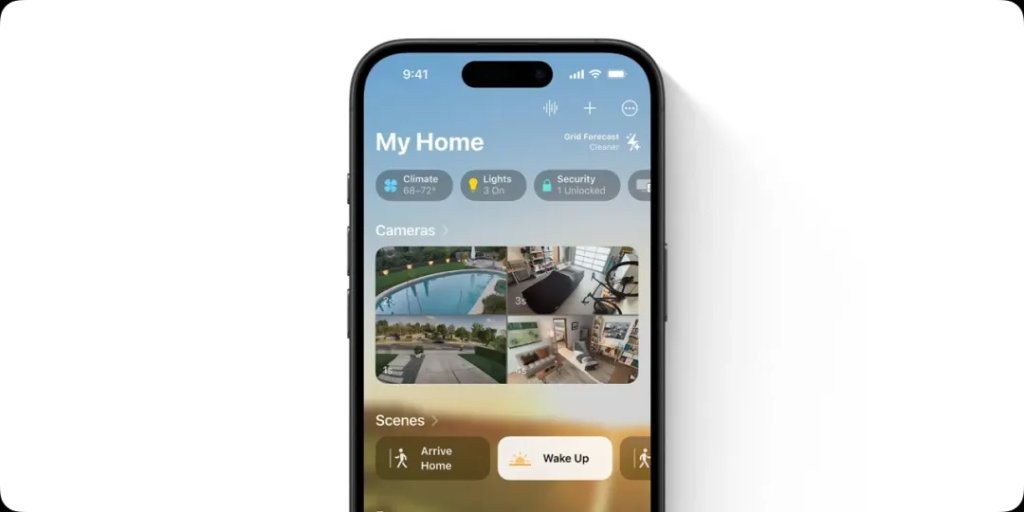
Generating an image, summarizing hours of surveillance footage, or having Siri complete a more complex task primarily consumes model resources and computing power. Ordinary users do not need to know how many tokens a request uses, nor can they decide whether to ask Siri a few more questions today based on a price list of “cost per million tokens,” as API developers might.
The cleverness of Apple’s choice to use iCloud+ lies precisely here. It is difficult to explain AI costs directly to ordinary users, but everyone is already familiar with the various iCloud+ tiers. Previously, the choice of tier depended mainly on storage needs; in the future, there may be another reason to upgrade: to use more AI.
Last month, Tim Cook publicly addressed this matter during an earnings call. He mentioned that some users might heavily utilize these AI capabilities in the future, and if they require more usage quota, they can “buy up the stack” via iCloud+.
Less than two weeks later, this idea has taken shape in iOS 27 Beta 5.
In this way, Apple does not need to re-educate users on how to pay for AI. In the past, if you had too many photos, your iPhone would remind you to upgrade iCloud; in the future, if you generate too many images or have too many home cameras requiring AI summaries, you will likely see the same upgrade page.
After Selling Hardware, Apple Wants to Keep Collecting Money
If iCloud+ indeed starts selling more AI usage quotas in the future, the impact may extend far beyond the iPhone.
Rumors suggest that Apple is preparing a batch of new hardware that relies more heavily on AI. In addition to Apple TV, HomePod mini, and a home hub with a screen, Bloomberg reported this year on smart glasses, AirPods with cameras, and an AI device that can be clipped to clothing or worn around the neck. Home security cameras are also part of Apple’s development plans.

Image|MacRumors
Cameras need to understand video footage, glasses and headphones need to know what is happening in front of the user, and home hubs need to pull up corresponding calendars, reminders, and photos based on who is standing in front of the screen. These tasks cannot be handled entirely by the devices themselves.
For the past few years, Apple has emphasized the on-device capabilities of Apple Intelligence, with many tasks executable directly on iPhones, iPads, and Macs. However, tasks that exceed the device’s computational capacity must be handed over to Private Cloud Compute.
Consider a more understandable example: when you buy a 256GB iPhone, its storage capacity is “fixed” at 256GB. It may be completely sufficient at first, but after a few years, as photos accumulate and files grow larger, local space runs out. The most convenient solution is to subscribe to iCloud+.
The same logic applies to AI: the device itself provides a certain amount of “fixed” computing power, and once this limit is exceeded, Apple’s servers take over.
Furthermore, the smart glasses, camera-equipped AirPods, and home hubs that Apple plans to release will have even more limited local computational resources.

Image|Conceptual rendering of Apple smart glasses|TT Technology
If they are to continuously understand surrounding sounds, visuals, and user commands, many more complex tasks will naturally rely on the iPhone, or even further invoke Apple’s cloud computing power.
The Era of Free AI Is Quietly Coming to an End
Apple is only now starting to consider how to charge for AI, which is actually quite late.
ChatGPT, Claude, and Gemini have long placed stronger models and higher usage quotas behind paywalls, and several of the largest AI products in China have started to follow suit this year.
Doubao began testing paid subscriptions in May and officially launched different service tiers in June. Complex tasks such as PPT creation, data analysis, and video production have become the main paid content. Basic chatting remains free, but if you truly use Doubao as a productivity tool and assign it heavy workloads daily, you will need to pay.
Qwen also began charging professional users this week. Office assistant features offer increased usage quotas based on different plans, while AI video generation requires purchasing quotas separately. You can still chat with it for free, but once you move from chatting to more computationally intensive scenarios like office work and video generation, the free quota will not last long.

In the past two years, the priority was to cultivate user habits. Chatting, searching, and image generation were all free, and stronger models were continuously added to free tiers. As AI begins to enter fields like office work, video, deep reasoning, and agents, the number of tokens required per task increases, making it difficult to sustain unlimited free usage for all users.
Therefore, the current charging models generally follow one principle: keep daily needs free as much as possible, and charge based on membership levels or usage for features that heavily consume computational resources.
Apple’s difference is likely that it will not place a prominent “Buy 1000 AI Credits” button inside the iPhone.
Interestingly, on the same day that the AI plans in iOS 27 Beta 5 were discovered, there was new progress in Apple’s long-running App Store lawsuit against Epic. A U.S. federal judge refused to suspend the trial regarding commissions on external links in the App Store. Apple will next need to provide specific rates, calculation methods, and evidence to explain how much this commission should be.

Image|9to5Mac
Why the commission rate in the app store era was 30%, and why commissions on external transactions were once 27%, have been subjects of intense debate among various parties for many years.
In the AI era, this calculation is much simpler: the more you use, the more computational resources you consume.
This makes iCloud+ a logical tool for charging. Users do not need to worry about details like tokens or model sizes; they only need to determine whether their current plan is sufficient.
Two years ago, when Apple Intelligence was released, we posed a question to our readers: “Would you be willing to pay to make your iPhone smarter?”
At that time, domestic users in China did not even have the opportunity to answer. After waiting two years, Apple Intelligence is finally arriving, and today we face that “soul-searching question” again—
Would you be willing to pay to make your iPhone smarter?
Risk Warning and Disclaimer
The market involves risks, and investment should be approached with caution. This article does not constitute personal investment advice, nor does it consider the specific investment objectives, financial status, or needs of individual users. Users should consider whether any opinions, views, or conclusions in this article align with their specific circumstances. Investment decisions made based on this content are the sole responsibility of the user.
