


From Tech Narrative to Capital Narrative: The Next Main Battlefield in the AI Build-Out Cycle
US hyperscale cloud providers have significantly raised their Capex plans, public and private credit markets are accelerating their involvement in AI infrastructure financing, and financing structures are rapidly evolving and extending deeper into the value chain—all of this has occurred within just a few months, with speed, scope, and innovation exceeding market expectations. Morgan Stanley believes that AI is evolving into a Capital Markets story, and understanding the flow of capital will be as important as understanding technological innovation itself
On August 17, Vishwanath Tirupattur, Chief Fixed Income Strategist at Morgan Stanley, pointed out in his latest report that the AI investment cycle is shifting from being technology-driven to capital-driven.
Hyperscale cloud providers have significantly increased their Capex plans. Public and private credit markets are taking on a larger share in financing AI infrastructure. Investors are beginning to make more nuanced distinctions among different borrowers and business models, while financing structures are iterating rapidly, reaching deeper into the value chain and increasingly focusing on individual components such as chips.
Tirupattur wrote:
The scale of AI investment has long indicated that traditional financing channels alone cannot sustain it. What is truly impressive is the speed, breadth, and creativity of the market's response.
AI is no longer just a technology story; it is evolving into a Capital Markets story. Understanding the flow of capital will be as important as understanding technological innovation itself.
Financing Gap Continues to Widen, Credit Issuance Pressure Remains High
Computing power supply continues to lag behind demand, driving hyperscale cloud providers to continuously increase Capex to secure future capacity.
The latest estimates from Morgan Stanley's Equity Research team show that the combined Capex of the four major hyperscale cloud providers—Microsoft, Alphabet, Amazon, and Meta—in 2027 will increase by 57% compared to 2026.
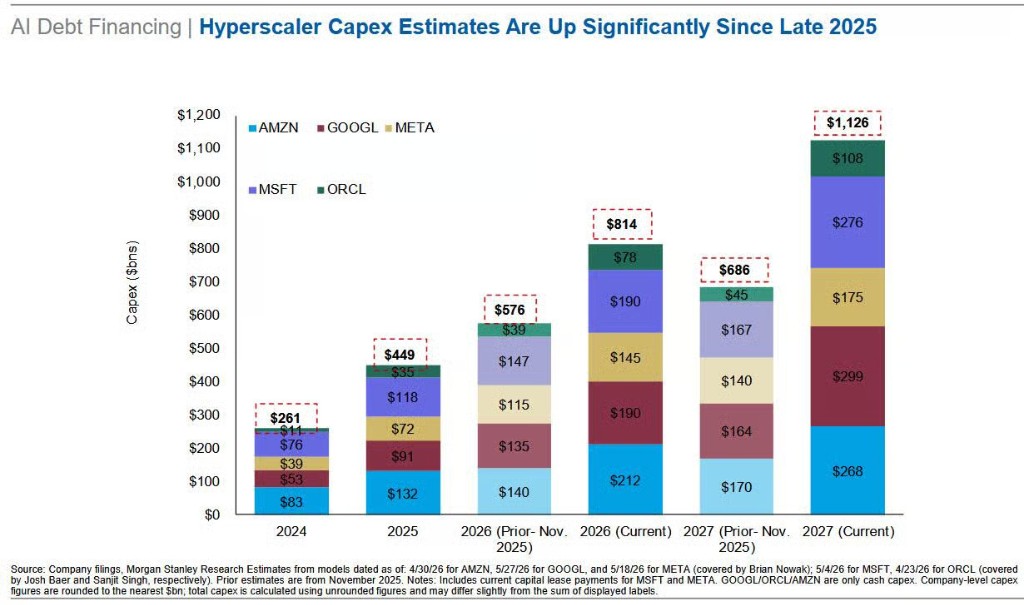
Behind these spending plans lies strong confidence in return on investment. Brian Nowak, Morgan Stanley Internet Analyst, pointed out in the report "The Path to 25%-50% Generative AI ROI" that related investments are expected to achieve a Return on Invested Capital (ROIC) of over 25%.
However, the issue is that there is a significant time lag between the deployment of Capex and monetization, leading to pressure on free cash flow in the near term. Morgan Stanley analysts have continued to lower their forecasts for the free cash flow of the four major hyperscale cloud providers in 2027. With rising Capex and declining cash flows, the financing gap is expected to widen further in 2027. Analysts believe that the volume of AI-related credit bond issuance will remain high and may even need to increase further.
Credit Spread Divergence: Who Is Under Pressure, Who Is Resilient
The performance of the credit market this summer has revealed structural differences within the AI financing ecosystem.
AI-related credit spreads have widened significantly: spreads for high-rated issuers once widened by about 35 basis points compared to the beginning of the year, while lower-rated names widened by about 50 basis points, before seeing a notable recovery in the past two weeks.
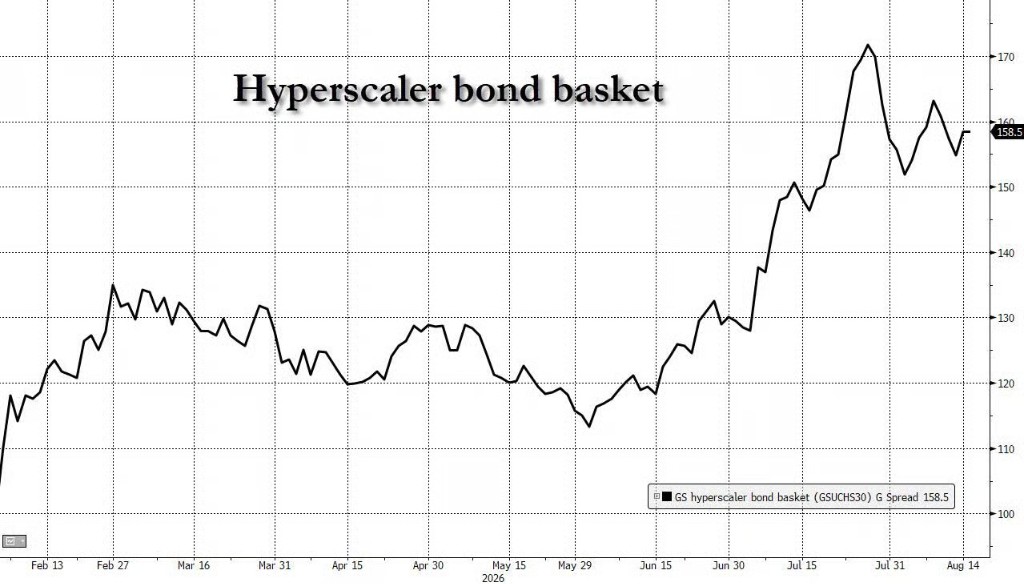
More noteworthy is the divergence between different financing channels.
High-grade unsecured bonds were hit the hardest. The reason lies in the surge in issuance volume and the broader risk exposure faced by investors, which is directly linked to the overall uncertainty of the AI investment cycle.
Data center ABS and CMBS, on the other hand, have been relatively resilient. These structured products are backed by operational assets that are built, powered, and leased, with largely certain contractual cash flows. Coupled with a more restrained issuance pace, they have effectively isolated themselves from the volatility of the unsecured market.
Tirupattur further distinguished the behavioral differences between two types of issuers:
-
High-grade segment: Hyperscale cloud providers such as Microsoft, Alphabet, Amazon, and Meta have an average rating of around AA. They have large financing needs but sufficient rating flexibility. Leading semiconductor companies like Nvidia and Broadcom also fall into this category. Given their ROIC expectations, these issuers are not sensitive to small changes in financing costs, and widening spreads will not substantially slow down their financing pace.
-
Low-grade segment: Borrowers such as Oracle (rated mid-to-low BBB by various agencies), as well as data center developers including former Bitcoin miners and REITs, have limited balance sheet flexibility and are more sensitive to financing costs. For these borrowers, widening spreads constitute a substantive constraint, with financing costs themselves acting as a natural stabilizer of supply.
Financing Frontier Moves Upstream: From Data Centers to Chips
Analyst Tirupattur pointed out that the next phase of AI financing will exhibit a clear structural shift.
The focus of incremental Capex is shifting from data center shells to computing equipment (servers and chips) and energy assets. These assets are naturally suited for asset-level financing arrangements, providing greater room for private capital involvement.
Recent market signals are clear:
-
Nvidia announced the launch of a computing infrastructure financing platform;
-
A $35 billion chip financing deal backed by Broadcom was completed, setting a record scale;
-
The Beignet transaction at the end of 2025, and the recent Sopaipilla transaction, both represent new directions in financing structure innovation.
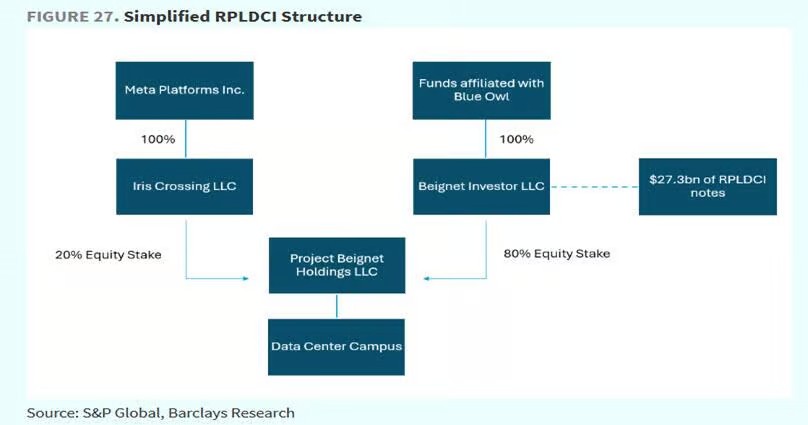
Tirupattur believes that the rise of large-scale component financing will largely depend on high-rated issuers leveraging their rating and balance sheet advantages—by providing backstop arrangements, credit support, and residual value guarantees—to help private capital underwrite increasingly large pools of AI infrastructure assets.
Capital Flows Will Be as Important as Technological Innovation
As AI evolves from a technology cycle to a capital cycle, understanding the details of financing is becoming increasingly important.
The AI financing ecosystem is expanding rapidly, but not uniformly. Different credit channels absorb varying levels of risk, and issuer behavior will accelerate its divergence based on capital needs, rating flexibility, and sensitivity to financing costs. The ultimate result is a more complex and stratified market, where financing outcomes will increasingly determine competitive outcomes.
As Tirupattur stated: "In the next phase of the AI build-out cycle, understanding the flow of capital is almost as important as understanding the flow of innovation. AI is no longer just a technology story; it is increasingly becoming a Capital Markets story."
