


UOB Reports Earnings — Can OCBC Outperform?
In our last piece on UOB《UOB Earnings Imminent! What’s next for the stock price? These Are the Core Drivers.》, we made the point that bank stocks aren't about headline net profit — what really moves the share price is NIM and fee income. UOB just proved us right: net profit fell 4% year-on-year, yet the stock still ticked up about 1%.
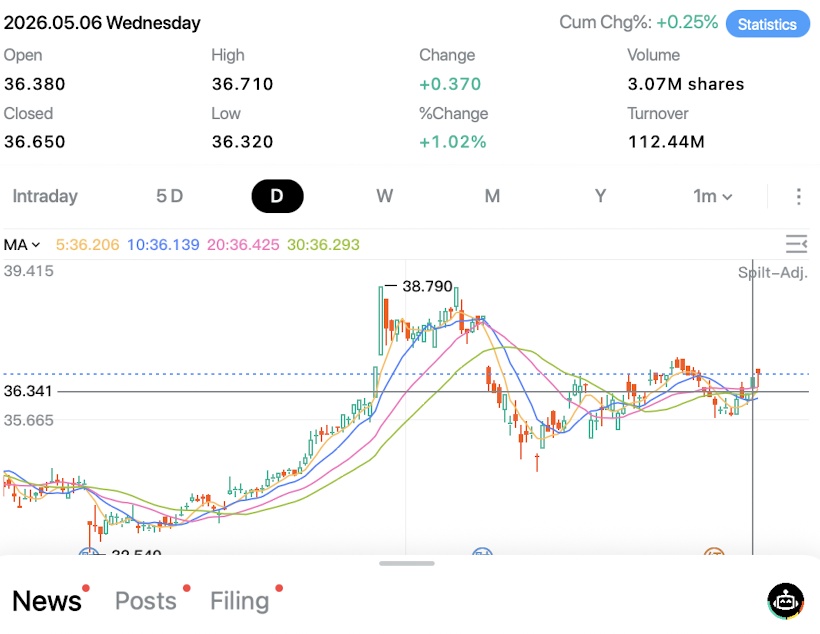
Why? Because earnings beat consensus, and while NIM is compressing, it's still tracking within management's guidance range. Once again — with banks, the direction of travel matters more than the absolute number.
Point proven. Now let's turn to $OCBC Bank(O39.SG), which reports Q1 2026 results tomorrow (May 8). Can it one-up UOB?
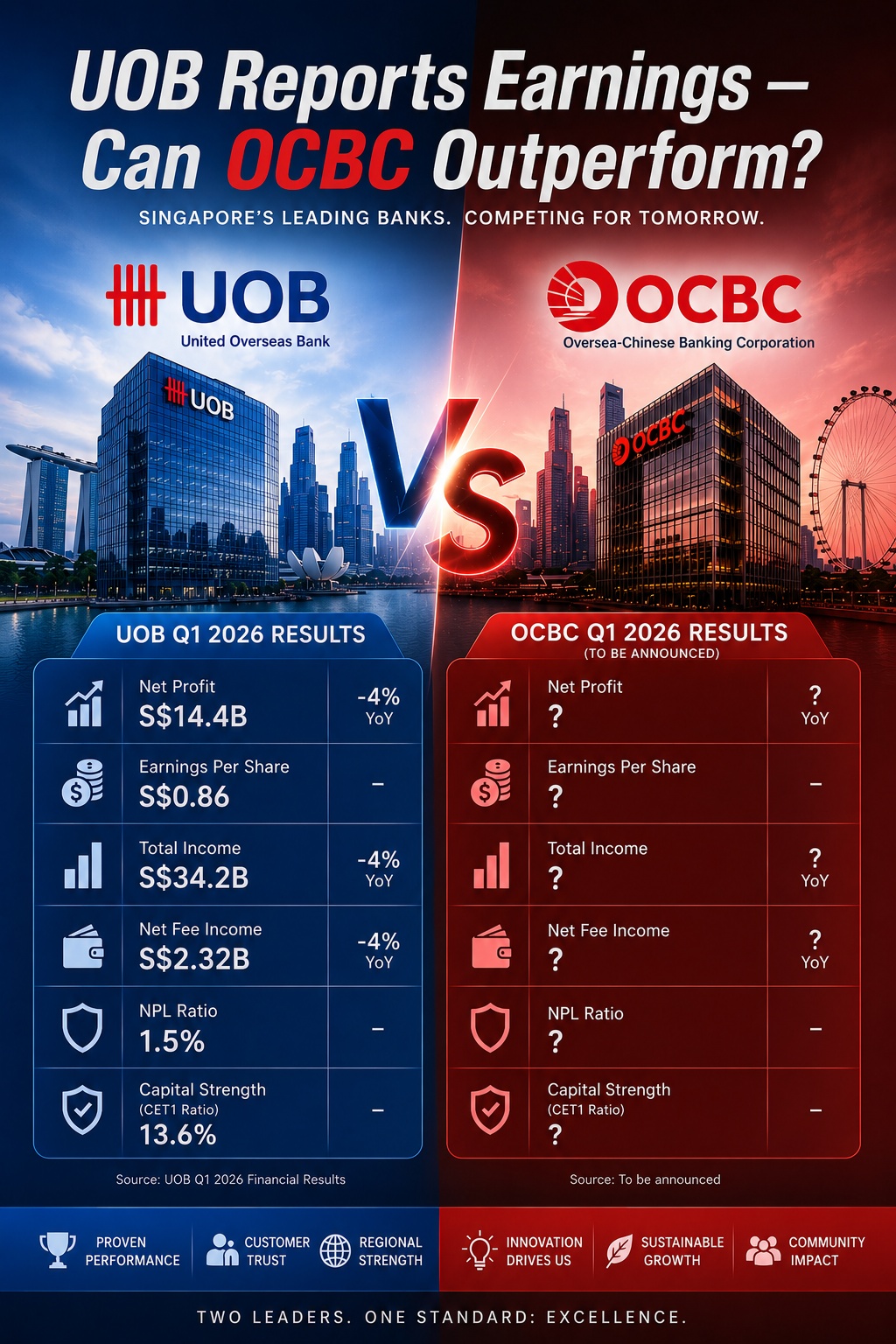
Here's what to watch.
What's OCBC likely to deliver?
Some context first. OCBC posted S$7.42 billion in net profit for FY2025, down just 2% year-on-year — but pre-tax profit actually hit a record S$9.12 billion. The dip in net profit was largely down to the global minimum tax kicking in; operationally, the bank was still growing. Full-year revenue came in at a record S$14.6 billion, with non-interest income surging 16% to more than offset the decline in interest income.
So what should we expect for Q1 2026? Using UOB's numbers as a benchmark and OCBC's own trajectory, here are the key metrics to focus on:
NIM: Likely to hover between 1.80%–1.86%
OCBC's NIM ticked up from 1.84% in Q3 to 1.86% in Q4 2025, showing early signs of stabilisation. But UOB just reported 1.82% for Q1 — down 2 basis points quarter-on-quarter. With the global rate environment still on the soft side, OCBC is likely facing similar headwinds. Holding around 1.83%–1.85% would be a decent result; a drop below 1.80% would be a mild negative.
Wealth management: Where OCBC pulls ahead
This is OCBC's trump card. Wealth management fees jumped 33% in FY2025, the fastest growth among Singapore's Big Three. Bank of Singapore's AUM topped US$145 billion. Meanwhile, UOB's CEO said today the bank is targeting to double its wealth income — by 2030. That's essentially acknowledging the gap.
Q1's heightened market volatility is a double-edged sword for wealth: trading activity picks up (good for transaction income), but clients may turn cautious (weighing on AUM growth). UOB saw fee income drop 8% year-on-year — but with its stronger wealth platform, OCBC is likely to fare better.
Asset quality: 0.9% vs 1.5% — OCBC has a stronger hand
OCBC's NPL ratio has held steady at 0.9% for several quarters, well below UOB's 1.5%. That said, total non-performing assets rose 13% at end-FY25, so it's worth watching whether there's further deterioration amid ongoing trade tensions. If NPL holds at 0.9%, that's a reassuring signal.
Capital returns: It's the "what's next" that matters
OCBC's S$2.5 billion capital return plan is on track for completion in FY26. Total FY25 dividends came to S$0.99 per share. What investors really care about now isn't this plan itself — it's whether management signals a follow-up. Any positive hints at the Q1 briefing could be a catalyst for the stock.
Where does the share price go from here?
Let's start with the chart. OCBC hit a record high of S$22.52 on April 15 before pulling back, and is currently consolidating around the S$22 level — roughly 2% off the peak. Technically, the stock is sitting just above its 50-day moving average, and MACD momentum is flattening near the zero line — classic "waiting for a catalyst" setup. RSI is hovering in the mid-range, neither overbought nor oversold.
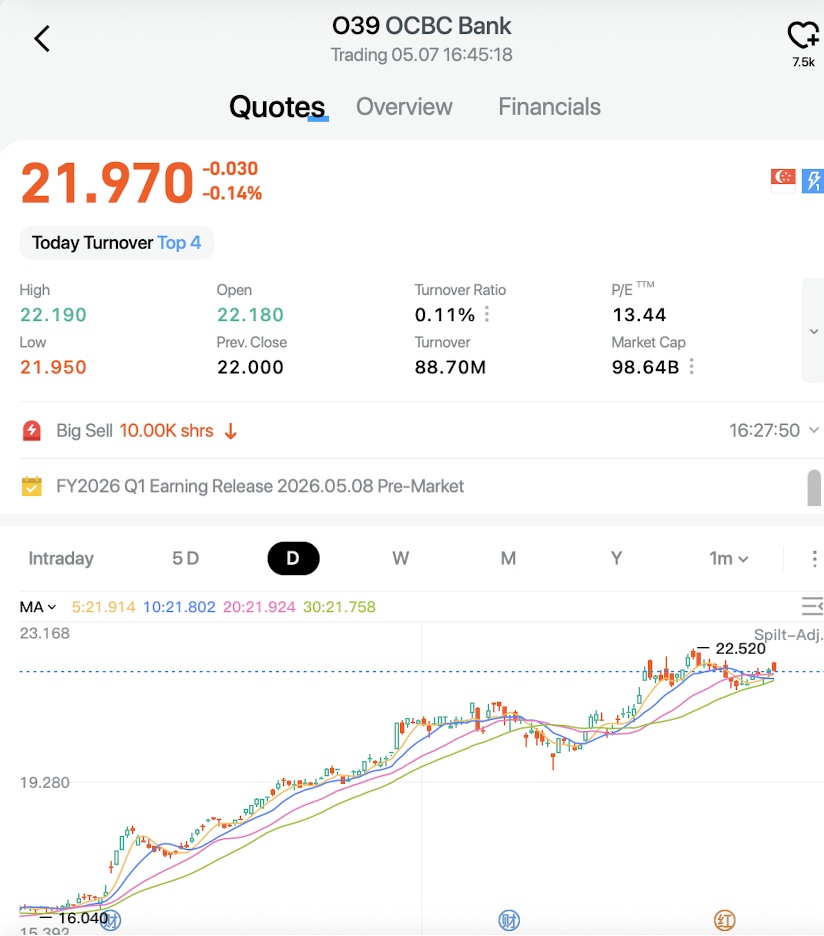
Now consider UOB's lead: profit down but beat expectations, stock up ~1%. That tells us the market has already recalibrated expectations for Singapore banks — no one's expecting blowout growth. As long as results don't disappoint, prices can hold or grind higher.
Putting it all together:
Base case (most likely): OCBC delivers a solid-but-not-spectacular quarter — NIM under mild pressure, wealth management still growing strongly, overall in line or slightly above consensus. Referencing UOB's reaction, expect the stock to trade sideways between S$21.50–S$22.50.
Bull case: NIM holds above 1.85%, wealth income surprises to the upside, and management drops hints about the next capital return plan. The stock could push through S$22.50 and test S$23.
Bear case: NIM slides below 1.80%, or there's an unexpected uptick in NPLs. That could see a pullback toward the S$21.00–S$21.50 support zone.
UOB turned in a "decent, slightly-better-than-expected" scorecard today. Tomorrow it's OCBC's turn. On fundamentals, OCBC holds slightly better cards — wealth management, asset quality, capital returns — but the market is pricing in higher expectations to match. It all comes down to whether management can deliver reassuring NIM guidance and a compelling capital return narrative.
Want to read earnings reports like this on your own?
If you found this breakdown useful, imagine being able to do it yourself — for any stock, any sector, any market. In our Financial Analysis and Technical Analysis courses, we teach you exactly how to cut through the noise: how to spot what really drives a stock price, how to read the numbers that matter, and how to combine fundamentals with chart setups to time your entries and exits.
The copyright of this article belongs to the original author/organization.
The views expressed herein are solely those of the author and do not reflect the stance of the platform. The content is intended for investment reference purposes only and shall not be considered as investment advice. Please contact us if you have any questions or suggestions regarding the content services provided by the platform.
