


 Buffett Apprentice
Freshly released TSMC earnings call, what are the key points to watch?

On October 17, 2024, TSMC released its Q3 earnings and held an earnings call.
Despite previous market skepticism about the semiconductor industry, TSMC maintained strong performance in Q3. So, what were the key highlights of TSMC's earnings call? Let’s dive into the details.
【TSMC Performance Overview】
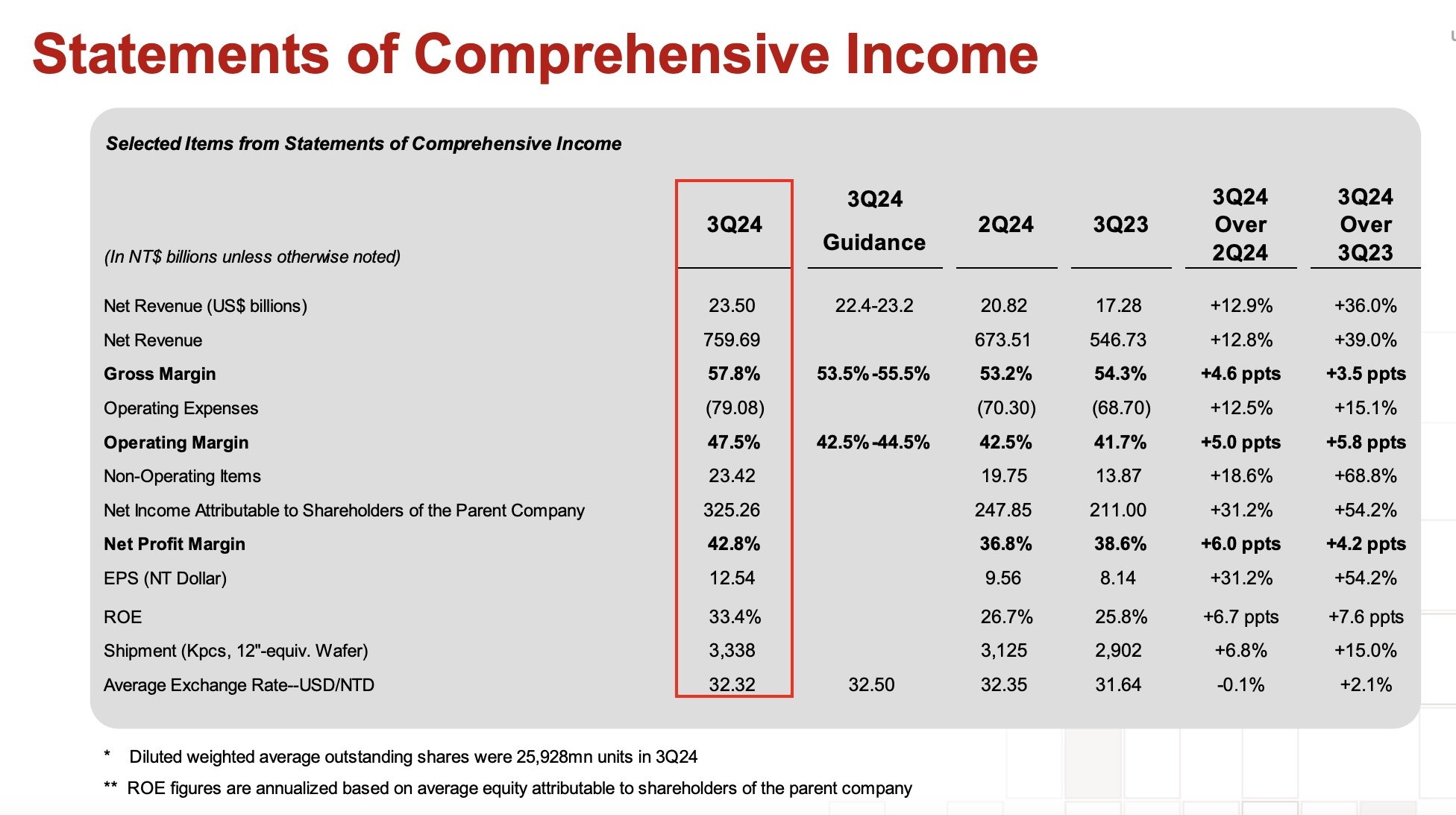
In Q3 2024, TSMC achieved a 12.8% quarter-over-quarter revenue growth, driven by strong demand for 3nm and 5nm technologies in smartphones and AI. Gross margin rose by 4.6% QoQ to 57.8%, primarily due to higher utilization rates and cost optimization. Operating expenses stood at 10.4%, with operating margin increasing by 5% QoQ to 47.5%. Q3 EPS was NT$12.54, and ROE reached 33.4%.
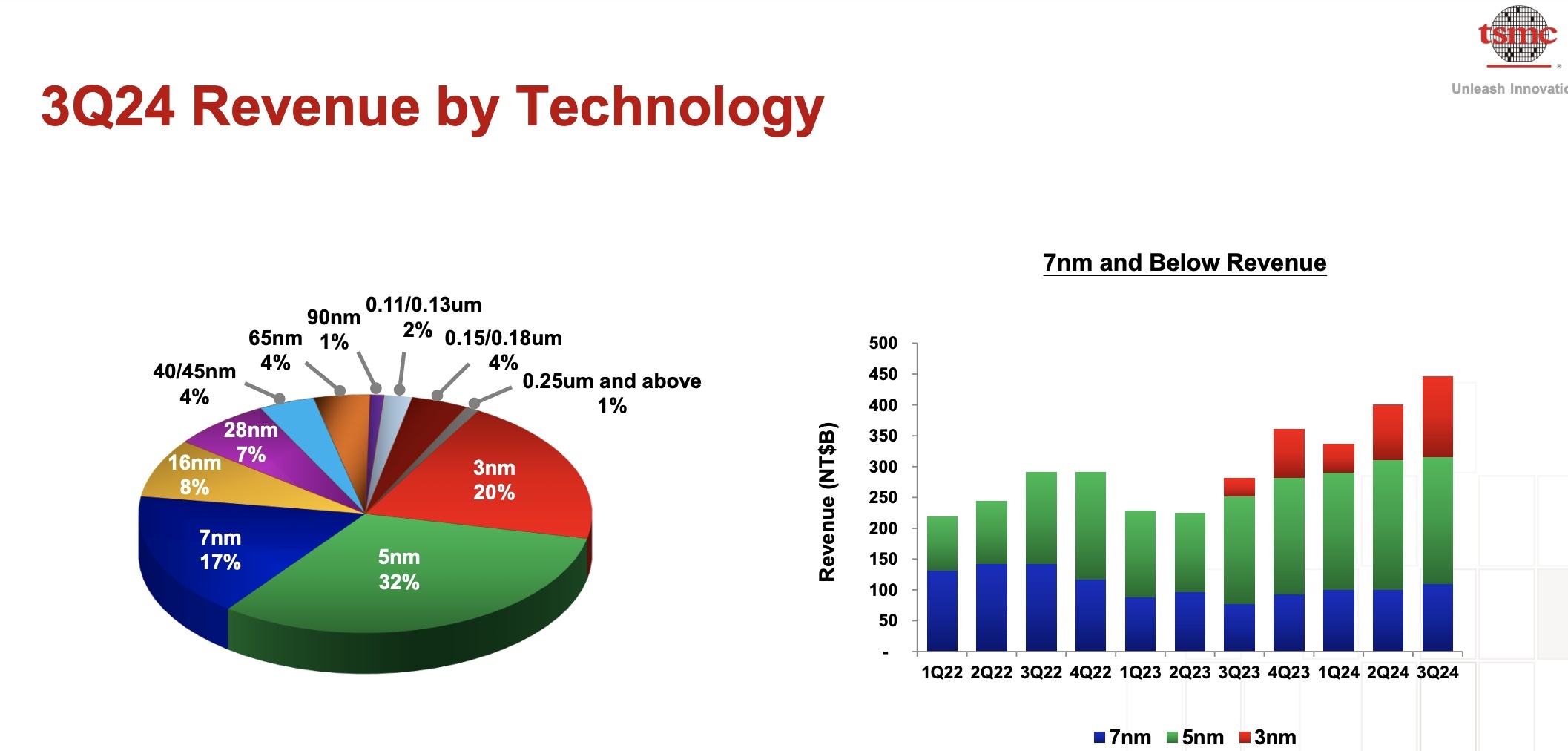
3nm revenue accounted for 20% of wafer revenue, while 5nm and 7nm contributed 32% and 17%, respectively.
7nm and more advanced technologies made up 69% of total revenue.
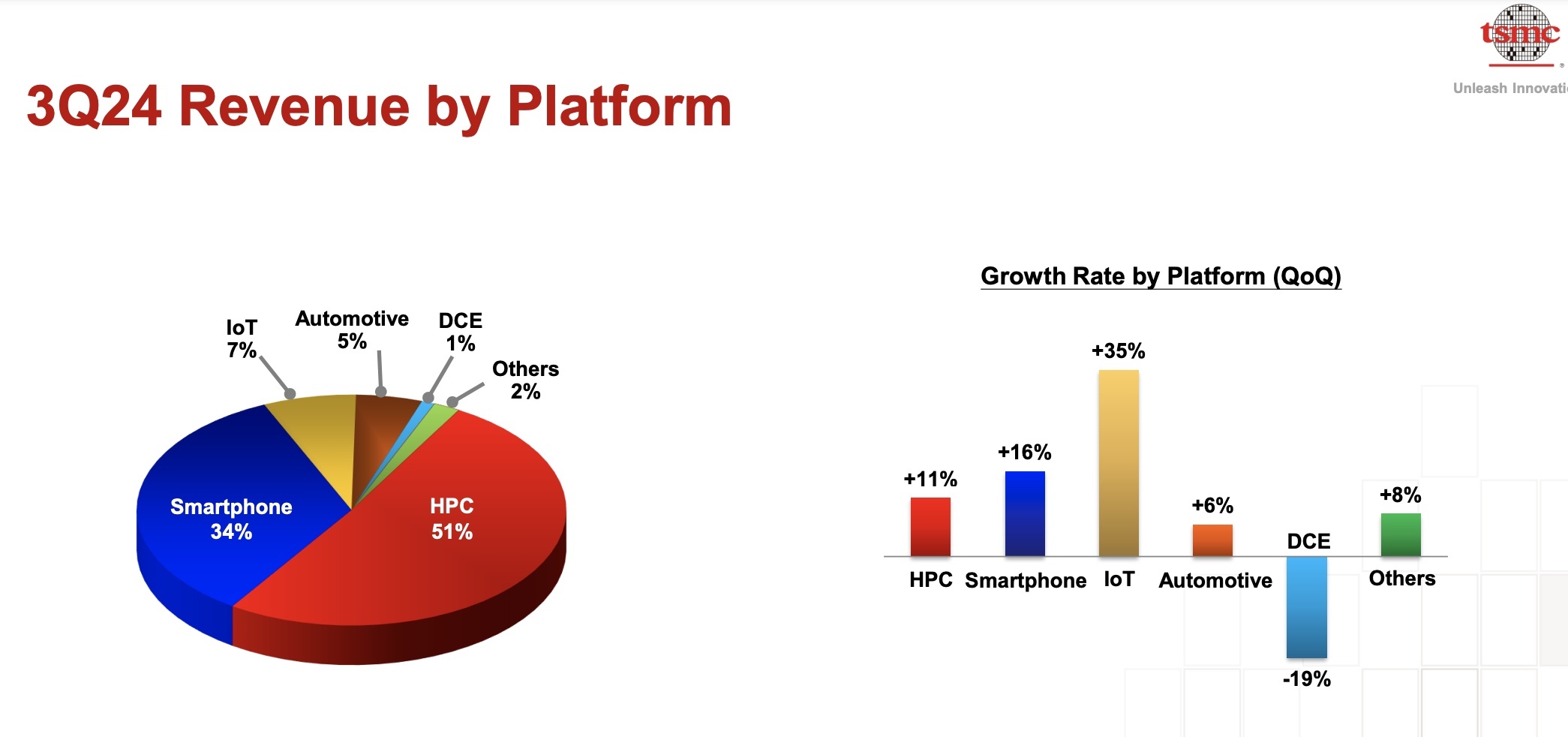
High-performance computing (HPC) grew 11% QoQ, reaching 51% of revenue; smartphones grew 16% QoQ to 34%; IoT surged 35% to 7%; automotive rose 6% to 5%; while DCE declined 19% to 1%.
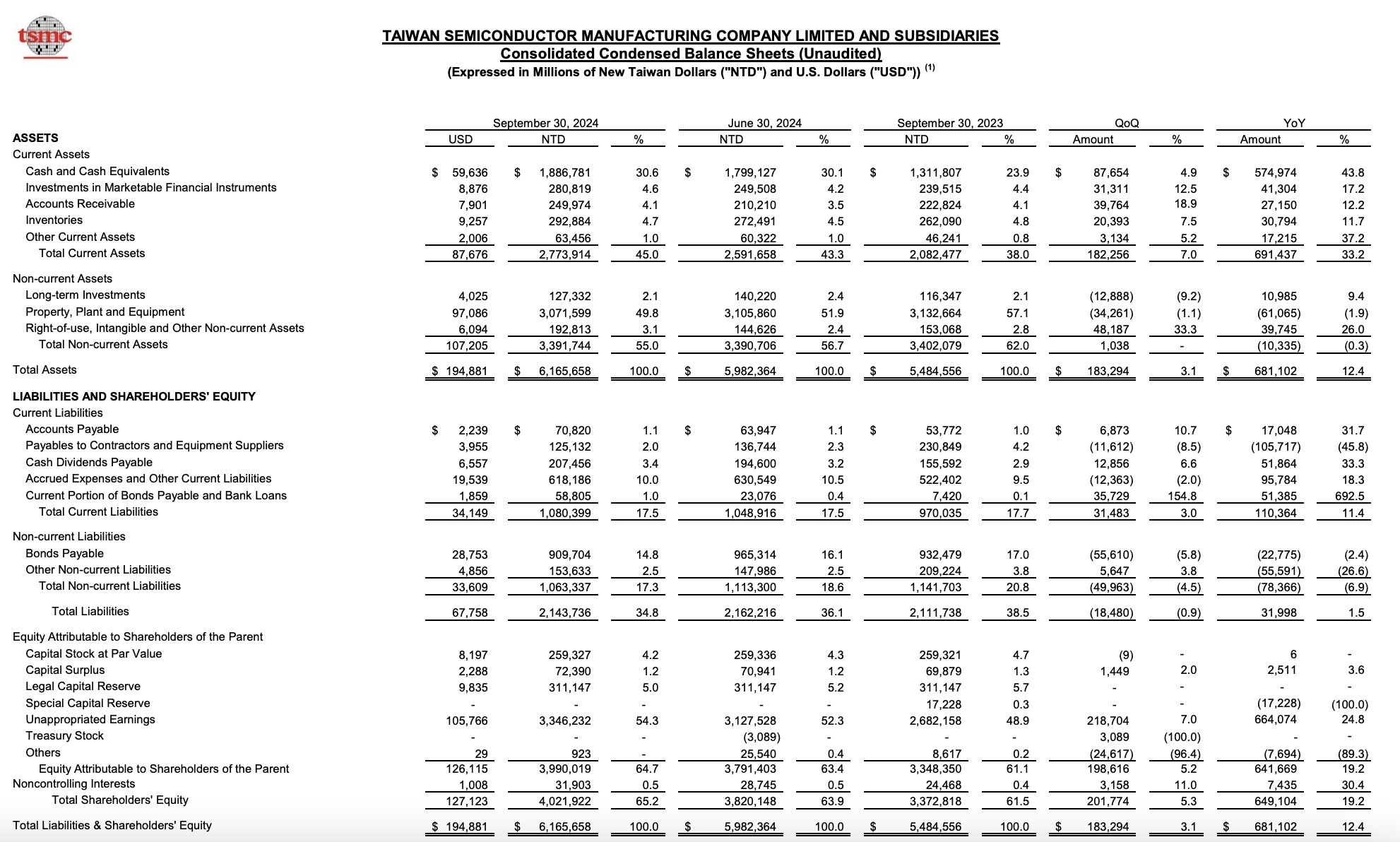
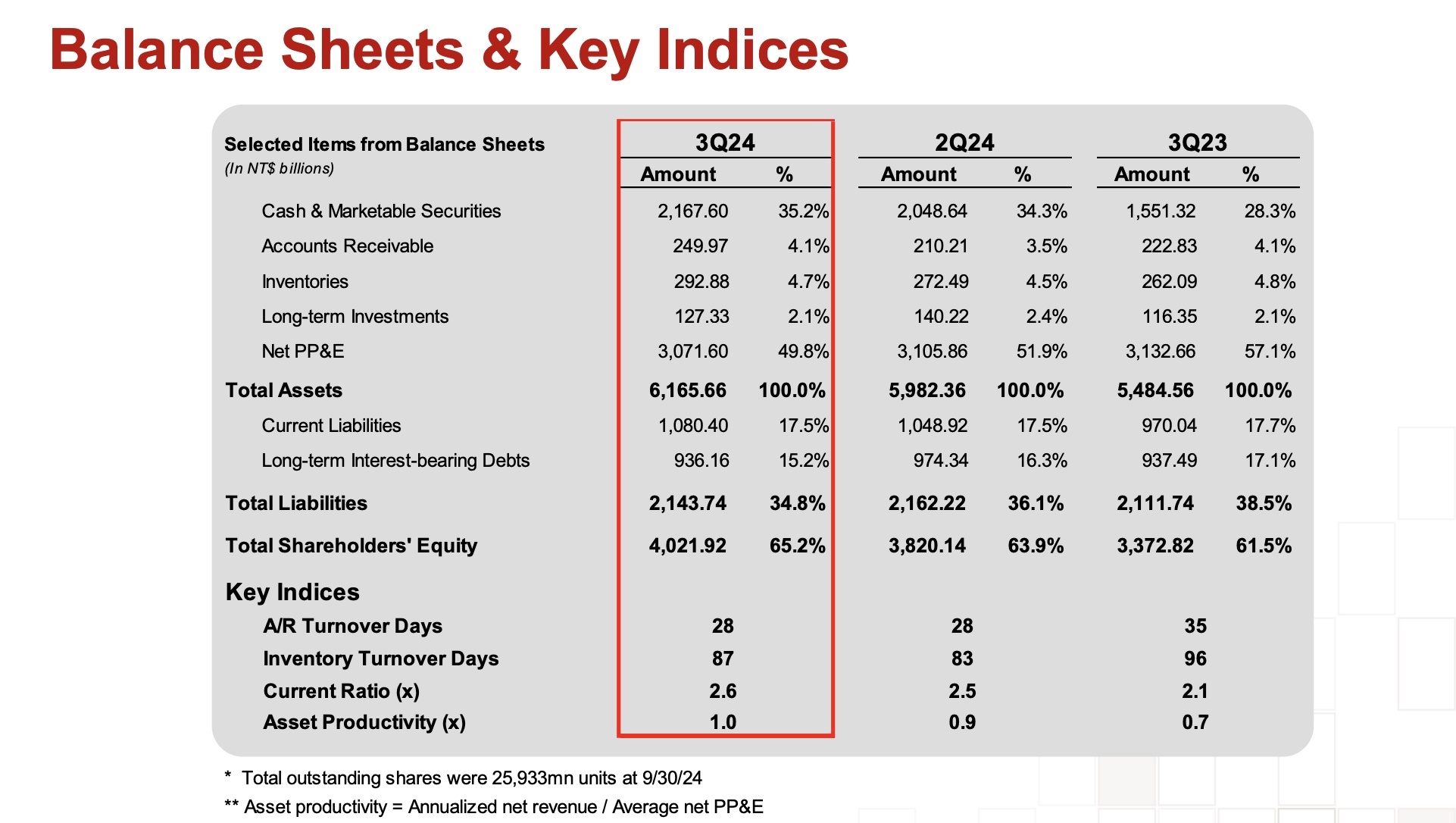
In terms of capital structure, cash and equivalents totaled NT$2.2 trillion (US$69 billion) by the end of Q3.
Short-term debt increased by NT$31 billion, while long-term debt decreased by NT$38 billion, mainly due to reclassification of debt payable. Accounts receivable turnover remained stable at 28 days, while inventory turnover days rose to 87 days, driven by 5nm and 3nm wafers. CFO was NT$392 billion, with capital expenditures of NT$207 billion and dividends of NT$91 billion. Cash increased to NT$1.9 trillion. Q3 dollar-based capex was US$6.4 billion.
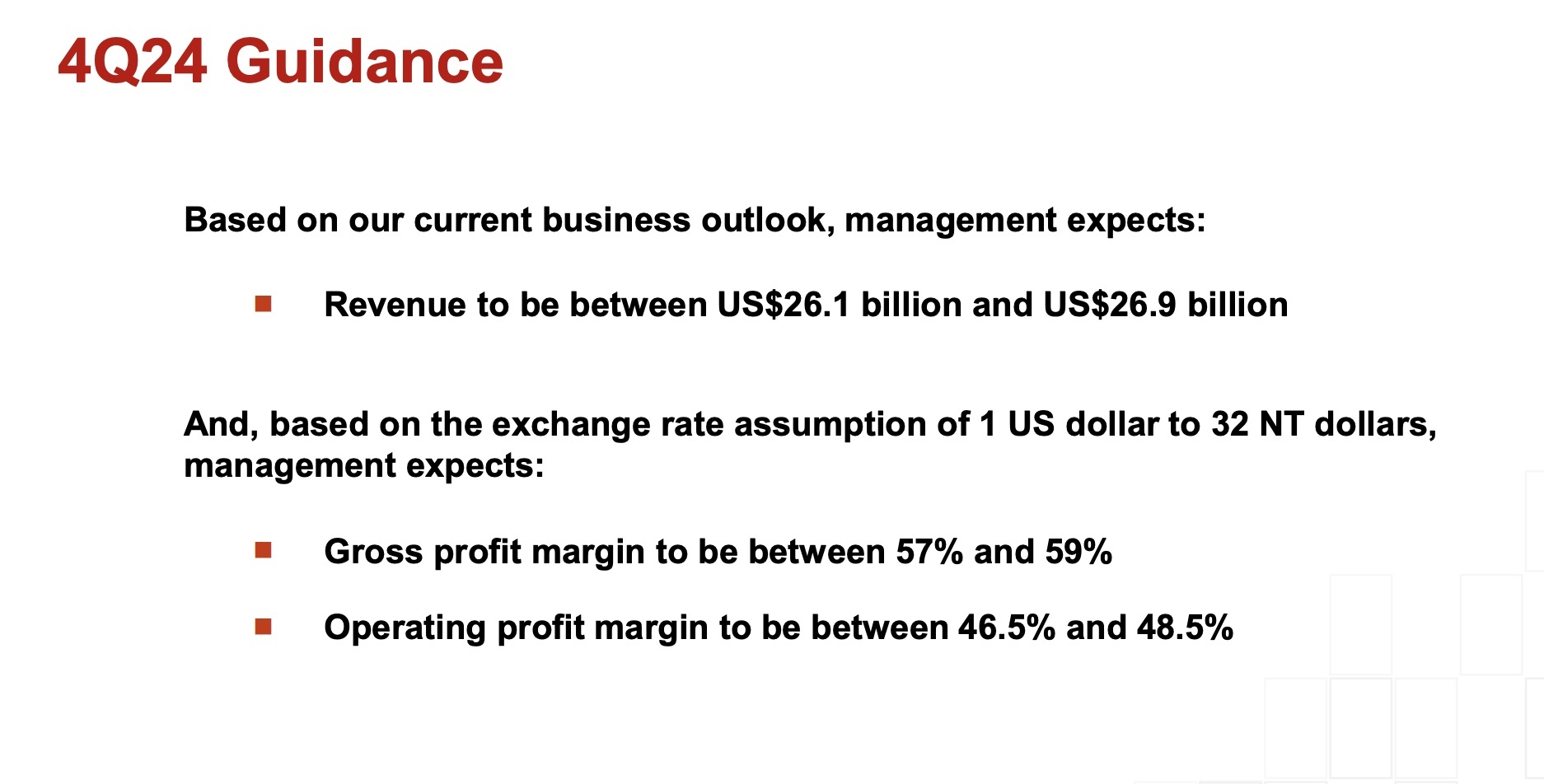
For Q4, TSMC expects revenue of US$26.1–26.9 billion, up 13% QoQ and 35% YoY. At an exchange rate of US$1=NT$32, gross margin is projected at 57–59%, with operating margin at 46.5–58.5%.
For Q3 and Q4 2024, Q3 gross margin expanded by 460 bps, exceeding guidance by 230 bps due to higher utilization and cost optimization. Q4 GM is expected to rise by 20 bps to a midpoint of 58%, supported by utilization improvements, partially offset by 3nm ramp-up.
For 2024 capex, TSMC continues to invest based on long-term demand, with strong AI momentum. Capex is now expected to slightly exceed US$30 billion, with 70–80% allocated to advanced nodes, 10–20% to specialty technologies, and 10% to advanced packaging and mask production.
Higher capex aligns with growth opportunities for the following year. TSMC remains optimistic and committed to investment.
Q3 performance was driven by robust smartphone and AI demand for 3nm and 5nm. For Q4, TSMC expects continued strength in advanced nodes and AI, boosting 3nm/5nm utilization. AI-related revenue (training/inference CPUs, GPUs, accelerators) is projected to triple, contributing mid-teens growth. Full-year revenue is expected to grow nearly 30% in USD terms.
In Arizona, TSMC is building three fabs (twice the size of typical fabs) with federal/local support. The first fab (4nm) is on track for early 2025 production, matching Taiwan’s quality. Fabs 2 and 3 will focus on advanced nodes, targeting 2028/2030 production.
In Japan, the specialty fab is validated and begins production this quarter. A second fab (for consumer/auto/industrial/HPC) starts construction in late 2025. In Europe, the Germany-based fab (auto/industrial) targets 2027 production.
TSMC continues to enhance competitiveness, leadership, and manufacturing efficiency to support customer innovation.
【Q】How do you view AI sustainability and capex planning? What’s the AI cycle outlook?
AI demand is real. We collaborate with hyperscalers and AI innovators, leveraging our deep expertise. TSMC also uses AI/ML internally to boost efficiency (1% improvement = US$100M savings). We believe AI adoption will expand across industries.
【Q】Is the semiconductor cycle peaking?
AI demand is just beginning. One major client called it "insane"—transitioning from sci-fi to reality. Non-AI semis are stabilizing.
【Q】Capex outlook for coming years?
No specific 2025 capex yet. We follow a disciplined process—higher capex reflects growth opportunities. 2025 looks healthy; updates in January.
【Q】GM guidance: overseas fabs dilute 2–3 pts. 2025 outlook?
Too early for 2025 details. 3nm dilution will ease; overseas fabs and N5→N3 transitions will impact. Taiwan’s 14% Oct power hike (doubled in recent years) affects GM by ~1 pt. Forex volatility (1% = 40 bps GM).
【Q】Overseas fab profitability (US/Japan)?
Smaller scale/higher costs initially, but improving. Arizona/Kumamoto will see 2–3 pt GM dilution annually for 3–5 years.
【Q】Pricing power given 57–58% GM (higher than some clients)? Mature node pricing? Antitrust risks?
We sell value, not leverage. Some AI clients have higher GMs. Capital-intensive models require healthy GMs. Foundry 2.0 (wafer+packaging+testing) addresses antitrust—we’re not dominant (~30% share).
【Q】Intel’s fab spin-off: more orders? Acquire fabs? Samsung’s IDM outsourcing?
No fab acquisitions. Intel remains a key client; updates in future quarters.
【Q】Long-term growth (15–20% CAGR to 2026)? AI impact? Post-2026?
2025 looks healthy; no long-term CAGR update yet.
【Q】Will AI accelerate growth?
We hope so, but no long-term CAGR to share.
【Q】2nm/A16 demand vs. chiplet impact?
2nm demand exceeds expectations (vs. 3nm). A16 attracts AI server chips. Preparing capacity diligently.
【Q】Long-term AI capacity planning? Hyperscaler capex derisking?
Collaborating with AI players on rolling demand. Disciplined capacity planning balances client needs and shareholder returns.
【Q】Taiwan energy challenges for 2nm (Hsinchu/Kaohsiung)? Nuclear power?
Working with authorities on power/water/land. No details on nuclear/green energy yet.
【Q】Non-AI demand (PC/phones in 2025)?
Low-double-digit growth with larger AI chips.
【Q】Advanced packaging revenue/margin?
High-single-digit % revenue in 5 years; margins approaching company average.
【Q】FCF/shareholder returns?
Sustainable, growing dividends. FCF supports organic growth and shareholder returns.
【Q】Foundry 2.0 growth drivers?
Advanced nodes/packaging outperform mature nodes.
【Q】Semiconductor growth outlook?
Similar to prior estimates; 2025 too early to call.
【Q】CoWoS capacity plans?
Doubling capacity in 2024/2025 still insufficient for demand.
【Commentary】
TSMC’s Q3 results and full-year outlook underscore its leadership in compute. The company maintains a clear edge over rivals.
1. **Technology Mix**: 3nm/5nm (>50% revenue) drives high GMs, serving CPUs/GPUs/smartphones. NVIDIA-led AI GPUs remain a key growth driver.
2. **End Markets**: PC/phone markets mature; HPC (e.g., GPUs) sustains strong growth.
3. **Financials**: High GMs and pricing power support robust cash flow.
4. **Expansion**: Overseas fabs (Arizona/Japan/Europe) sustain high capex, benefiting ASML/LAM/AMAT/TEL.
5. **AI Dominance**: TSMC is the enabler for 3nm/5nm and CoWoS in AI, reinforcing its moat.
6. **Advanced Packaging**: Post-Innolux acquisition, glass-substrate packaging capacity scales rapidly.
In summary, TSMC’s call signals optimism for semiconductors and downstream sectors, supporting its trillion-dollar valuation.$Taiwan Semiconductor(TSM.US)
The copyright of this article belongs to the original author/organization.
The views expressed herein are solely those of the author and do not reflect the stance of the platform. The content is intended for investment reference purposes only and shall not be considered as investment advice. Please contact us if you have any questions or suggestions regarding the content services provided by the platform.
