



The State Council Information Office's real estate conference has concluded. What expectation gap does the performance of real estate stocks reflect?

On October 17, the State Council Information Office held a press conference to report and interpret the results of the real estate policies implemented since the "9.24 policy package" and introduced future real estate policies to be implemented. In conclusion, the October 17 real estate meeting did not provide enough positive news to support an upward trend in the stock market. In fact, real estate stocks in both the Hong Kong and A-share markets experienced significant pullbacks that day.
From a causal perspective, on one hand, it has been too short a time since the policies were implemented, and there is insufficient market data to confirm their effectiveness. On the other hand, the policy's stance on real estate remains "stabilizing the bottom line," hoping that the market will drive the real estate cycle upward through self-regulation rather than forced reversal under stimulus policies. For real estate-related stock assets, this conclusion is clearly not what the market wanted to see.
Despite the poor market feedback, in terms of policy continuity, real estate policy support has indeed been passed on. Market information since the National Day holiday suggests that housing transactions in both high-tier and low-tier cities seem to have improved. Although the real estate policies may have fallen short of expectations, their subsequent impact remains promising.
01
Policy Package Combines Old and New, with "Two Increases" Offering Notable Incremental Information
According to the press conference summary, the "9.24 policy package" was summarized as "four cancellations, four reductions, and two increases." Most of these policies had already been repeatedly mentioned in previous market interpretations, including the cancellation of purchase/sale/price restrictions, reductions in housing provident fund loan interest rates, down payment ratios, and existing loan interest rates, as well as support for a series of real estate financing tools.
In contrast, the "two increases" are considered by the author to be the new and highly important policies introduced in this press conference. These are "adding 1 million units of urban village/dilapidated housing renovations through monetized resettlement" and "increasing the white-list credit scale to 4 trillion yuan by the end of 2024." Both policies provide specific numerical targets and are planned to work in conjunction with the aforementioned real estate financing tools to support the real estate market.
Among these, the Ministry of Housing and Urban-Rural Development analyzed the demand for monetized resettlement housing. By 2024, there are 1.7 million urban village units in 35 cities requiring renovation, along with 500,000 dilapidated housing units. According to the ministry, monetized resettlement can release housing demand, allowing residents to choose suitable resettlement methods independently, reducing transition time for home purchases, and helping to absorb existing commercial housing inventory.
Regarding the white list, the press conference disclosed that as of October 16, 2.23 trillion yuan worth of commercial housing projects had entered the loan white list. In the next two months, the related credit scale will be increased to 4 trillion yuan, nearly doubling in size. The financing coordination mechanism aims to include all qualified real estate projects in the "white list," ensuring full coverage and meeting reasonable financing needs to secure the delivery of housing projects and promote stable and healthy development of the real estate market.
In response to reporters' questions, the conference mentioned progress on affordable housing and public rental housing. From January to September 2024, China built 1.48 million units of affordable housing, with an estimated 4.5 million young residents expected to move in by year-end. In addressing housing issues, the government adopts a "dual approach": ensuring basic housing needs through government-led efforts while promoting market-driven housing to meet diverse residential demands.
Meanwhile, the market-focused topics of commercial housing acquisitions and land inventory purchases were also reiterated at the press conference. The conference proposed researching the establishment of special loans for acquiring land inventory as a supplement to special bonds, with the People's Bank of China providing special relending support. Specific acquisition progress and details may require further policy support.
01
Policy Tone Remains Focused on "Stability," Market Revival Awaits Improved Purchasing Power
Compared to the intensity and innovative effects of financial policies, the real estate sector's administrative measures this time feel somewhat "old-fashioned," still focusing on content well-known to the market, such as ensuring project delivery, relaxing housing purchase restrictions, and bank support for developers' funding. In terms of real estate growth, monetized resettlement housing was indeed a surprise, but overall, the policy's stance on real estate remains "seeking stability" and "safeguarding the bottom line," which may deviate from market expectations.
Taking the "white list" as an example, the 4 trillion yuan loan support epitomizes this round of policy support for real estate, using monetary policy tools to help developers "stay afloat," but the core model mostly relies on loans. Although monetary policy tools have already offered low-interest rates, for borrowers, the declining market prices continue to dampen their willingness to borrow. After all, the principal must be repaid, and even low-interest rates represent additional expenses. Given the current market outlook, developers' willingness to borrow may not be high.
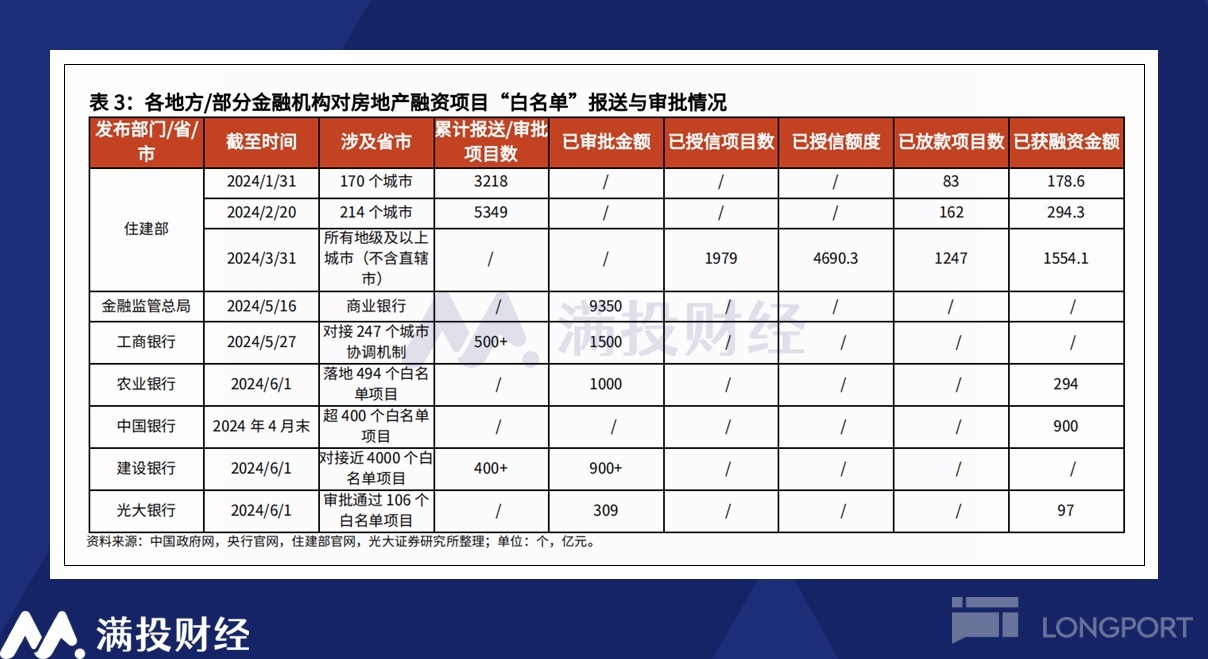
Regarding the funds guaranteed by the white list, the conference noted that approved amounts reached 2.23 trillion yuan. However, in terms of actual fund disbursement, as of June 2024, the performance lagged behind the credit quota, with a relatively low disbursement ratio. After three years of adjustments, few developers may face imminent debt crises, and even fewer may be willing to increase loans for investments during a downturn.
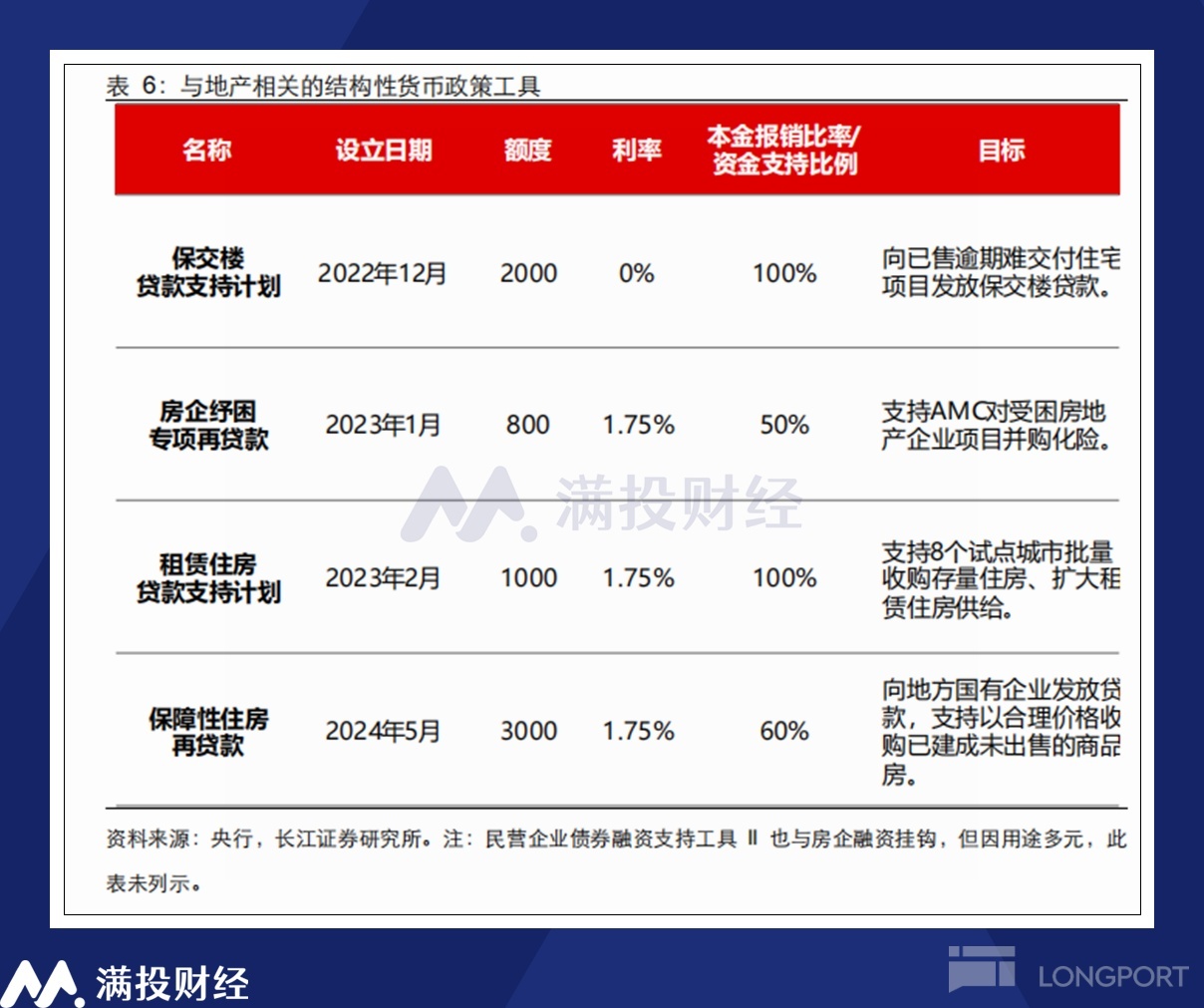
Beyond the white list, other financing tools may face similar issues, such as low borrowing willingness among developers. Credit-based tools are inherently more "pro-cyclical." Against a backdrop of weak industry sentiment, developers remain cautious about further expansion and borrowing. On the other hand, policymakers are reluctant to push for drastic changes through large-scale stimulus, resulting in a perceived lack of "aggressiveness" in various policies.
Apart from loan support, the main real estate policies proposed include monetized resettlement and inventory purchase-related measures, both focusing on reducing housing inventory and mitigating local debt risks. Transforming inventory reduction into a balanced supply-demand dynamic for the real estate market may require more time and conditions. Inventory reduction needs longer to achieve supply-demand equilibrium, while improving residents' purchasing power remains the key to boosting real estate demand.
Notably, the press conference's emphasis on "good housing"—high-quality housing construction—may indicate the future direction of the real estate market. The conference stated, "China's housing development has entered a new phase, shifting from 'whether there is housing' to 'whether the housing is good.'" Against ample existing inventory, the demand generated by replacing old homes with new ones or renovating old homes may be more promising than a return to past growth rates. As consumer confidence improves, companies in the home renovation sector may see an earlier performance turnaround than the real estate industry as a whole.
01
Final Thoughts
Regardless, under the support of a series of real estate policies, recent real estate data should show some improvement. As of mid-October, the average daily transaction area for new homes in 30 major cities was 226,000 square meters, with the year-on-year growth rate for the first 15 days narrowing sharply from -32.4% in September to -4.5%. First-tier cities performed even better. If policy support continues, Q4 real estate data may be the best in recent times.
However, improvement does not equate to a reversal. The real estate sector still faces many unresolved issues, and inventory reduction requires more time. At present, investing in real estate can hardly be considered a good business. To improve the real estate market—or the 低迷 sentiment around real estate stocks—further policy escalation may be needed. The balance between strong stimulus and stability must be carefully managed. For investors, patience is required in the recovery of the real estate market: no need for pessimism, but don’t expect overnight success.
$CHINA VANKE(02202.HK) $POLY PPT SER(06049.HK)
The copyright of this article belongs to the original author/organization.
The views expressed herein are solely those of the author and do not reflect the stance of the platform. The content is intended for investment reference purposes only and shall not be considered as investment advice. Please contact us if you have any questions or suggestions regarding the content services provided by the platform.
