


 Likes Received
 Posts
PostsWhether it's a bull market or not, these three industry sectors should be kept an eye on!

Recently, the A-share market has been relatively stronger, while the Hong Kong market has been weaker in contrast.
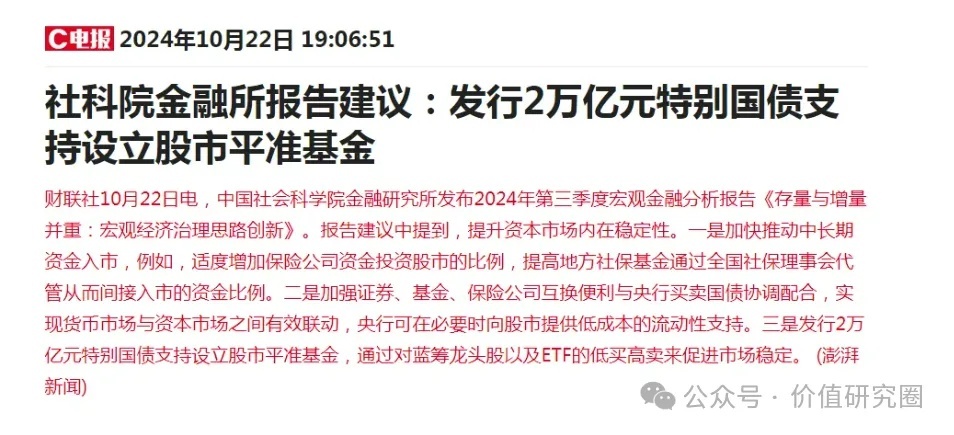
The biggest news tonight is the release of the 2024 Q3 Macro-Financial Analysis Report titled "Balancing Stock and Increment: Innovations in Macroeconomic Governance" by the Institute of Finance and Banking at the Chinese Academy of Social Sciences.
One key proposal highlighted is the issuance of 2 trillion yuan in special treasury bonds to support the establishment of a stock market stabilization fund!
Historically, the market has entered a bull run after the introduction of a stabilization fund.
However, this is just a proposal—whether it will be implemented is another story.
Regardless of whether there is a bull market or not, stock selection remains the top priority.
If you pick a company with strong fundamentals, it can still hit new highs even in a bear market. Conversely, a poorly performing company may decline even in a bull market.
The Hong Kong market has always been a structural bull market, where penny stocks are marginalized even during a bull run.
For the A-share market, before 2015, there were bull markets where even low-quality stocks surged. However, in recent years, with the continuous inflow of foreign capital and market improvements, some small-cap stocks in the A-share market have also shown signs of marginalization.
If you buy a junk stock, you might still be left behind in a bull market.
So, what types of stocks should we focus on in this market cycle?
Here are three directions investors can consider:
First, stocks directly benefiting from policy stimulus, such as real estate.$Sunac China(01918.HK)
Apart from the stock market itself, another major focus of this policy stimulus is the property market.
In some ways, policymakers are paying more attention to the property market than the stock market.
First, the Politburo meeting emphasized stabilizing the real estate market, followed by the Ministry of Finance allowing special bonds for land reserves and supporting the acquisition of existing homes. Additionally, local governments have lifted purchase restrictions, and the central bank has cut mortgage rates—all to stimulate the property market.
Of course, despite policy support, the fundamentals of real estate remain weak. From a value investing perspective, it’s not an ideal investment.
Second, high-dividend assets.$HKEX(00388.HK) $PING AN(02318.HK)
High-dividend stocks have been a mainstream choice in both the A-share and Hong Kong markets over the past two years.
The underlying logic is that in a declining interest rate environment, high-dividend assets offer higher yields than deposits or bonds.
Some argue that high-dividend stocks have already risen significantly and that investors should sell them to buy undervalued stocks when the market turns. Indeed, many high-dividend stocks were sold off early in this cycle, but they quickly stabilized when the market corrected.
Many believe that the "Big Four" banks and oil giants are only traded by state-backed and institutional investors, but this is a misconception.
Why shouldn’t retail investors buy into a sector with strong certainty and upward momentum?
Third, high-performing internet stocks.$TENCENT(00700.HK) $BABA-W(09988.HK)
This mainly applies to the Hong Kong market, as the A-share market lacks internet stocks.
Based on interim reports, Hong Kong internet companies have delivered solid earnings. For example, the Hang Seng Tech Index constituents saw an 8.93% increase in revenue and a 100.45% surge in net profit in the first half of the year.
Of course, the net profit growth is partly due to a low base effect. If profits could truly double, the Hang Seng Tech Index would rival the Nasdaq.
Nevertheless, among China’s asset classes, internet stocks remain relatively stable. While revenue growth is modest, cost-cutting measures have driven profit recovery.
The copyright of this article belongs to the original author/organization.
The views expressed herein are solely those of the author and do not reflect the stance of the platform. The content is intended for investment reference purposes only and shall not be considered as investment advice. Please contact us if you have any questions or suggestions regarding the content services provided by the platform.
