


Tianrun Rongtong launched intelligent voice navigation, automatically identifying customer intent to achieve efficient routing.

Your clients are also experiencing such moments of despair:
Anxiously waiting for the voice prompt, finally getting through to a customer service representative, only to be told they need to be transferred to another department... During peak hours of enterprise service hotlines, long waits and multiple transfers are all too common.
The root cause is that traditional voice navigation lacks intent recognition and automatic routing capabilities, leaving agents overwhelmed with repetitive tasks, drastically reducing effective service capacity, and leading to declining customer satisfaction.
Even today, countless enterprises still use traditional voice navigation, and its drawbacks are glaring:
- Long wait times: When calling the service hotline, clients often endure lengthy waits before connecting to a human agent, especially during peak hours, which can easily lead to frustration.
- Repeated transfers: In traditional call centers, clients frequently need multiple transfers to reach the right agent, resulting in redundant communication, inaccurate information relay, and increased time and cost.
- Unclear demands: If clients struggle to articulate their needs, traditional button-based navigation fails to route them correctly, often directing them to the wrong department and lowering first-contact resolution rates.
- Repetitive information sharing: During transfers, clients must repeatedly provide details like identity verification and issue descriptions, wasting time and degrading the experience.
1. Comprehensive Upgrade! Intent-Based Voice Navigation
Tianrun Rongtong, leveraging the Weiteng Intelligent Agent Platform, has developed an Intent Recognition Agent and integrated it into voice navigation, upgrading it to "Intelligent Voice Navigation"—injecting new productive forces into enterprise service teams!
Enterprise service departments are numerous, and client demands are complex. The Intent Recognition Agent accurately identifies client intent from speech, guides them through information collection, and routes them to the correct department. This effectively avoids misrouting and repeated transfers common in traditional systems.
Before intent recognition:
Take a manufacturing company as an example. Previously, clients reporting repairs had to navigate a traditional system, transfer to an agent, who then manually determined the issue—e.g., collecting device model and SN for repairs—before routing to the technical team. The process was time-consuming and tied up agents.
After intent recognition:
After adopting Tianrun Rongtong’s Intelligent Voice Navigation, the company abandoned traditional navigation.
Clients now describe their issue verbally. The Intent Recognition Agent extracts session details, identifies the business need, and requests specifics. It matches the client to the right agent and displays the extracted info on their dashboard, boosting resolution efficiency.
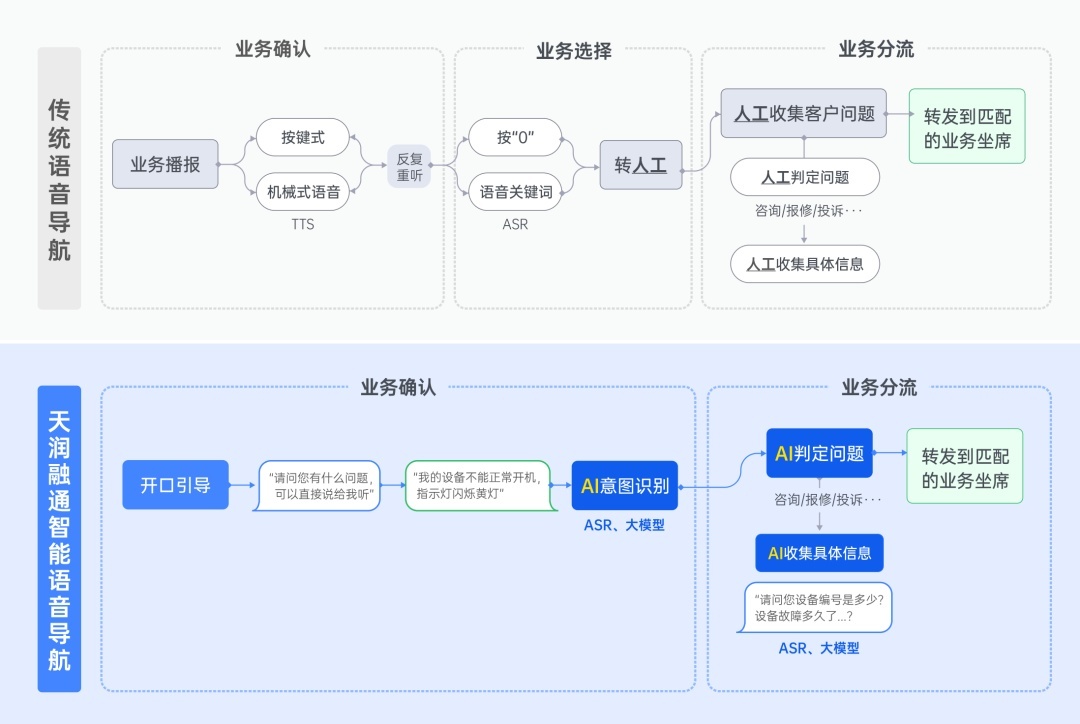
▲Traditional vs. Tianrun Rongtong Intelligent Voice Navigation
The Agent then routes the client to the relevant technical team for remote support while displaying the info on their dashboard, streamlining the process.
For the company, departments now focus on their core tasks, significantly improving efficiency.
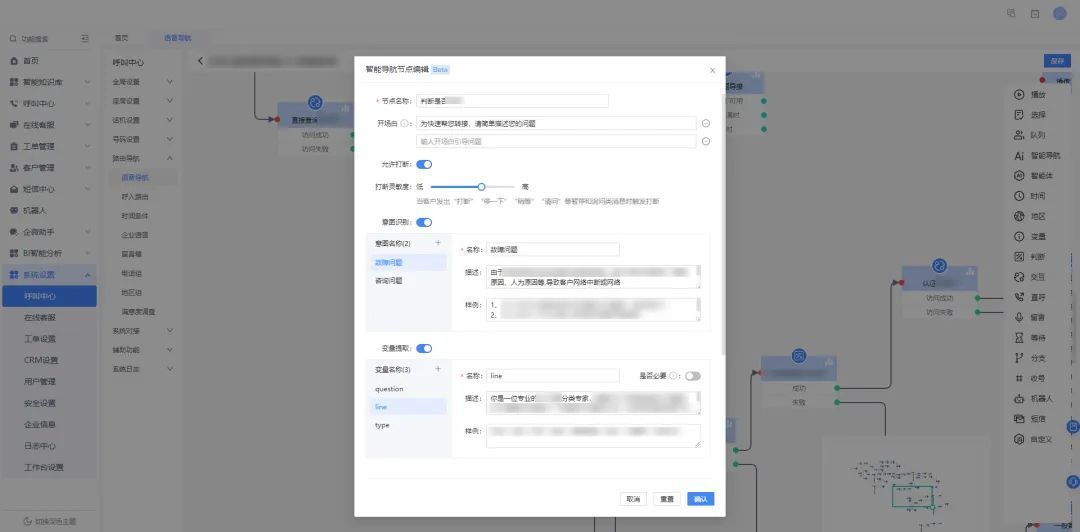
▲Intelligent Navigation Product Demo
2. Six Key Benefits of Intelligent Voice Navigation
1. Enhanced client experience: Rapid demand identification and precise routing reduce wait times and unnecessary transfers, speeding up resolutions.
2. Higher efficiency: The system automates routine tasks and data collection, freeing agents to focus on complex cases, improving overall productivity.
3. Less redundant communication: Client data is automatically captured and shared, eliminating repetitive explanations.
4. Lower operational costs: Reduced reliance on human agents lets enterprises handle more calls at the same or lower cost, optimizing staffing.
5. Improved satisfaction and loyalty: Faster service minimizes frustration, boosting retention and loyalty.
6. Data-driven insights: The system analyzes client behavior, uncovering preferences and pain points to refine services and support future decisions.
3. Conclusion
From an operational standpoint, Intelligent Voice Navigation elevates efficiency, cuts costs, and enhances client satisfaction and loyalty—critical for competitive edge.
Efficiency gains allow enterprises to handle more demand with optimized resources. Cost savings stem from reduced inefficiencies. Satisfaction and loyalty directly impact market positioning and growth.
In today’s client-centric era, delivering exceptional experiences is key to standing out.
The copyright of this article belongs to the original author/organization.
The views expressed herein are solely those of the author and do not reflect the stance of the platform. The content is intended for investment reference purposes only and shall not be considered as investment advice. Please contact us if you have any questions or suggestions regarding the content services provided by the platform.
