


As BYD and SAIC Maxus pressure suppliers, Tesla wants to coexist with suppliers?
In the context of the current price war, automakers are not only tightening their own spending but also continuously pressuring the upstream supply chain.
On November 28, it was reported that SAIC Maxus requested its suppliers to reduce prices by 10%. A screenshot of an email circulating online shows that SAIC Maxus believes the current oversupply issue in the automotive market is very prominent, and with a large number of new cars being launched, the imbalance between supply and demand is expected to be difficult to fundamentally improve in the short term. Just a day earlier (November 27), domestic new energy leader BYD was also reported to have asked its suppliers to reduce prices by 10% starting next year. In a circulated email, BYD stated that market competition will be even more intense next year, entering the "great battle" and "elimination round" stages. In response, Li Yunfei, General Manager of BYD Group's Brand and Public Relations Department, confirmed the request for suppliers to lower prices on Weibo on November 27, stating that annual negotiations with suppliers are a common practice in the automotive industry. BYD's request for price reductions from suppliers based on large-scale procurement is not mandatory, and both parties can negotiate. Subsequently, a response email allegedly from a BYD supplier was leaked. The email used quite harsh language, accusing BYD of "ruthlessly squeezing" suppliers and believing that such practices would lead the industry into a dead end of low-end competition.

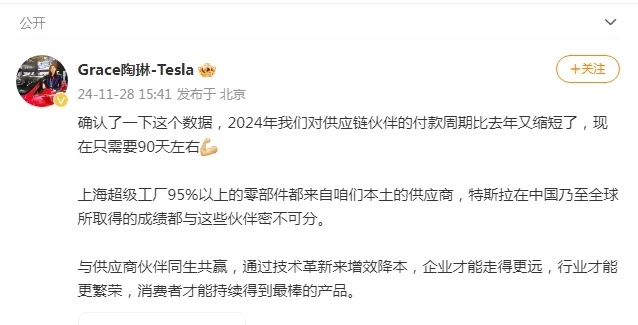
As a new round of price cuts sweeps through the entire automotive industry, Tesla Vice President Tao Lin stated on November 28 that over 95% of the components for Tesla's Shanghai Gigafactory come from local Chinese suppliers, and the payment cycle for the supply chain has now been shortened to about 90 days, further reduced from 100 days in 2023.
Tao Lin further added that cost reduction relies on technological innovation and reducing unnecessary expenditures, reiterating the importance of safeguarding suppliers' interests. "We will save where we need to save, but we will also spend where we need to spend. Quick payments to suppliers do not mean we need to raise product prices."
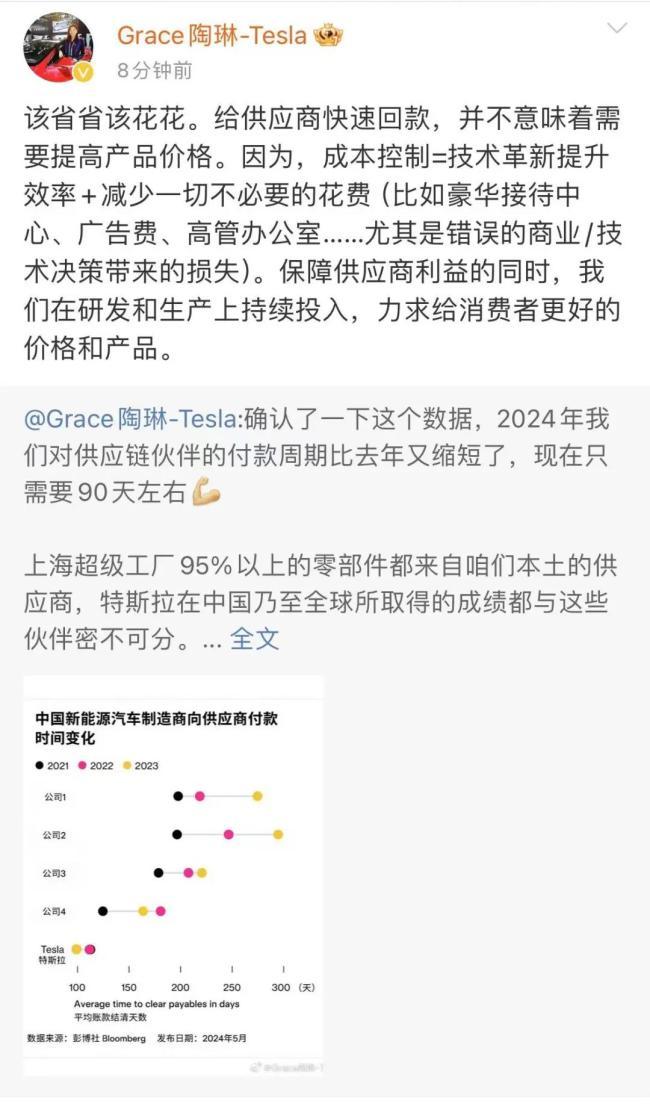
Tao Lin emphasized that the payment cycle is crucial for suppliers. Extending the payment period is an indirect cost control strategy implemented by many automakers on suppliers. Some payment cycles that originally only required three to four months have been extended by some automakers to six months or even a year, posing severe challenges to the liquidity of small and medium-sized suppliers.
As competition between new energy vehicles and fuel vehicles becomes increasingly fierce in terms of market share and prices, it is expected that by 2025 or 2026, the competitive landscape of the automotive market will gradually become clearer. Currently, the issue of supply and demand imbalance in the automotive market is very evident, which is directly related to the contradiction of oversupply and insufficient demand With the influx of new models into the market, the issue of supply and demand imbalance is difficult to fundamentally resolve in the short term, and the flames of the price war are also hard to extinguish.
"The leakage of information regarding annual price negotiations between manufacturers and suppliers reflects that competition within the industry is still ongoing, and the price war in the industry is far from over," pointed out an automotive industry analyst, noting that next year's price war is already quietly brewing
The copyright of this article belongs to the original author/organization.
The views expressed herein are solely those of the author and do not reflect the stance of the platform. The content is intended for investment reference purposes only and shall not be considered as investment advice. Please contact us if you have any questions or suggestions regarding the content services provided by the platform.
