



SHEIN continues to advance green carbon reduction throughout the entire process, with 4 storage and logistics parks certified as 'Zero Waste Factories'.

SHEIN's green and carbon reduction initiatives in warehousing and logistics have consistently received certifications from authoritative institutions. Recently, TÜV Rheinland Greater China, an international independent third-party testing, inspection, and certification organization, awarded SHEIN's four warehousing and logistics parks the Zero Waste to Landfill Management System Certification (also known as the "Zero Waste Factory" certification). This marks an additional "Zero Waste" certification following SHEIN's previous two warehousing and logistics parks and its Apparel Manufacturing Innovation Research Center, further accelerating SHEIN's supply chain green carbon reduction and sustainable development.
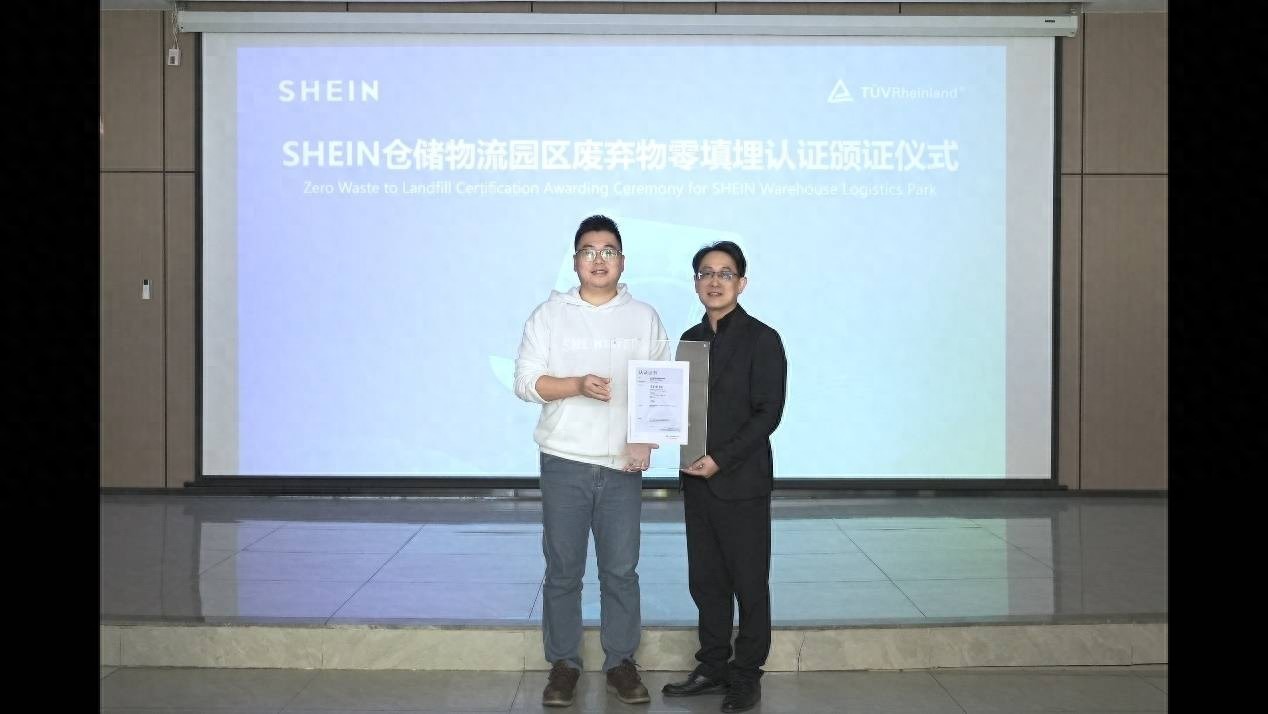
"Zero Landfill + Reuse": Multiple Warehousing and Logistics Parks Achieve Full Lifecycle Waste Management
TÜV Rheinland conducts Zero Waste to Landfill Management System Certification services based on international standards, evaluating enterprises' waste management levels from both process and quantitative performance dimensions. According to TÜV Rheinland officials, the certification of SHEIN's four warehousing and logistics parks demonstrates that the parks have clearly identified waste flows, established robust waste management systems, and implemented recycling for valuable industrial waste, extending product lifespans and reducing waste.
Previously, two of SHEIN's warehousing and logistics parks and its Apparel Manufacturing Innovation Research Center had already received the "Zero Waste to Landfill" certification. Currently, SHEIN continues to advance zero-landfill initiatives across more self-operated facilities. Through full lifecycle waste management, SHEIN aims to upgrade solid waste treatment toward "efficient, high-value, and large-scale utilization," striving to reduce environmental impact and achieve an orderly green and low-carbon transition. This is a key measure for SHEIN to accelerate green and sustainable business practices, implement new quality productivity, and drive high-quality industry development.
While standardizing waste management across its parks, SHEIN is also actively exploring waste recycling. Reportedly, in line with TÜV Rheinland's Zero Waste to Landfill certification requirements, SHEIN's warehousing and logistics parks have adopted full lifecycle waste management methods, addressing source reduction, reuse, resource recovery, and landfill reduction to develop solutions for waste minimization and resource utilization, transforming waste into reusable resources.
The certified parks have established regular collaborations with multiple waste treatment and recycling units, implementing detailed waste sorting. For example, food waste is recycled into organic fertilizer, while industrial waste such as PET bottles, tape, plastic ropes, fabric straps, and cardboard from packaging is collected on-site and transported for recycling. Remaining industrial and domestic waste is incinerated for energy recovery by specialized units.
Additionally, SHEIN repurposes eligible waste materials for supplier empowerment programs. For instance, qualified textile waste is sorted, opened, carded, layered, and heat-pressed to create insulation materials for steam pipes in supplier factories, improving energy efficiency. Such materials are also used in vocational training programs for industry professionals.
In recent years, as a critical part of its supply chain, SHEIN has implemented multiple green and carbon-reducing sustainability initiatives in warehousing and logistics. For example, by switching to reusable metal meal trays, the company has significantly reduced disposable plastic container usage, with most warehouses now eliminating such containers entirely. In the first half of 2024 alone, SHEIN recycled 48.7 tons of PP meal trays and plastic bottles, reducing approximately 113.8 tons of CO2 emissions compared to incineration.
Today, SHEIN has established a smart supply chain network spanning Guangzhou, Zhaoqing, Foshan, Jiangmen, Qingyuan, and other Greater Bay Area cities. In Zhaoqing, the SHEIN Greater Bay Area Western Smart Industrial Park, with a total investment of 3.5 billion yuan, commenced construction at the end of 2023, integrating full lifecycle ESG principles from planning and construction to operations. In Guangzhou, the SHEIN Greater Bay Area Supply Chain Project, with a total investment of over 10 billion yuan and launched in late September, also fully incorporates green and sustainable development concepts.
"Own Brand + Platform" Dual-Engine Strategy Drives Apparel Industry Sustainability
Beyond its own operations, SHEIN, driven by its "Own Brand + Platform" dual-engine strategy, continues to create value for the industry and market, advancing sustainability across the apparel sector.
First, SHEIN's innovative "small-order, quick-response" flexible supply chain model and digital tools help reduce production waste at the source, leading the industry's digital and industrial internet transformation.
Meanwhile, from eco-friendly materials like surplus inventory fabrics, recycled fabrics, and forest-friendly viscose to sustainable practices such as digital heat transfer printing, digital cold transfer printing, new energy trucks, rooftop solar panels, energy efficiency projects, recycled plastic packaging, and the SHEIN Exchange secondhand platform, sustainability is embedded in every stage of production and operations. SHEIN implements sustainable strategies across the entire product lifecycle.
SHEIN's own brand also promotes green carbon-reduction projects, including innovative technologies, rooftop solar, and energy efficiency improvements, among its suppliers. Furthermore, SHEIN empowers suppliers through technological innovation, training, factory expansion, community initiatives, and compliance, enhancing their capabilities and sustainability while boosting the global influence of the apparel industry. According to statistics, SHEIN's growth has driven trade exports, manufacturing, warehousing, logistics, transportation, and employment for millions in upstream and downstream sectors.
On the platform front, SHEIN's "on-demand production" flexible supply chain model, pioneered by its own brand, is now empowering third-party merchants and brands across China through initiatives like the "SHEIN Million Sellers Program," "National 500-City Industrial Belt Global Expansion Plan," and "Premium Products" Global Expansion Plan. In the synergy between cross-border e-commerce and industrial belts, SHEIN is enabling high-quality global expansion for third-party products and brands, including those in the apparel industry.
The copyright of this article belongs to the original author/organization.
The views expressed herein are solely those of the author and do not reflect the stance of the platform. The content is intended for investment reference purposes only and shall not be considered as investment advice. Please contact us if you have any questions or suggestions regarding the content services provided by the platform.
