


Companies 'hard-controlled' by ESG, a new way of carbon reduction is trending

Original © New Entropy
Author 丨 Saike Editor 丨 Jiuli
It's the end of the year again, a time when industries are usually the busiest. Major listed companies are busy summarizing their annual work and preparing next year's budget reports.
What's troubling isn't just compiling statistics and making budget plans. Over 400 key companies among listed firms, as well as those listed both domestically and overseas, also need to disclose ESG reports.
Nowadays, ESG reports are becoming increasingly important. Did companies achieve their ESG goals set at the beginning of the year? How to quantify the results? These are all questions.
When it comes to ESG, we have to talk about carbon reduction.
For companies, carbon reduction is like optimizing a phone's operating system. You don’t need to explain the optimization process to every user, but it’s a core step to make the company run more smoothly, energy-efficient, and competitive in the market—it’s a must-have.
The recent Central Economic Work Conference even listed "coordinated efforts to reduce carbon emissions and pollution" as a key task, proposing to "promote the construction of a national carbon market." With the goals set, the next step is to figure out how to implement carbon reduction and quantify it.
For example, how can non-energy and non-manufacturing industries quantify carbon reduction in their business details? This still requires careful consideration.
On December 24, Fadada and the Enterprise Green Development Research Institute jointly released the "2024 Carbon Reduction Through Contract Signing and Low-Carbon Office White Paper" (hereinafter referred to as the White Paper), providing a new perspective for companies to achieve their annual ESG goals and quantify the carbon reduction effects of digital office practices.
Ditching Paper Contracts, This Company Helps Reduce Carbon Emissions by 1.75 Million Tons
Fadada has rich practical experience in digital office carbon reduction.
Statistics show that as of mid-December 2024, Fadada's platform has processed over 10 billion contracts/files, helping users reduce more than 1.75 million tons of carbon dioxide emissions and freeing up 3,036 square kilometers of forest carbon sequestration capacity.
So here’s the question: How much carbon can a non-manufacturing, non-energy company reduce through digital office practices?
The White Paper jointly released by Fadada and the Enterprise Green Development Research Institute provides the answer.
Shanghai Huifu Payment Co., Ltd. is a licensed third-party payment platform whose business covers internet payments, mobile payments, bank card acquiring, and more. According to statistics, Shanghai Huifu Payment signs about 42.16 million electronic contracts annually. Based on the "Carbon Reduction Through Contract Signing" calculation model developed by Fadada, the Enterprise Green Development Research Institute, and the Beijing Green Exchange, this translates to an annual carbon reduction of approximately 1,408.56 tons of CO2 equivalent.
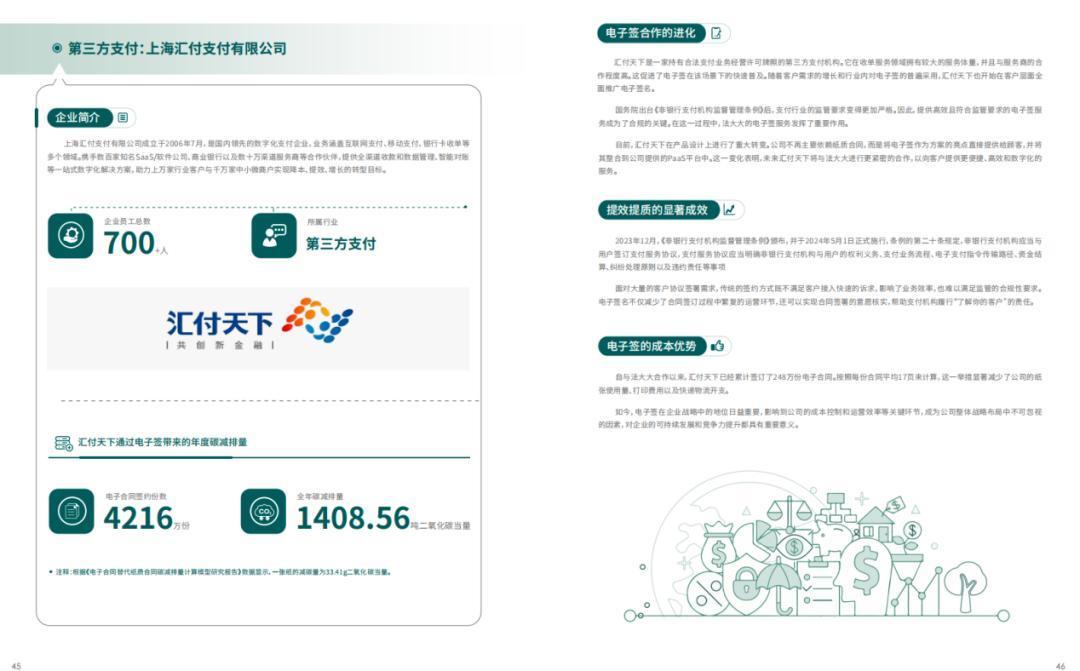
Junrun Human Resources Services (Shenzhen) Co., Ltd. is a human resources solutions provider. Since adopting electronic signing in 2019, it has saved 16 million pages of paper, reducing carbon emissions by 534.56 tons of CO2 equivalent.
Similarly, Topsway, a commercial services company based in Shenzhen, has saved 26.6 million pages of paper since replacing paper contracts with electronic signing in 2022, equivalent to a carbon reduction of 888.7 tons of CO2 equivalent...
The White Paper cites many such cases. Most of these companies have reduced carbon emissions in their daily operations and business processes by adopting electronic signing to replace paper contracts.
So, where do these numbers come from?
This brings us to the first highlight of the White Paper: the "Carbon Reduction Through Contract Signing" calculation model.
In fact, Fadada released this calculation model as early as 2022. This year’s White Paper showcases the model’s value through real-world examples. Thanks to this model, many embedded carbon reductions in business processes have been successfully quantified.
Many companies are already practicing ESG but lack effective quantification tools. For instance, the use of digital tools like electronic signatures and paperless offices objectively contributes to carbon reduction. However, this aspect of carbon reduction has long gone unnoticed.
For companies preparing ESG reports, quantifying these reductions is highly valuable.
The significance of the "Carbon Reduction Through Contract Signing" calculation model lies in providing a "measuring stick" for digital office carbon reduction.
With this stick, companies gain a quantification mechanism for digital office carbon reduction. This mechanism can further popularize low-carbon office practices. Making the value of carbon reduction through signing more tangible gives companies greater motivation to promote low-carbon office initiatives.
Beyond the calculation model, the second highlight of this year’s White Paper is its emphasis on the importance of corporate ESG 信息披露 (disclosure).
Compared to the 成熟 (maturity) and 完善 (completeness) of financial report disclosures, ESG 信息披露 by major listed companies is still a relatively "new thing."
Data in the White Paper shows that as of the end of September 2024, 2,200 A-share listed companies had disclosed their 2023 sustainability reports/social responsibility reports. Among them, over 40% have established an ESG governance framework and built an ESG 制度体系 (system), while over 60% have identified and disclosed the analytical 路径 (path) for material issues.
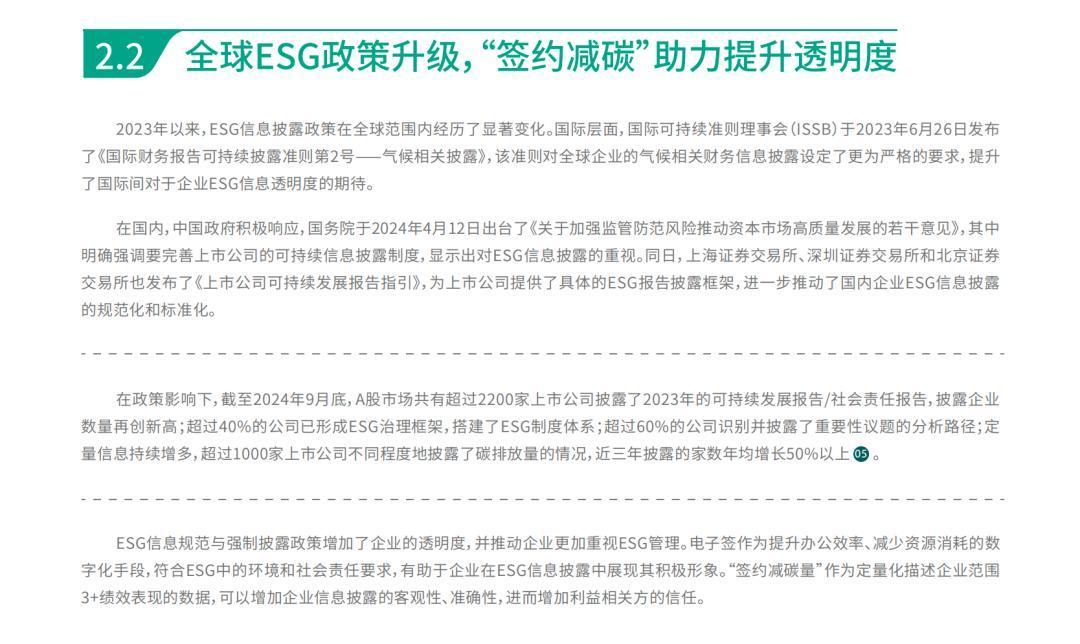
These numbers indicate one thing: The mechanisms and content of corporate ESG disclosures are rapidly improving.
Quantifying carbon reduction through signing further standardizes and supplements corporate ESG disclosures, making them more detailed and persuasive.
Currently, carbon reduction disclosures in many industries are incomplete. The digital transformation process in some industries 本身就是 (is itself) a carbon reduction process, but ESG disclosures lack sufficient detail.
Take the retail industry, for example.
The retail industry has a long supply chain involving numerous contracts, most of which are paper-based. There’s still room for digital carbon reduction here. Most retail companies focus on eco-friendly packaging and carbon reduction in production and transportation, often overlooking office-related carbon reduction.
Other companies may use digital office tools but lack quantification methods, leading to incomplete disclosures.
With electronic signing in business processes and a 量化 (quantification) method, this aspect of carbon reduction will gain more attention. Under Fadada’s ecosystem collaboration, improved carbon reduction quantification mechanisms will likely lead to more complete ESG disclosures. The more detailed and data-supported the disclosures, the more substantive the reports become.
The third highlight of the White Paper is the exploration of a "carbon 普惠 (inclusive)" mechanism.
The report mentions that the "carbon 普惠" mechanism is essentially "a mechanism to 牵引 (guide) 全民 (public) green and low-carbon actions." It targets individuals, families, and small businesses, focusing on carbon emissions in production and consumption, quantifying and managing the "small, scattered, and diverse"低碳 (low-carbon) behaviors at the consumption end, thereby achieving carbon reduction in this segment.
To engage "small, scattered, and diverse" groups—small businesses and even individuals—requires not just 科普 (awareness-raising) but also the 带动 (leadership) of larger companies and industries.
From this perspective, Fadada’s exploration and experimentation with "carbon 普惠" are highly valuable for the application and 普及 (popularization) of low-carbon offices.
The market for low-carbon offices is vast, spanning countless industries. Theoretically, such mechanisms can promote green and low-carbon transformation across all sectors.
Today, electronic signing is being adopted by 越来越多的 (more and more) companies. Fadada serves over 4,000 industry-leading clients, including more than 1/5 of the world’s or China’s top 500 companies. This gives it strong 辐射 (influence) 能力 (capability) in the corporate world. This is highly valuable for the 普及 (popularization) of low-carbon offices.
Whether it’s electronic signing or the "carbon 普惠" mechanism, when a product or mechanism truly benefits the masses, it fulfills the true meaning of "普惠 (inclusiveness)."
Starting with Electronic Signing, "Carbon Reduction" in New Quality Productivity Will Become a "Standard Feature"
From Fadada’s founding in 2014 to today, China’s electronic signing industry has rapidly evolved.
It’s fair to say that Fadada’s 十年 (decade) of existence has coincided with the 崛起 (rise) of China’s electronic signing industry. Over these ten years, its products have not only created significant 商业价值 (business value) but also gradually 释放 (unleashed) 社会价值 (social value), gaining increasing attention and recognition.
In a sense, Fadada’s rapid growth mirrors China’s progress in digitalization over the past decade.
In modern 商业社会 (business society), societal development and 进步 (progress) are, to some extent, the results of corporate development and 进步 (progress). Starting with electronic signing and under the "carbon 普惠" mechanism, "carbon reduction" in new quality productivity will become a "must-have and standard feature" for corporate green development.
What is new quality productivity?
It’s productivity empowered by advanced technologies like AI and big data. And 低碳事业 (low-carbon initiatives) are, by nature, data-driven.
One observation about corporate green development is that in the future, the significance of corporate low-carbon growth will rival that of corporate output driving GDP.
From a results perspective, the 碳中和 (carbon neutrality) goal is unwavering. Corporate green and low-carbon development must ultimately be data-driven. Therefore, Fadada’s exploration of "carbon 普惠" not only creates a new channel for low-carbon office implementation but also finds the motivation for companies to adopt low-carbon offices.
Under this motivation, it’s only a matter of time before "carbon reduction" in new quality productivity, represented by digital economy tools like electronic signing, becomes a corporate standard.
On one hand, in the process of corporate digital transformation and "carbon reduction" in new quality productivity, the value of electronic signing as infrastructure continues to grow.
Whether in the low-carbon economy or the digital economy, as new quality productivity 落地 (takes root) in industries, the value of electronic signing as low-carbon and efficiency infrastructure remains unchanged. This infrastructure value manifests in multiple dimensions, such as cost reduction, efficiency improvement, and risk mitigation.
The White Paper cites survey data: 77% of companies believe electronic signing reduces signing costs; 67% think it effectively mitigates risks; and 56% say it enhances customer experience.
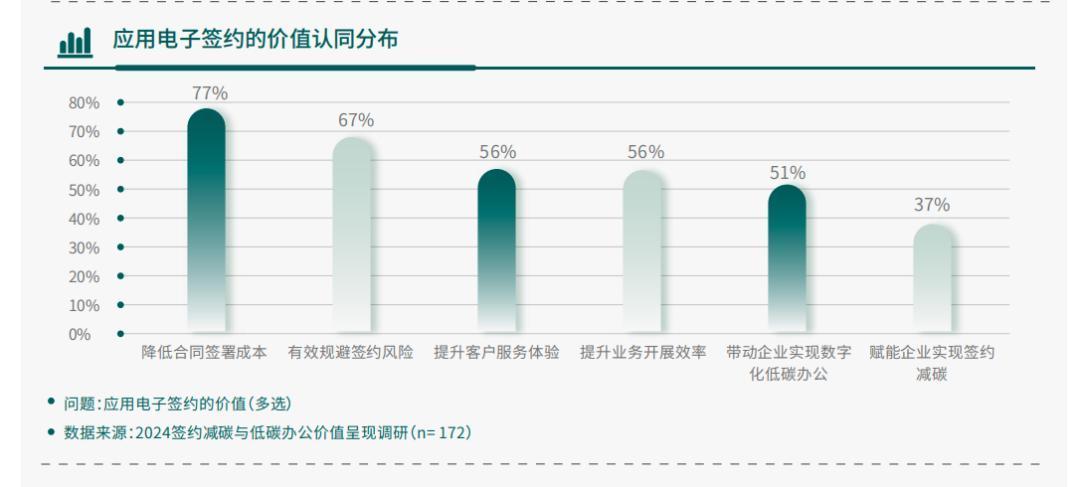
Helping companies cut costs and mitigate risks addresses their most fundamental needs.
In other words, in the process of corporate green and low-carbon growth, electronic signing platforms like Fadada serve as the "water, electricity, and gas" of the digital economy.
On the other hand, the electronic signing industry, as a foundation for corporate digitalization, naturally covers many new quality productivity sectors.
An interesting data point in the White Paper is that the legal field isn’t the top application scenario for electronic signing.
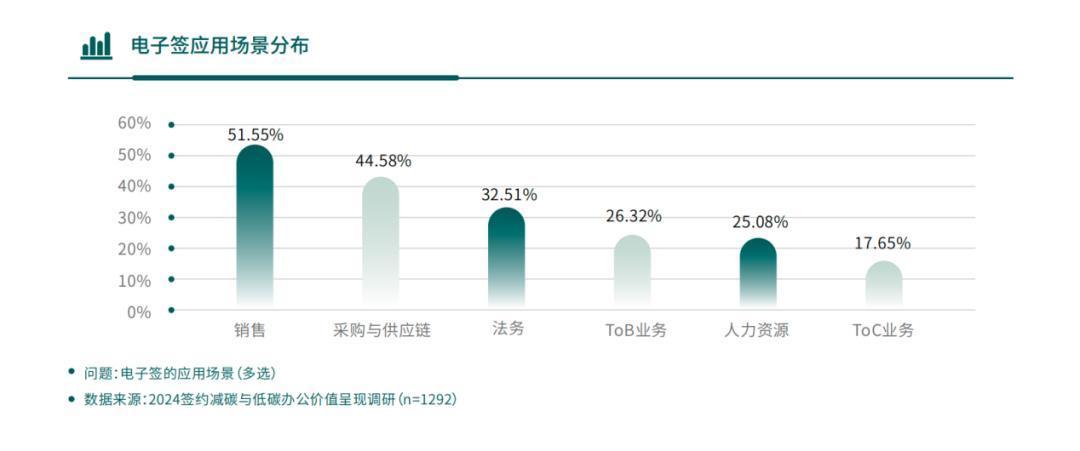
Application scenario distribution data shows that sales account for the highest proportion, followed by procurement and supply chain, with legal scenarios making up only about 32%.
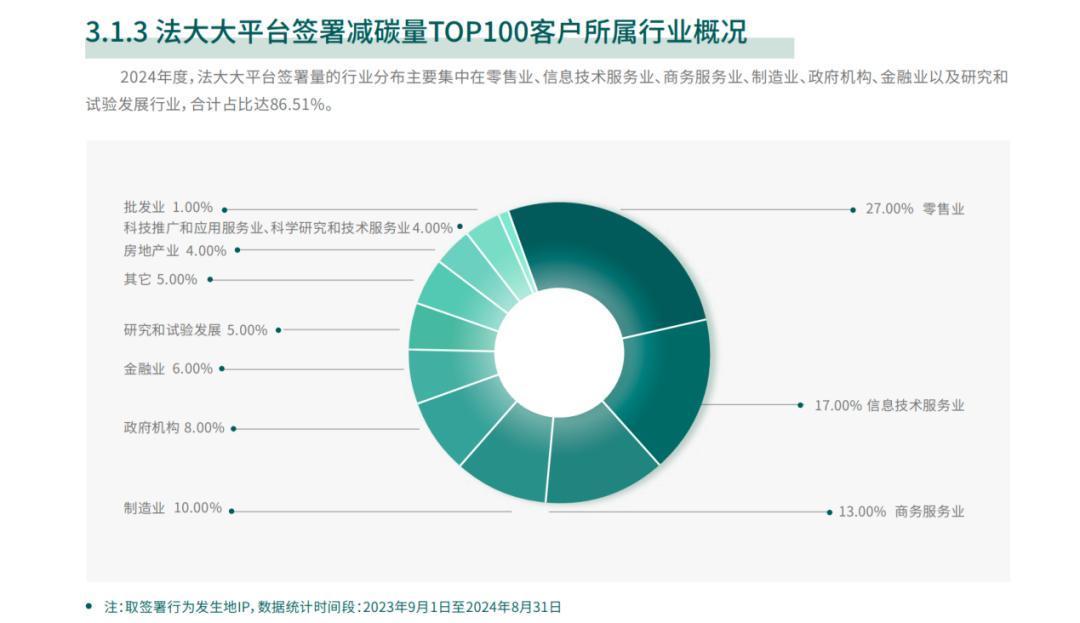
Industry distribution data reveals that Fadada’s platform 签署量 (signing volume) is concentrated in retail, information technology services, business services, manufacturing, government agencies, finance, and research and experimental development, accounting for 86.51% combined. These sectors are also key areas for 孵育 (nurturing) new quality productivity.
The prerequisite for 孵育 (nurturing) new quality productivity is the digitalization of corporate production and management, with contract digitalization as the foundation. The greatest value of electronic signing lies in digitizing contractual relationships, which is crucial for corporate management digitalization.
Corporate carbon reduction is, in fact, complementary to digital upgrades and new quality productivity empowerment.
Using electronic signing as an anchor to promote "carbon reduction in new quality productivity" is like "killing three birds with one stone."
First, it solidifies the foundation for digitalization, accumulating experience for more complex business digitalization. Second, it promotes carbon reduction in office scenarios, further quantifying 阶段性成果 (phase achievements) in reducing carbon footprints. Third, it aids corporate digital and intelligent upgrades, driving the development of new quality productivity.
On a smaller scale, the 低碳增长 (low-carbon growth) brought by electronic signing offers high 回报价值 (return on investment) with minimal 投入 (input).
On a larger scale, digitalization is 关乎 (key to) industrial transformation and upgrading, making it a "critical industry" for future new quality productivity development.
From this perspective, corporate adoption of electronic signing can also 助力 (assist) digital and intelligent upgrades, empowering new quality productivity. It’s a highly cost-effective investment.
This may be one reason why electronic signing platforms like Fadada are widely recognized across industries.
After all, the path to corporate green development is long. Digitalization and carbon reduction are just 一个个节点 (milestones) on this journey, and adopting electronic signing is only the first step.
For companies transitioning to new quality productivity, "taking that critical first step" is often the most important part.
The copyright of this article belongs to the original author/organization.
The views expressed herein are solely those of the author and do not reflect the stance of the platform. The content is intended for investment reference purposes only and shall not be considered as investment advice. Please contact us if you have any questions or suggestions regarding the content services provided by the platform.
