


 Posts
PostsIf the Bitcoin reserve bill is passed, it may end the four-year boom and bust cycle of cryptocurrency.

Original author: DANIEL RAMIREZ-ESCUDERO, Cointelegraph
Compiled by: Lawrence, MarsBit
Could the "Bitcoin Reserve Act" disrupt the halving cycle? Will this four-year cycle unfold differently? Are we entering a mythical supercycle?
Speculation is growing that incoming President Trump might sign an executive order on his first day in office to establish a Bitcoin reserve, or pass legislation to do so during his term. Many are wondering if this move could trigger a cryptocurrency supercycle.
Since Wyoming Senator Cynthia Lummis proposed the "Bitcoin Reserve Act" earlier this year, states like Texas and Pennsylvania have introduced similar bills. Reports suggest that Russia, Thailand, and Germany are also considering their own proposals, further increasing the pressure.
If governments are racing to secure their Bitcoin reserves, could this mean the end of the four-year boom-and-bust cycle in cryptocurrency prices that many attribute to Bitcoin halvings?
Iliya Kalchev, an analyst at cryptocurrency lending platform Nexo, believes, "The Bitcoin Reserve Act could be a milestone moment for Bitcoin, signaling its 'recognition as a legitimate global financial instrument.'"
"Every Bitcoin cycle has had a narrative pushing the idea that 'this time is different.' The conditions have never been this ideal. Cryptocurrency has never had a pro-crypto U.S. president who controls the Senate and Congress."
The 2024 Bitcoin bill proposed by Lummis would allow the U.S. government to introduce Bitcoin as a reserve asset by purchasing 200,000 BTC annually over five years, accumulating 1 million BTC, and holding it for at least 20 years.
Jack Mallers, founder and CEO of Strike, believes Trump "could potentially use an executive order to buy Bitcoin," but he warns that this wouldn’t equate to purchasing 1 million BTC.
Dennis Porter, co-founder of the nonprofit Satoshi Act Fund, which supports Bitcoin-friendly U.S. policy bills, also believes Trump is exploring the establishment of a strategic Bitcoin reserve via executive order.
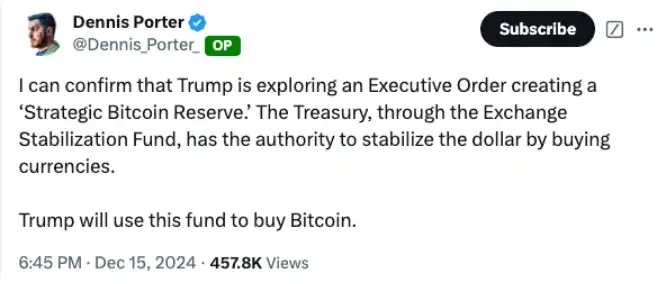
Dennis Porter announces Trump is studying an executive order on a strategic Bitcoin reserve. Source: Dennis Porter
So far, Trump’s team has not directly confirmed the claims about the executive order. However, when asked on CNBC whether the U.S. would establish a BTC reserve similar to its oil reserve (which could imply legislation), Trump replied, "Yes, I think so."
However, executive orders lack stability, as subsequent presidents often overturn them. The only way to ensure the long-term future of a strategic Bitcoin reserve is through legislation backed by a majority.
With Republicans dominating Congress and holding a slim majority in the Senate, Bitcoin advocates in Trump’s team have strong reasons to push for Lummis’ bill. However, even a few Republican defectors swayed by progressive backlash could block the bill, viewing it as handing government wealth to Bitcoin holders.
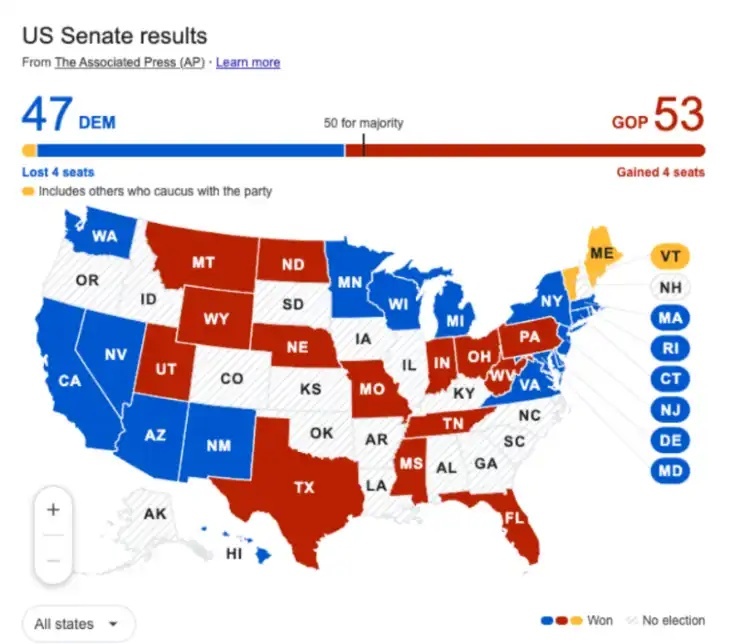
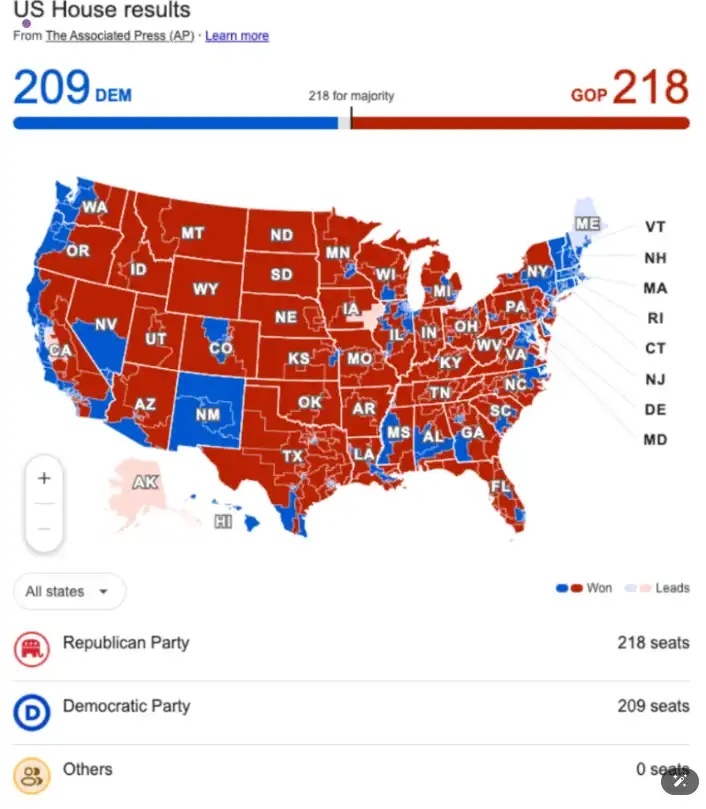
U.S. Senate and House election results after the 2024 election. Source: AP
Stop comparing this cycle to previous ones
Earlier this month, Alex Krüger, founder of macro digital asset advisory firm Asgard Markets and an economist, said the election results convinced him that "Bitcoin is highly likely to enter a supercycle."
He believes Bitcoin’s unique situation can be compared to gold. After U.S. President Richard Nixon announced the end of the Bretton Woods system by abandoning the gold standard, gold prices surged from $35 per ounce in 1971 to $850 in 1981.
Krüger doesn’t rule out the possibility of Bitcoin experiencing a bear market as it has in the past. However, he urges crypto investors "not to compare this cycle to previous ones," as this time could be different.
Trump’s actions so far undoubtedly suggest that government policy will move in a favorable direction. After Gary stepped down, he nominated pro-crypto and deregulation advocate Paul Atkins as SEC chair.
He also nominated crypto supporter Scott Bessent as Treasury Secretary and appointed former PayPal COO David Sacks as AI and Crypto Czar to develop a clear legal framework for the crypto industry.
Supercycle theories have never delivered super results
However, the idea that "this cycle is different" has appeared in every past Bitcoin bull run, each time supported by narratives around mainstream and institutional adoption.
During the 2013-2014 bull run, the supercycle theory was backed by the idea that Bitcoin would gain international attention as an alternative to fiat currency.
In the 2017-2018 cycle, rapid price surges were seen as signs of mainstream financial adoption and the beginning of Bitcoin’s acceptance by the mainstream, with institutional interest poised to flourish.
In the 2020-2021 cycle, when tech companies like MicroStrategy, Square, and Tesla entered the Bitcoin market, many believed other tech-related firms would follow.
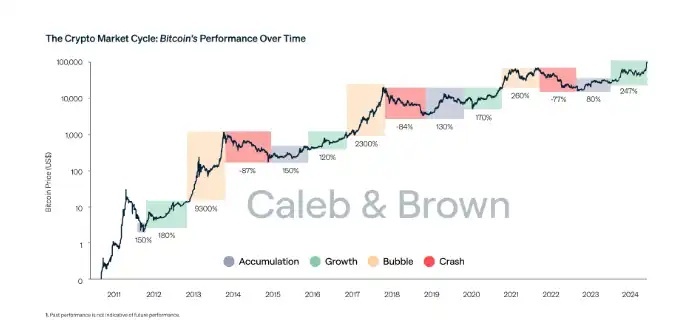
Bitcoin’s price performance peaking and bottoming in previous cycles. Source: Caleb & Brown
Yet, in each cycle, the supercycle narrative failed to materialize, ultimately leading to price crashes, bankruptcies among supporters, and prolonged bear markets. Su Zhu, co-founder of Three Arrows Capital and one of the most prominent supercycle advocates in 2021, argued that even without a sustained bear market, the crypto market would remain bullish, with Bitcoin eventually peaking at $5 million.
3AC borrowed heavily as if the supercycle theory were true, and when it was ultimately liquidated, the crypto market cap fell nearly 50%. The crash led to bankruptcies and financial distress for lenders like Voyager Digital, Genesis Trading, and BlockFi.
Thus, the supercycle is a dangerous theory—one you shouldn’t bet your life savings on.
For Chris Brunsike, partner at venture capital firm Placeholder and former head of blockchain products at ARK Invest, the Bitcoin supercycle is just a myth.
The supercycle is undoubtedly a collective delusion. That said, given the U.S. election results and unprecedented pro-crypto conditions—with a U.S. president seemingly fulfilling his pro-crypto promises, including never selling Bitcoin from the U.S. reserve—the outlook is extremely bullish.
Potential global domino effect
If the Bitcoin Reserve Act passes, it could trigger a global race to hoard Bitcoin, with other countries following suit to avoid falling behind.
George S. Georgiades, a lawyer who shifted from advising Wall Street firms to serving the crypto industry in 2016, told Cointelegraph that enacting the Bitcoin Reserve Act "would mark a turning point in global Bitcoin adoption" and could "prompt other nations and private institutions to follow, driving broader adoption and enhancing market liquidity."
Basel Ismail, CEO of crypto investment analysis platform Blockcircle, agrees, calling approval "one of the most exciting events in crypto history," as "it would catalyze a race to acquire as much Bitcoin as possible."
Other nations would have no choice but to act—adapt, compete, or perish. He believes, "Most G20 nations, the world’s most powerful and economically advanced countries, would follow suit and establish their own reserves."
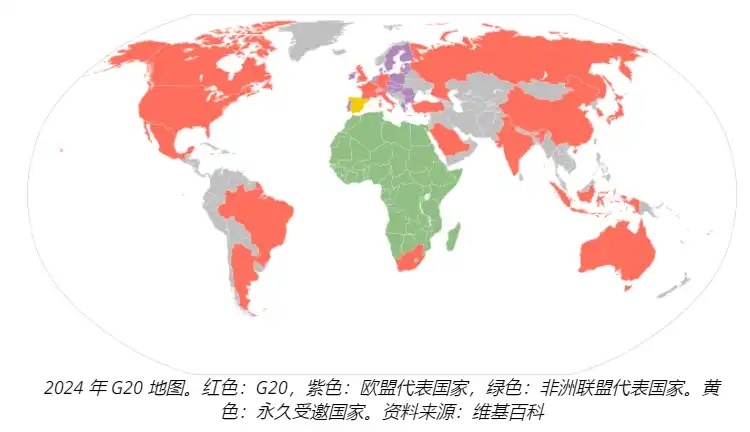
Veteran crypto investor and Bitcoin educator Chris Dunn told Cointelegraph that this FOMO-driven buying frenzy among nations could completely alter the current crypto market cycle.
If the U.S. or other major economic powers start accumulating, Bitcoin could trigger FOMO, potentially creating a market cycle and supply-demand dynamic unlike anything we’ve seen so far.
Hong Fang, president of OKX exchange, told Cointelegraph that other nations may already be preparing for such a race.
Game theory has likely been quietly at work.
However, Ismail notes that most Bitcoin purchases would occur via OTC brokers and settle in block trades, so "it may not have an immediate impact on Bitcoin’s price," but it would create sustained demand that ultimately drives prices higher.
A new wave of crypto investors could change market dynamics
If nations become market buyers, Bitcoin’s market could fundamentally change. A new wave of investors from global financial hubs would flood the crypto market, altering its dynamics, psychology, and reactions to certain events.
Nexo analyst Kalchev says that while it’s speculative whether this legislation could disrupt Bitcoin’s well-known four-year halving cycle, several dynamic shifts could emerge.
Bitcoin is a unique market, historically driven by retail buying and selling, with prices highly reactive to market psychology. The emergence of new investor types could change market dynamics and historical cycles.
Ismail believes "stock market investors would behave differently" from overreacting retail investors. Institutional investors have deep pockets and advanced risk management strategies, enabling them to approach Bitcoin differently.
Over time, Wall Street’s participation would foster a more stable, less reactive market environment. Stability is another word for reduced volatility, which logically means bear markets wouldn’t be as severe as in past cycles.
Georgiades thinks "price cycles will persist," but "sustained demand from large buyers like the U.S. could reduce the volatility and swings seen in past cycles."
Meanwhile, Ismail points out that Bitcoin’s market performance has already diverged from the four-year cycle pattern. Bitcoin’s price in this cycle fell below the previous cycle’s all-time high (ATH), which "everyone thought was impossible," only to set a new ATH before the official halving.
The four-year cycle has been debunked and broken multiple times
So far, Bitcoin has only experienced four halvings, with nearly thirty more to come. "It’s hard to imagine all these halvings following the same predictable four-year pattern," says Kalchev, especially as broader macroeconomic and political factors—like central bank policies and regulatory developments—increasingly influence Bitcoin’s market movements.
Kalchev believes Bitcoin’s price action will become less driven by internal mechanisms like halvings and more by external factors like institutional adoption and geopolitical events.
The copyright of this article belongs to the original author/organization.
The views expressed herein are solely those of the author and do not reflect the stance of the platform. The content is intended for investment reference purposes only and shall not be considered as investment advice. Please contact us if you have any questions or suggestions regarding the content services provided by the platform.
