


特斯拉机器人出租车挑战性测试:
$Tesla(TSLA.US) I saw a challenge test for RoboTaxi on YouTube, and the conclusion was optimistic. https://youtu.be/OVqIkyDtxxo?si=faTo9kjyJkwRWD3n The complete test cases were compiled. Interestingly, the testers played the role of normal passengers and tried to find corner cases to challenge the RoboTaxi.
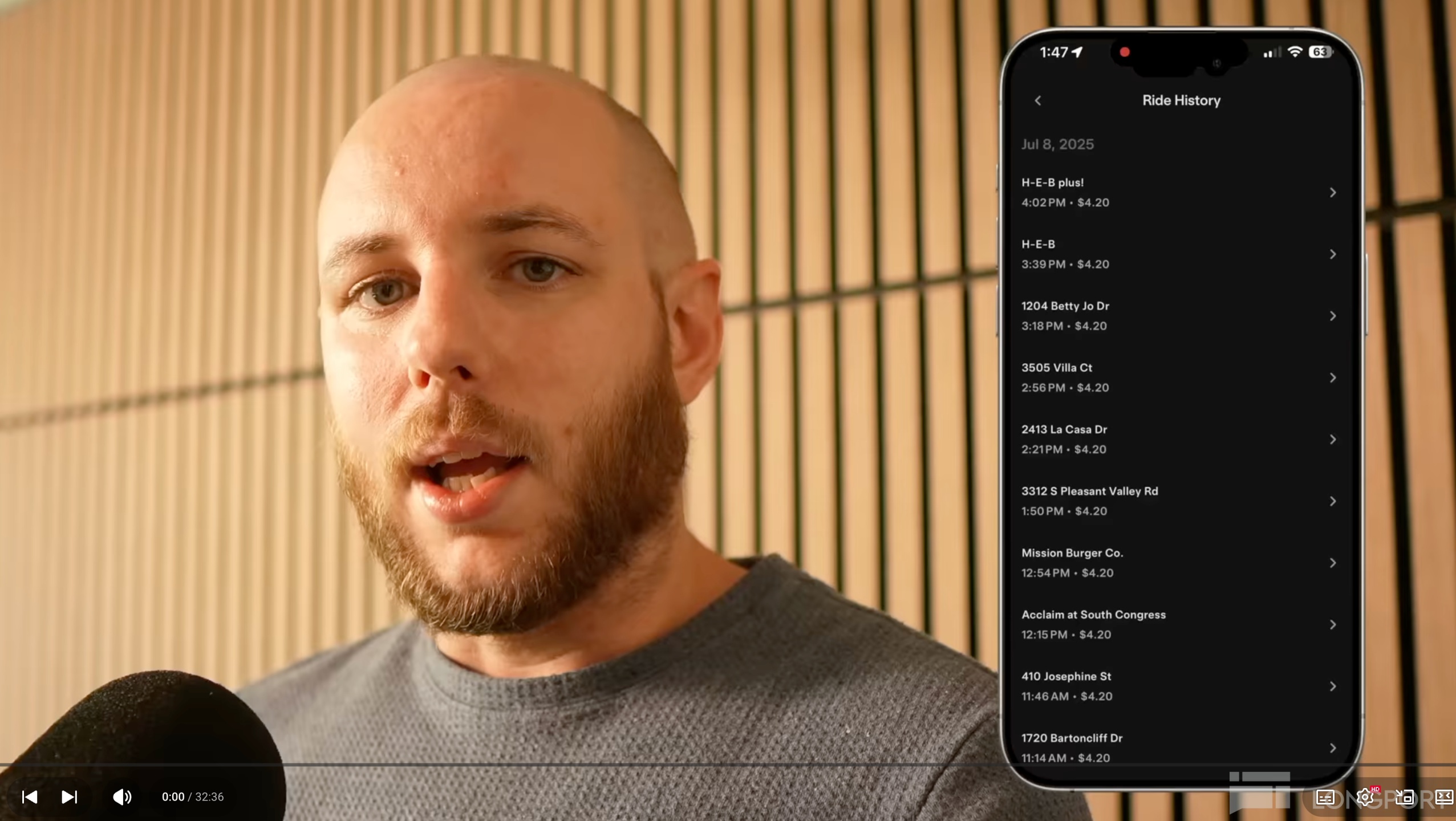
Okay, here is a detailed summary of the test cases, processes, results, and conclusions for Tesla's Robotaxi based on the YouTube video you provided:
Test Case 1: Pickup Point Adjustment—Obstruction in a Closed Area
- Test Objective/Process: The tester intentionally blocked the Robotaxi from entering the yard where he requested pickup.
- Result: The Robotaxi did not stop in the middle of the road as expected but accepted the fact that it could not enter and adjusted the pickup point to the nearest location outside the yard.
- Conclusion: This demonstrates "true intelligence." Unlike other autonomous vehicles that often stop in inappropriate locations and ignore traffic congestion, the Robotaxi seems to genuinely consider traffic flow and strives to find a position that does not obstruct traffic.
Test Case 2: Pickup Point Adjustment—Pickup on a No-Stop Street
- Test Objective/Process: The tester requested pickup on a street where stopping was prohibited to observe if the Robotaxi would double-park.
- Result: The Robotaxi passed the requested pickup point but continued slowly to the end of the street, where it found a spot to pull over without obstructing traffic.
- Conclusion: This ability to adjust on the fly is impressive, as it considers traffic flow and never inconveniences the tester, always finding a safe spot that doesn’t interfere with setting up or packing camera equipment. This indicates it has a good understanding of traffic flow during driving.
Test Case 3: Automatic Window Closing Feature
- Test Objective/Process: The tester intentionally left the window down when exiting the vehicle.
- Result: The Robotaxi used the rear occupancy sensor to detect the passenger's departure and automatically rolled the window back up. If the window was rolled down again afterward, it would remain open until the next passenger.
- Conclusion: The tester was surprised by this feature, acknowledging that Tesla had considered this detail.
Test Case 4: Driver’s Door Unlocked
- Test Objective/Process: The tester checked the driver’s door of the Robotaxi.
- Result: The driver’s door was unlocked.
- Conclusion: This surprised the tester, and the Robotaxi account also seemed dissatisfied, but this could likely be resolved with a software update.
Test Case 5: Pretending to Sleep Test ("Nap Test")
- Test Objective/Process: The tester arrived at the destination and pretended to be asleep in the back seat. Previously, he had accidentally dozed off in the car, which greatly increased his trust in the Robotaxi.
- Result: After waiting for 2 minutes, a remote support agent asked via the car’s speaker if everything was okay, confirming that the passenger had arrived but had not exited.
- Conclusion: The Robotaxi "had a plan" for this situation. This test aimed to understand what would happen if a passenger were completely unconscious.
Test Case 6: Front Bumper Camera Usage—Blocking with Luggage (First Attempt)
- Test Objective/Process: The tester placed his luggage directly in front of the car, where the front bumper camera should have had a clear view. He explicitly informed the safety driver.
- Result: The Robotaxi lurched forward slightly, then the hazard lights came on, and the vehicle stopped. The safety driver did not allow the vehicle to proceed, even after a long wait. The tester eventually removed the luggage.
- Conclusion: The tester believed the safety driver stopped the vehicle, not the car itself.
Test Case 7: Front Bumper Camera Usage—Blocking with Luggage (Second Attempt, Stealthy)
- Test Objective/Process: The tester quietly placed the luggage in front of the car without the safety driver noticing (as it was in the driver’s blind spot).
- Result: The video did not explicitly state the outcome, but it implied the vehicle’s behavior suggested it did not "see" the luggage.
- Conclusion: This "basically confirmed" the tester’s theory that the Robotaxi was not using the front bumper camera. He also observed the sound of the door opening and closing, supporting his other theory that the button was used by the safety driver as an emergency stop. Thus, he concluded the Robotaxi was a **"better version of V13"** and had issues already present in V13, such as prematurely entering turn lanes or unnecessary lane changes. He saw this as a positive sign, as it meant the software could run on vehicles without front bumper cameras (Hardware 4, not Hardware 3). He believed Hardware 4 was sufficient for autonomous driving even without the front bumper camera.
Test Case 8: Harassing the Robotaxi with a Cybertruck
- Test Objective/Process: The tester’s friend drove a Cybertruck, intentionally slowing down unnecessarily in front of the Robotaxi, pretending to pull over, and blocking its path, driving well below the speed limit to "provoke" it.
- Result: The Robotaxi decided to go around the Cybertruck. When it needed to turn right but the truck blocked a comfortable lane change, it first tried to accelerate slightly to overtake. When that didn’t work, it changed tactics, slowing down sharply and almost coming to a complete stop at the corner to enter the right lane. The Cybertruck driver then stopped the harassment.
- Conclusion: The tester thought the Robotaxi handled it "absolutely perfectly," displaying a "human-like" driving style and seemingly understanding the human driver’s intentions.
Test Case 9: Rerouting—Parking Lot Exit Blocked
- Test Objective/Process: One exit of the parking lot was blocked.
- Result: The Robotaxi immediately found a new route out of the parking lot without hesitation.
- Conclusion: This showed better rerouting capabilities than the current FSD version.
Test Case 10: Rerouting—Left-Turn Lane Congestion
- Test Objective/Process: The navigation required a left turn out of the parking lot, followed by another immediate left turn at a traffic light, but the left-turn lane was heavily congested.
- Result: Instead of waiting, the Robotaxi decided to turn right and go around the block, even before the navigation route updated.
- Conclusion: This behavior was "absolutely brilliant," demonstrating good judgment and rerouting ability.
Test Case 11: Driving in Severe Weather (Heavy Rain/Flooded Streets)
- Test Objective/Process: Driving in "biblical" rain with streets completely flooded.
- Result: The vehicle drove "confidently and smoothly," never requiring manual intervention. It performed excellently in slippery and heavy rain conditions.
- Conclusion: "The Tesla AI team did an outstanding job." The vehicle’s hardware is "very capable of driving in these conditions," contrasting sharply with the current FSD version, which "gives up at the slightest rain."
Test Case 12: Drop-off at Geofence Edge/Backing into Drive-Thru (First Incident)
- Test Objective/Process: Navigation to a destination slightly outside the geofence led to the Robotaxi dropping off at the edge (a Popeye’s fast-food restaurant). After the passenger exited, the vehicle turned right and began backing into the drive-thru lane.
- Result: The vehicle stopped just before fully backing into the drive-thru lane, then "slowly reversed."
- Conclusion: Initially, the tester suspected remote operation, as his own FSD typically performs multi-point turns rather than continuous reversing.
Test Case 13: Backing into Drive-Thru (Repeat Test)
- Test Objective/Process: A few minutes later, the tester called another vehicle to the exact same location to see if the same mistake would occur.
- Result: The vehicle again turned right and began backing into the drive-thru lane. The safety driver nearly intervened but didn’t. The vehicle "seemed to understand on its own" that it was reversing and performed a "slow reverse."
- Conclusion: Although the vehicle shouldn’t have made this mistake, its handling afterward was "perfect and very interesting." In subsequent 6-7 attempts, the vehicle never repeated the error, instead performing three-point turns or choosing new drop-off points.
Test Case 14: Navigating Flooded Area/Safety Driver Intervention (First Incident)
- Test Objective/Process: When picking up from a hotel, the vehicle needed to pass through a flooded area. The safety driver stopped the vehicle and pressed the "in-lane stop" button.
- Result: The hazard lights immediately came on, and the Robotaxi stopped. The tester initially thought the vehicle had stopped on its own. Remote support was contacted but couldn’t connect due to technical issues, so no assistance was provided. Eventually, the trip was canceled and rebooked.
- Conclusion: This revealed that safety drivers can manually mark areas within the geofence as no-go zones. It also exposed potential issues with remote support connectivity and recovery.
Test Case 15: Navigating Flooded Area (Subsequent Tests/Observations)
- Test Objective/Process: After the previous incident, the tester rebooked a trip from the same location. The next Robotaxi attempted the same route.
- Result: This time, the safety driver did not stop the vehicle from passing through the flood. However, afterward, the entire area was prohibited as a pickup/drop-off location. In earlier attempts in other areas, the vehicle showed randomness—sometimes driving straight through the water, other times performing three-point turns to avoid it—but even underwater, it seemed to understand curb locations.
- Conclusion: This confirmed that different safety drivers have varying tolerances for intervention. It also revealed that areas can be manually disabled. The randomness in the vehicle’s decisions is a byproduct of neural networks.
Overall Observations/Performance (Non-Controlled Tests but Important Findings)
- Observation: The Robotaxi typically "confidently does what everyone around it expects it to do." Despite having white seats, many people didn’t even notice there was no one in the driver’s seat.
- Conclusion: This is a major advantage of training based on human driving data. The overall impression was "very profound," especially considering this is its first iteration. It is "the worst version ever," meaning it will only get better. Even when making mistakes, it never put the tester in danger. Currently, the most dangerous part of the Robotaxi is "other human drivers on the road."
Observation/Weakness: Difficulty Avoiding Known Bad Drivers
- Observation: The Robotaxi struggled to identify and avoid "bad drivers" (e.g., a Subaru suddenly drifting into its lane and braking while the driver was on their phone). It treated them as normal vehicles and got "trapped" again.
- Conclusion: The tester hopes the next-gen FSD will improve this, possibly requiring 10x the current version’s parameters for better "memory."
The copyright of this article belongs to the original author/organization.
The views expressed herein are solely those of the author and do not reflect the stance of the platform. The content is intended for investment reference purposes only and shall not be considered as investment advice. Please contact us if you have any questions or suggestions regarding the content services provided by the platform.
