


A monkey costs 140,000 yuan! Zhaoyan New Drug's stock price surged nearly 20% in a single day. Has the golden period for 'monkey hoarders' arrived?

Lab monkeys become "skyrocketing monkeys" again?
It is reported that in early December, the unit price of cynomolgus monkeys, the experimental animals for preclinical drug research, has exceeded the 100,000 yuan mark. The price of 3-5-year-old cynomolgus monkeys at some breeding manufacturers has risen to 140,000 yuan each. Although it is still lower than the historical peak of nearly 200,000 yuan in 2022, compared to the market price as low as 50,000 yuan last year, it is already a significant increase.
Moreover, with the continuous surge in drug R&D demand, the industry generally believes that this round of monkey price increase cycle will not be short. In this context, companies like Joinn Laboratories, which have been dormant for a long time as "big monkey hoarders," naturally enjoy a wave of benefits, with the most immediate being the soaring stock price.
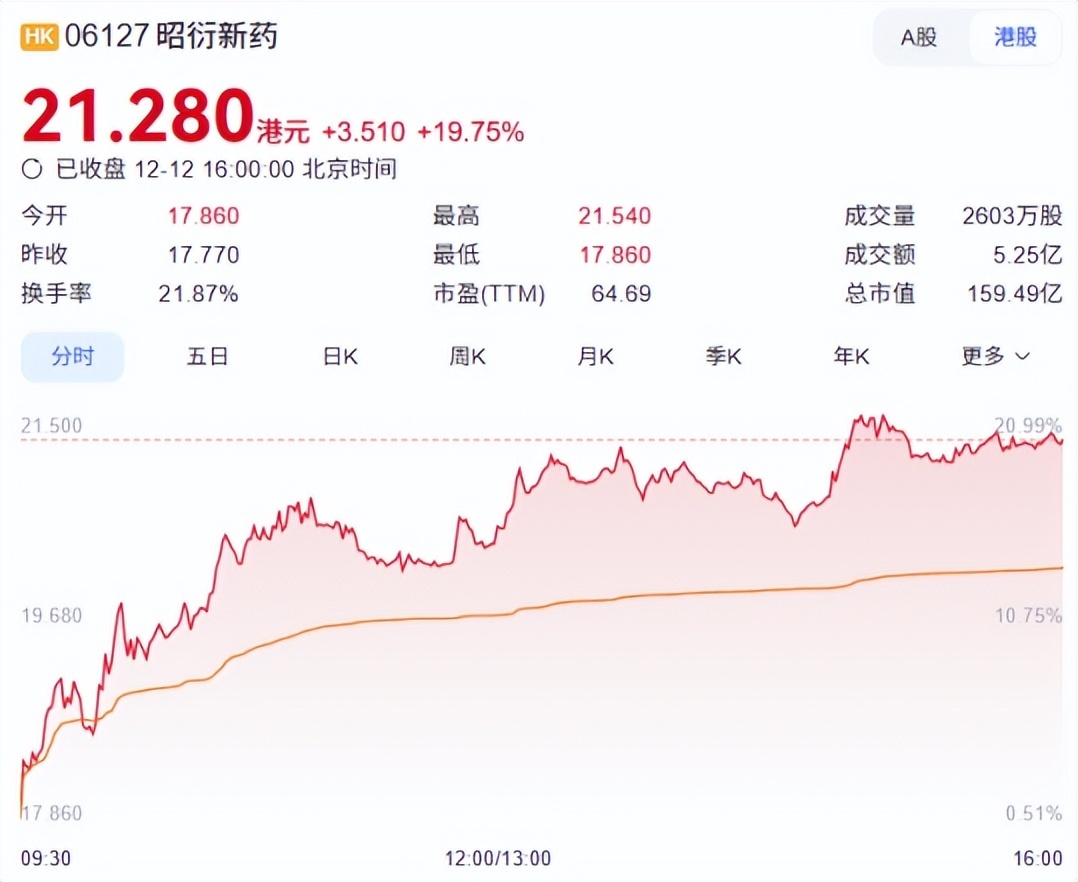
On December 12, Joinn Laboratories (06127) H-shares rose more than 11% in the morning session, closing with a 19.75% increase at HK$21.28 per share.
However, it is worth noting that for Joinn Laboratories to truly enter a new growth cycle, having monkeys alone is not enough.
Supply-demand imbalance drives monkey prices up, benefiting "water sellers"
The rise in monkey prices undoubtedly reflects changes in supply and demand.
As is well known, lab monkeys are indispensable animal models for studying complex disease mechanisms and evaluating drug safety and efficacy in new drug development. Among them, cynomolgus monkeys have become the mainstream species due to their smaller size, lower drug dosage, and over 93% genetic homology with humans.
According to statistics, a 28-day repeated-dose toxicology study for a new drug requires about 40 lab monkeys. If drug metabolism tests are needed, another 20 lab monkeys are required. In other words, preclinical research for a new drug requires an average of at least 60 lab monkeys.
This also means that the more clinical candidate pipelines in the pharmaceutical industry, the greater the demand for lab monkeys. However, one problem is that the supply of lab monkeys is difficult to keep up with demand.
According to the annual drug review reports published by the CDE (Center for Drug Evaluation of the number of new drug clinical trial applications (IND) accepted by the CDE has increased significantly in recent years, from 767 in 2017 to 2,412 in 2021, more than doubling. After a slight decline in 2022, it broke through to 3,073 in 2024, remaining at a high level.
Especially this year, innovative drugs have seen a wave of breakthroughs, and it is estimated that the number of INDs still has significant room for growth. Data from the National Medical Products Administration shows that from January to August this year, China approved 56 innovative drugs, already exceeding the 48 for the whole of last year, showing rapid growth. In addition, the 2025 National Medical Insurance Drug List successfully added 114 new drugs, 50 of which are first-class innovative drugs, with an overall success rate of 88%, significantly higher than the 76% in 2024.
However, at the same time, the supply problem of lab monkeys in new drug development has not been effectively resolved. It is reported that the breeding cycle of lab monkeys is extremely long. Cynomolgus monkeys take 4 years to reach sexual maturity, with a gestation period of about 5.5 months, and young monkeys must grow to 3 years old before they can be used. In total, it takes 6 to 7 years from breeding to market, creating a significant supply-demand gap.
Founder Securities estimates that from 2025 to 2027, the supply of lab monkeys will be about 49,000-52,400 per year, while the demand will be about 51,300-62,600 per year.
Under the market conditions of insufficient supply, the rise in monkey prices is not surprising. Riding this wave, companies like Joinn Laboratories, which hold large monkey resources, have become the biggest beneficiaries.
Previously, Guojin Securities pointed out that lab monkeys have gradually become a key scarce resource in preclinical development, and attention should be paid to leading preclinical CRO companies with sufficient animal resources such as lab monkeys.
Joinn Laboratories is among them. It is reported that in 2022, Joinn Laboratories spent about 1.8 billion yuan to acquire Guangxi Weimei Biotechnology and Yunnan Yingmao Biotechnology, obtaining 9,941 and 9,622 lab monkeys, respectively. Combined with its own more than 3,000 lab monkeys, Joinn Laboratories once had a total of over 22,000 lab monkeys. In addition, the company continues to build and operate its own monkey farms, with abundant core strategic resources, and will undoubtedly benefit fully during the demand explosion period.
However, for companies, growth is a systemic issue.
"Side business" thrives, but is the CRO business stable enough?
Looking at Joinn Laboratories' third-quarter report this year, it can be seen that the rising trend of lab monkeys has had a certain stimulating effect on the company's performance growth.
According to the financial report, in the first three quarters of this year, Joinn Laboratories achieved operating income of 985 million yuan, a year-on-year decrease of 26.23%; net profit attributable to the parent company was 80.7061 million yuan, a year-on-year increase of 214.79%.
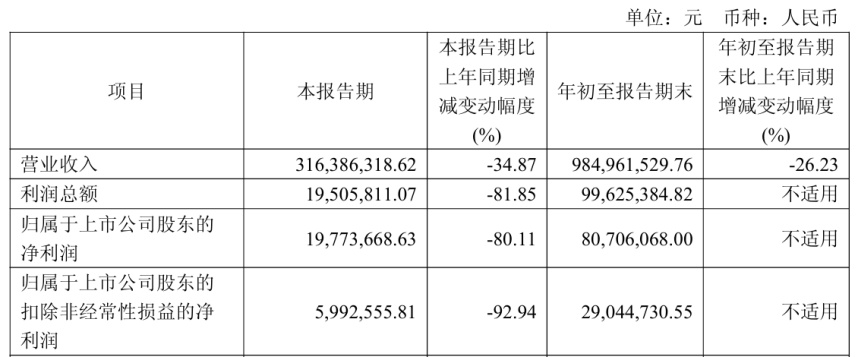
Although revenue is still declining, the significant improvement in profits is obviously more eye-catching. In this regard, Joinn Laboratories also explained with data, mainly from two aspects: in the first three quarters, the fair value change of biological assets contributed about 140 million yuan in net profit (i.e., the book value increase of lab monkeys due to market price changes); fund management income contributed 45.7684 million yuan in net profit.
Therefore, some people joked that Joinn Laboratories made a big profit through "monkey speculation + wealth management." Moreover, it is worth noting that both hoarding monkeys and wealth management should be part of Joinn Laboratories' long-term strategy.
On December 5 this year, Joinn Laboratories held a board meeting and approved a proposal on the use of idle own funds for entrusted wealth management in 2026. According to the proposal, the company plans to use idle own funds with a maximum daily balance of no more than 2 billion yuan in 2026 (from January 1, 2026, to December 31, 2026) to purchase wealth management products with high safety, good liquidity, and low risk. The investment scope includes bank wealth management products, trust products, reverse repurchase of government bonds, and other medium-low risk and below-grade wealth management products approved by internal procedures.
Joinn Laboratories stated that this move is carried out under the premise of ensuring that daily operations are not affected, aiming to improve capital returns.
But while the "side business" is thriving, the market is still concerned about the stability of the company's core business.
It is understood that Joinn Laboratories mainly engages in non-clinical drug services, including non-clinical evaluation services and drug discovery services. The former refers to the evaluation, testing, and research of the safety, efficacy, and quality controllability of test substances before the clinical trial stage. The latter mainly serves the early R&D stage of innovative drugs from target screening and validation to the determination of clinical candidate molecules (PCC), providing comprehensive integrated biological evaluation support. The breeding and sales of experimental models are considered an extension and supplement to Joinn Laboratories' main business.
In the view of many investors, whether Joinn Laboratories can achieve greater growth in the future and get rid of the impact of the "monkey cycle" still depends on the strength of its core business.
In the past few years, CRO has experienced a downturn. For example, data from Yaozhi shows that in the first quarter of 2024, there were 57 investment and financing events in the domestic new drug field, with a cumulative financing amount of 9.401 billion yuan, both showing a significant decline. With the investment market remaining cautious, the R&D momentum of innovative pharmaceutical companies is not sufficient, and the business expansion of CRO companies like Joinn Laboratories can only slow down.
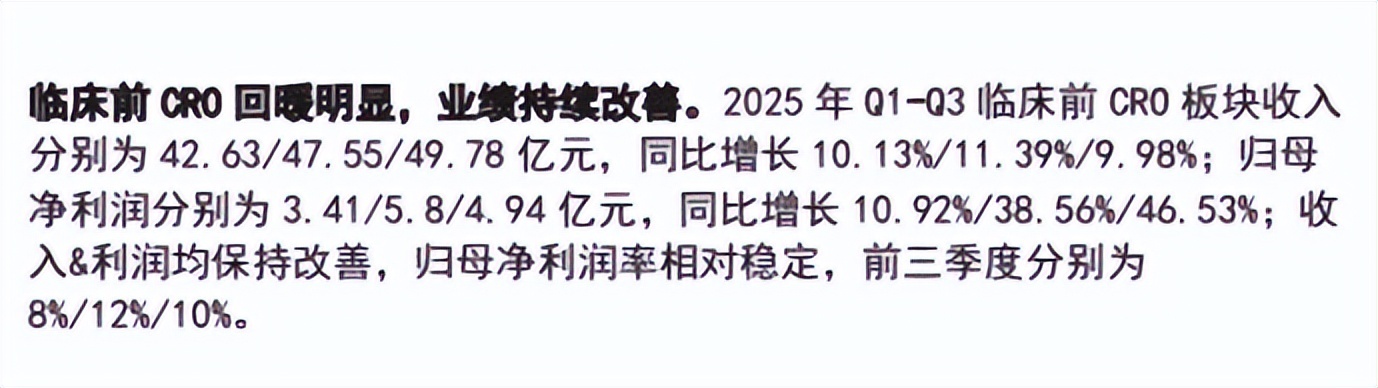
The good news is that entering 2025, based on policy benefits, the recovery of investment and financing, the growth of pharmaceutical companies' R&D demand, and the drive of innovative technologies, the recovery signals of the CRO industry are becoming increasingly obvious. Founder Securities' research report shows that in the first three quarters of 2025, the revenue of the preclinical CRO sector was 4.263 billion yuan, 4.755 billion yuan, and 4.978 billion yuan, respectively, with year-on-year growth of 10.13%, 11.39%, and 9.98%. The net profit attributable to the parent company was 341 million yuan, 580 million yuan, and 494 million yuan, respectively, with year-on-year growth of 10.92%, 38.56%, and 46.53%.
Although for individual companies, the operational aspects have not been completely improved, some growth foreshadowing has been laid. For example, in the first three quarters of 2025, Joinn Laboratories signed new orders worth about 1.64 billion yuan, a year-on-year increase of 17%, of which new orders in the third quarter were 620 million yuan, a year-on-year increase of 24%, and a month-on-month increase of 5%, showing accelerated order recovery.
When the negative factors are exhausted and the industry accelerates its recovery, Joinn Laboratories may indeed be about to reach a key cyclical turning point, and the new round of growth is not only driven by lab monkeys.
Source: Pharmaceutical Research Society
The copyright of this article belongs to the original author/organization.
The views expressed herein are solely those of the author and do not reflect the stance of the platform. The content is intended for investment reference purposes only and shall not be considered as investment advice. Please contact us if you have any questions or suggestions regarding the content services provided by the platform.
