



Ping An Good Doctor: Certainty Through Cycles

Introduction: In the eyes of investors, Ping An Good Doctor is currently standing at a rare "triple resonance" point.
In the capital market, smart money is always looking for certainty to navigate through cycles.
Recently, Morgan Stanley released a heavyweight research report, listing Ping An Insurance Group as a key focus and maintaining its top rating, while significantly raising its A/H share target price.
The underlying logic behind Morgan Stanley's bullish stance on Ping An lies in its precise capture of three major societal needs: wealth management, healthcare, and elderly care.
In this grand narrative of "value revaluation," $PA GOODDOCTOR(01833.HK) has been assigned significant strategic weight.
In Morgan Stanley's analysis, Ping An Good Doctor is no longer just an internet healthcare platform; it is the "game-changer" for Ping An Group's differentiated competition. By deeply integrating medical, health, and elderly care services, and using AI technology as its foundation, Ping An Good Doctor is becoming the core hub connecting Ping An Group's vast financial customer base with high-quality medical services.
Coincidentally, China International Capital Corporation (CICC) also made a similar judgment in its recently released 2026 outlook. CICC believes that the life insurance industry is standing at the threshold of a new "golden development period," and the positive improvements on the liability side will drive the industry's investment logic to return—from a purely defensive attribute to the track of "valuing growth capability premiums."
This means that the operational advantages of high-quality assets will be amplified.
With the dual tailwinds of industry beta (Beta) rising and policy dividends, Ping An Good Doctor is building a unique alpha (Alpha) advantage through deep synergy with the group. As the certainty of performance growth meets the recovery period of industry valuations, Ping An Good Doctor may be standing at a critical juncture for a "Davis Double Play" in performance and valuation.
01 The Tough "Slow Work"
The wave of medical O2O has surged for years, but this thick book of business is far from its final chapter.
Looking back, starting with online consultations and appointment bookings to today's instant drug delivery and health management extensions, internet healthcare has profoundly changed the medical habits of hundreds of millions of Chinese people. However, as the early dividends of user habit formation fade, the industry has reached a structural inflection point at a crossroads.
The next growth drivers, without exception, are tough "slow work" and "heavy work."
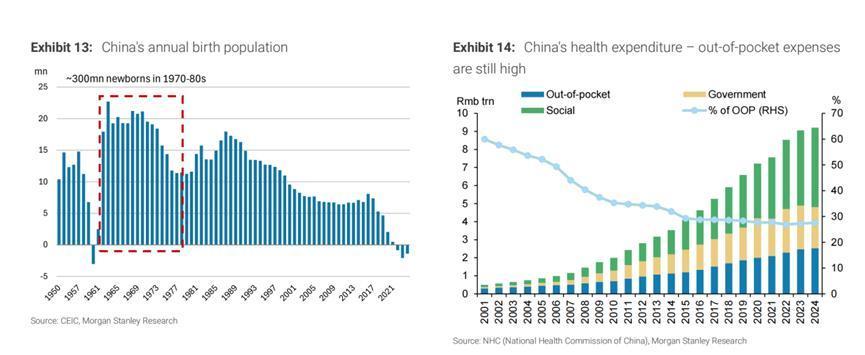
First, there is the capability contest under the silver wave. By the end of the "14th Five-Year Plan," China's population aged 60 and above will exceed 310 million, and the management of chronic diseases and the complex scenarios of home-based elderly care will become the biggest stress test for the medical service system.
Second, there is the supply test of high-end medical services. As medical insurance payment reforms enter deep waters and household wealth accumulates, the money in the hands of high-net-worth individuals is seeking outlets that can provide differentiated, high-quality services.
Finally, there is the technological leverage brought by AI. From intelligent triage to assisted diagnosis, AI healthcare is becoming the "singularity" driving the industry back to high-speed growth.
If we only consider revenue scale and GMV, JD Health and AliHealth have indeed built extremely high barriers and greatly improved the efficiency of drug circulation with their strong e-commerce genes and supply chain advantages.
But compared to the immediate GMV growth of e-commerce, the accumulation of reputation for medical services, the integration of doctor resources, and the establishment of patient trust all require a longer time cycle.
02 The Confidence of an Old Player
This is precisely the key logic behind Morgan Stanley's emphasis on Ping An Good Doctor:
It has not tried to engage in close combat with giants in the "drug-selling" red ocean but has instead built a differentiated model of "insurance + healthcare" by leveraging Ping An Group's ecosystem.
Unlike most internet healthcare platforms that rely heavily on C-end customer acquisition, Ping An Good Doctor's user sources cover F, B, and C ends.
First is the "birthright dividend" brought by the F-end (financial end). Backed by Ping An Group, Ping An Good Doctor directly reaches 247 million high-net-worth financial customers. For these users who have already purchased life insurance, health insurance, or banking services, chronic disease management and elderly care services are not just medical needs but also "value-added benefits" inherent in their policies.
This "policy in the left hand, healthcare in the right" synergy allows Ping An Good Doctor to gain tens of millions of users without having to engage in fierce competition in the external market. In 2025, 20 million Ping An Group financial customers had already been converted into Ping An Good Doctor users, with a year-on-year growth rate as high as 34.6%. Morgan Stanley's research report predicts that this conversion rate will continue to maintain a steady growth of about 10% to low double digits over the next 3 to 5 years.
Second is the B-end (enterprise end), which constitutes the second growth driver. As of September 2025, Ping An Good Doctor has covered more than 4,500 large and medium-sized enterprises, firmly occupying the health entry point for workplace professionals by providing one-stop solutions such as physical examinations, medical rooms, and health plans. Morgan Stanley's research report predicts that this segment will achieve explosive growth of 30% to 50% over the next 3 to 5 years.
With the dual support of the F-end and B-end, coupled with the steady contribution of the C-end, Morgan Stanley predicts that Ping An Good Doctor's mid-term revenue will maintain a good growth trend, with a compound annual growth rate expected to exceed 10%.
However, customer acquisition is only the first step. The "depth" of service fulfillment and user retention rates are the core tests of whether the business model can succeed. How to transform low-frequency insurance and corporate customers into high-frequency health management users depends on whether the platform can provide substantive medical value.
Ping An Good Doctor's proposed "online, in-store, at-home, and in-company" model is essentially building a three-dimensional medical service delivery network. From millisecond-level responses in online AI consultations to precise referrals in offline medical institutions, and extending services to homes and companies, it attempts to cover a wide range of scenarios in user health management—matching users with the most suitable doctors, the most accurate solutions, and the most efficient medications.
Under this closed-loop system, a business story that spans the entire user lifecycle becomes clear:
A 30-year-old user completes an annual physical examination through B-end corporate services; at 45, abnormal indicators are detected, and they naturally enter the chronic disease management system through F-end policy benefits; by 70, they naturally transform into a high-retention home-based elderly care customer.
03 AI Goes Practical, Services Go Deep
The second half of AI healthcare has begun.
In recent years, the national attitude toward AI healthcare has shifted from "support" at the macro level to "regulation" at the execution level. A clear signal is that the "path" for product market approval systems has been cleared, with relevant documents such as classification catalogs, approval processes, and key points being released one after another, and the call for practical applications growing louder.
At the end of 2025, which serves as a bridge between the past and the future, AI healthcare received a policy hammer: the "Implementation Opinions on Promoting and Regulating the Application Development of 'AI + Healthcare'" clearly stated that by 2030, intelligent auxiliary applications for primary diagnosis and treatment will basically achieve full coverage.
With policy push, scenario demand, and enterprise efficiency, leading players have long been preparing to reshape healthcare with technology:
AliHealth began laying out AI healthcare as early as 2017, stating that it would "replace half of doctors' workload within ten years"; JD Health started AI R&D in 2018 and has since released a series of AI healthcare products based on large models, such as "AI Jingyi" and "JD Zhuoyi."
In comparison, where does Ping An Good Doctor's advantage lie?
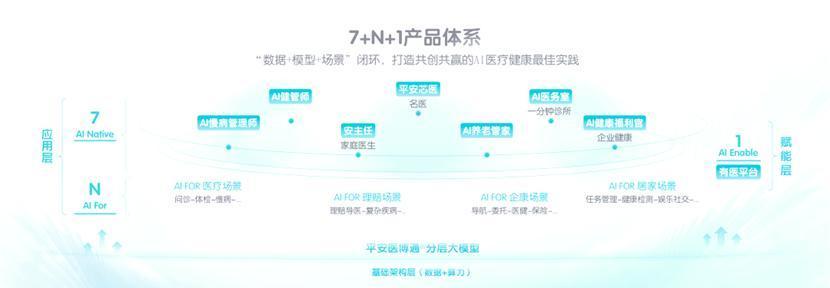
What Ping An Good Doctor holds in its hands is high-quality "raw ore" covering all scenarios of medical, health, and elderly care.
Over the past decade, Ping An Good Doctor has accumulated over 1.44 billion consultation records; with the integration with Ping An Group, it has gained access to insurance claims and health records data from approximately 250 million financial customers. This data is continuously fed into five major databases—disease, prescription, product, resource, and personal health—nurturing large models such as "Ping An Yibotong," which understand healthcare and patients better than general models.
Data feeds models, and models feed scenarios. The AI large models developed by Ping An Good Doctor not only take over repetitive tasks such as basic medical consultations, case organization, and triage reception but also standardize the wisdom of top experts, providing doctors with more knowledge and efficiency empowerment in delivering medical services, even playing a key auxiliary role in the diagnosis and treatment of complex diseases.
The efficiency improvements in AI healthcare have directly translated into economies of scale in cost reduction and efficiency gains. In the first half of 2025, the application of AI drove significant cost optimization, reducing the average service cost per household doctor by about 52%, while maintaining a diagnostic accuracy rate of about 98%.
04 When "Selling Drugs" Is No Longer the Only Business
But under the same revenue scale, Ping An Good Doctor has a better profit story: whether it's the health packages purchased by enterprises for employees or the family doctor cards included with insurance, they are essentially a more growth-oriented business logic.
In terms of Ping An Good Doctor's peers, UnitedHealth and Kaiser Permanente, the two "white moons" in the hearts of Wall Street investors, can be considered. The reason why such companies can enjoy high valuations lies in their creation of the most valued metric by investors—ARR (Annual Recurring Revenue).
When "selling drugs" is no longer the only business, Ping An Good Doctor's valuation logic has been reconstructed.
The market is voting with real money: Ping An Good Doctor has seen net inflows of southbound capital for multiple consecutive trading days. As of now, the shareholding ratio of Hong Kong Stock Connect has quietly climbed to 23.07%.
In the eyes of investors, Ping An Good Doctor is currently standing at a "triple resonance" point: first, industry resonance, where policy direction and the maturity of AI technology have turned internet healthcare from a "concept" into "infrastructure"; second, cycle resonance, where the recovery of market sentiment has brought undervalued high-quality assets back into the spotlight; and third, fundamental resonance, where the realization of cost reduction and efficiency gains and the success of the managed care model have made the company's endogenous momentum stronger.
Winds rise from the tips of grass, and waves form from ripples. Performance growth is not only a reward for long-termists from time but also the prelude to the next golden decade.
The copyright of this article belongs to the original author/organization.
The views expressed herein are solely those of the author and do not reflect the stance of the platform. The content is intended for investment reference purposes only and shall not be considered as investment advice. Please contact us if you have any questions or suggestions regarding the content services provided by the platform.
