



Besides marketing reform, Xijiu needs to show the courage to "cut the feudal lords"

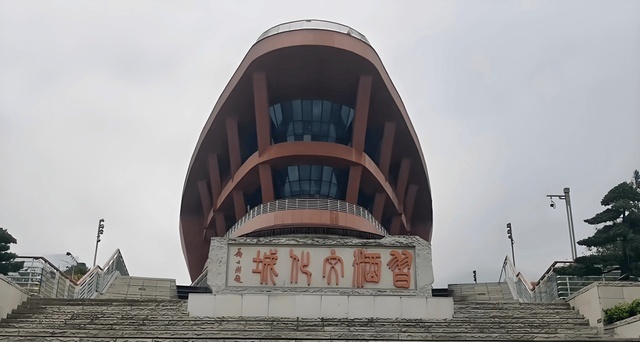
Introduction: Xijiu must promote the affordability of "Yuan Xijiu" to the general public while emphasizing the exclusivity of "Junpin Xijiu" to high-end consumers.
Amid the downturn in the baijiu cycle and price disorder, Xijiu is undergoing an "internal surgery" to recalibrate its course.
On December 5, Wan Bo, Vice Chairman and General Manager of Xijiu Group, introduced the "Marketing 2.0 Reform" at the 30th-anniversary event of the China Alcoholic Drinks Association. The reform includes establishing three major centers—marketing, digital operations, and brand promotion—and shifting from "selling liquor" to "selling a lifestyle" to further enhance the cultural essence of Junpin.
Xijiu aims to regain control over its channels and pricing through a scalpel-like reform.
The "2025 China Baijiu Market Mid-Term Research Report," jointly released by the China Alcoholic Drinks Association and KPMG, reveals that among the T9 lineup representing China's top-tier baijiu brands, the wholesale price of Junpin Xijiu dropped from 955 yuan per bottle in June 2021 to 683 yuan per bottle in the same period of 2025, a cumulative decline of 39.82%, making it one of the worst-performing products in the segment.
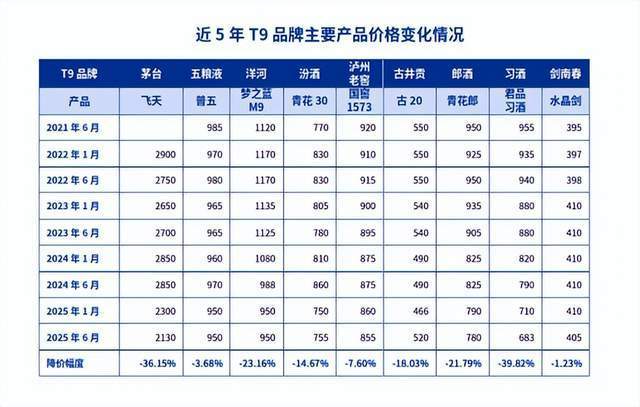
Source: 2025 China Baijiu Market Mid-Term Research Report
By December 10, the wholesale price of Junpin Xijiu had fallen to the 620-yuan mark, more than halving from its original price of 1,399 yuan.
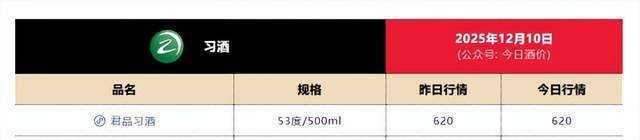
Source: Today's Liquor Price (WeChat public account)
When compared horizontally with other T9 products, the relative fragility of Junpin Xijiu's price support becomes evident.
The price of premium baijiu is a "greatest common denominator" in the market, shaped by brand history, quality perception, cultural value, and channel confidence.
Feitian Moutai's financial attributes and status as a social hard currency have built an insurmountable moat. Wuliangye's "Pu Wu" and Luzhou Laojiao's "Guojiao 1573" are backed by decades of national brand recognition and a vast consumer base for business banquets. Even Langjiu's "Qinghua Lang," another premium baijiu, has established a solid brand identity through its differentiated positioning as "one of the two great sauce-aroma baijiu" and "manor-brewed sauce-aroma baijiu."
Junpin Xijiu, launched only in 2019, is Xijiu's first attempt to break into the high-end market with a thousand-yuan sauce-aroma baijiu. While it seeks to tell a cultural story of "the taste of a gentleman," its market consensus largely relies on the strong endorsement of being a "product of Moutai Group." Junpin Xijiu's brand foundation has yet to withstand a full economic cycle.
Thus, when the sauce-aroma baijiu craze receded and the market shifted from frenzy to rationality, Junpin Xijiu became the target with the weakest brand support, the first to be "discounted" by channels and consumers to mitigate risks.
Previously, distributors were willing to stockpile heavily, and consumers were willing to pay high premiums, largely due to the trust transferred from the quality, value, and scarcity represented by the "Moutai" name.
In July 2022, Xijiu officially separated from Moutai Group and was taken over by the Guizhou Provincial SASAC. With the "halo effect" stripped away, Xijiu's brand assets must now rely entirely on its own accumulation to sustain its vast pricing system.
Since its independence, the continuous decline in Junpin Xijiu's wholesale price reflects the market's "invisible hand" re-anchoring its intrinsic value.
Under pricing pressure, Xijiu adopted the industry's common strategy of "launching new products to lift prices."
In April 2022, Xijiu upgraded its brand strategy, raising the retail price of Junpin Xijiu from 1,399 yuan to 1,498 yuan per bottle. In December 2023, it launched a new high-end product, "Junpin Xijiu · Chongli," priced above 2,000 yuan.
This mechanism can be an efficient growth tool when the industry is rising and channel confidence is high. But when the cycle reverses, with high inventory and weak terminal sales, its drawbacks become glaring.
For example, in February 2025, when Xijiu announced it would stop accepting orders for the older version of "Jiaocang 1988" to focus on promoting the higher-priced 2025 edition, it sparked widespread industry discussion. Many veteran dealers believe that forcing new products while the old ones still suffer from price discrepancies will only heighten their hesitation, fearing a return to the "overstocking-unsalable" cycle.
Despite Xijiu's introduction of a "dynamic evaluation for procurement" mechanism, the cancellation of scan-to-win red envelopes, and a shift toward terminal sales support, dealers argue that the market's excess inventory makes it difficult to quickly establish a new pricing system, with little effect on stabilizing terminal prices.
They must bear the losses from clearing old inventory while deciding whether to invest in new, higher-priced products with uncertain prospects. This "catch-22" situation not only fails to establish a stable new pricing benchmark but may also weaken channel investment in core products.
The same scenario applies to Junpin Xijiu. In April 2024, Xijiu publicly proposed a "Support Junpin" strategy, including controlling shipment pace, increasing brand investment, and canceling "reverse red envelope" policies. However, dealers generally found the results underwhelming.
Whether launching higher-positioned "Junpin Xijiu" or other products, the essence is to reset channel price expectations through new releases, avoiding direct price hikes for existing products.
Beyond new launches, Xijiu also faces an overly extensive product line.
In challenging times, brands must focus limited marketing, channel, and mindshare resources on "flagship products" to build strong brand momentum.
Compared to peers, Feitian Moutai, Pu Wu, and Guojiao 1573 have become hard currencies precisely because their manufacturers have concentrated resources for decades, turning them into absolute core products.
In contrast, Xijiu's product lineup spans from 80-yuan daily baijiu to thousand-yuan premium baijiu, with multiple products in the 200-400 yuan and 400-800 yuan ranges. This means every marketing effort and brand campaign is diluted across numerous product lines.
It must promote the affordability of "Yuan Xijiu" to the masses while emphasizing the exclusivity of "Junpin Xijiu" to high-end consumers, creating internal friction in brand communication. Internal competition disrupts the pricing system and confuses channels.
Thus, the fundamental intent of the "Marketing 2.0" reform appears particularly urgent. As Xijiu Group Chairman Wang Diqiang put it, "Rebuilding is not about simple expansion but reconstructing the development logic with a reset mindset."
The starting point of the reform lies in reshaping the marketing organization. Xijiu has broken away from the traditional sales-centric model, establishing three new centers—brand promotion, marketing, and data operations—forming a "troika" structure.
The core of this framework is the separation of "branding" and "sales." The Brand Promotion Center has been elevated to unprecedented strategic importance, shifting from passive sales support to actively building brand equity and consumer mindshare as a "pull" strategy.
By centering on consumers and using data for decision-making, Xijiu aims to forge emotional connections through brand culture, creating lasting brand "pull." This is precisely what Xijiu currently lacks most.
However, whether Xijiu can ultimately repair its damaged pricing system and channel expectations depends not only on the efficiency of the new organizational structure—whether the "troika" can truly collaborate—but also, more fundamentally, on whether Xijiu can muster the courage to recalibrate its product portfolio, brand positioning, and new product launch strategy after the growing pains.
Does Junpin Xijiu's high-end story need retelling? How can its flagship product balance new launches and inventory clearance? Can its sprawling product lines be successfully streamlined?
Each question is a tough nut to crack—but one that must be cracked.
The copyright of this article belongs to the original author/organization.
The views expressed herein are solely those of the author and do not reflect the stance of the platform. The content is intended for investment reference purposes only and shall not be considered as investment advice. Please contact us if you have any questions or suggestions regarding the content services provided by the platform.
