


How many more Pinduoduos can be created ultimately depends on the heavy investment in China's supply chain


The phrase "Rebuild a Pinduoduo" originated from the speech by Pinduoduo's co-chairman Zhao Jiazhen at the shareholders' meeting last Friday (December 19). As the strategic core of the company for the next three years, this statement quickly sparked heated discussions among investors.
From a quantitative perspective: Temu achieved in just three years the business scale that took Pinduoduo's domestic main site about a decade, and the two are now comparable in size. Therefore, "rebuilding a Pinduoduo" means that in three years, the group's overall scale will double the current combined size of Temu and the main site—in other words, its scale will be equivalent to rebuilding four of today's Pinduoduo main sites.
This is undoubtedly an ambitious plan. The ensuing question is: How will Pinduoduo achieve it?
As long-term observers of the e-commerce industry, we believe this strategy is not empty talk. It is backed by the resonance of three industrial drivers: Temu's explosive growth over the past three years, the structural opportunities in the global e-commerce market, and the profound transformation of China's supply chain logic. The convergence of these factors is expected to drive the company's scale to double or even grow more significantly in the coming years.
The more fundamental logic lies in: How many "Pinduoduos" Pinduoduo can ultimately "rebuild" does not simply depend on the speed of overseas market expansion, but more on the intensity of its commitment to China's supply chain and the depth of its upgrade and transformation. This will be the core cornerstone for navigating cycles and implementing the strategy.
The specific logic is as follows.
01 The Clear Path: Structural Growth Window in Global E-Commerce
The opportunity to "rebuild a Pinduoduo" first comes from the incremental space in the global e-commerce market. Whether in emerging markets where penetration rates are not yet saturated or developed markets where there is still room for share growth, both provide fertile ground for Chinese cross-border e-commerce expansion.
Currently, China's e-commerce penetration rate has exceeded 36%, with shelf e-commerce and live-streaming e-commerce structures stabilizing, and growth increasingly shifting overseas. In contrast, global e-commerce is still in a steady growth phase: in 2024, the global e-commerce penetration rate is about 20%, only half of China's; global e-commerce retail sales total about $6.3 trillion, while China's is $3.3 trillion.
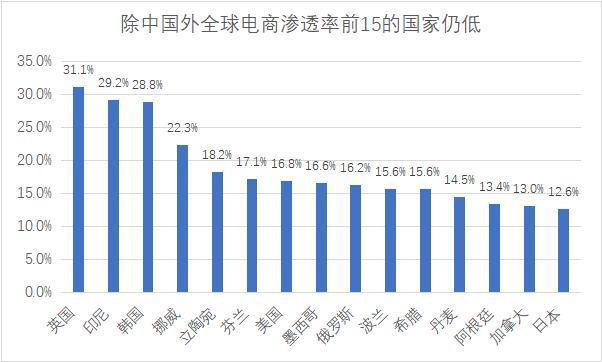
Source: eMarketer
The lower base means overseas e-commerce has considerable potential, with core logic including:
Logistics, online payment, and other infrastructure in many regions are still not as convenient as in China, and as facilities improve, e-commerce convenience will continue to rise;
The pandemic accelerated the shift of consumer behavior online, especially in regions with large populations and originally low penetration rates like Southeast Asia and Latin America, where e-commerce habits have quickly taken root.
eMarketer predicts that the global e-commerce penetration rate will increase by about 1 percentage point annually, with the market size expected to exceed $8 trillion by 2027, achieving a compound annual growth rate of over 8% in the next three years.
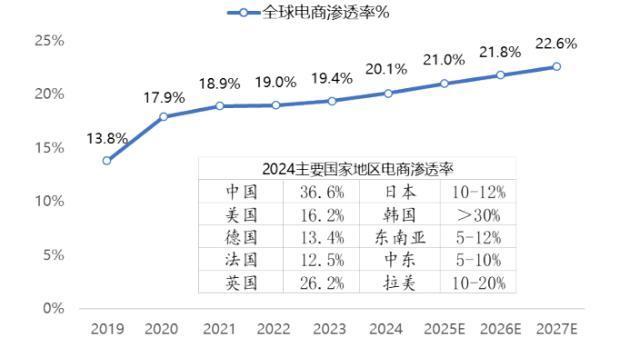
Chart: Global e-commerce penetration to rise by 1 percentage point annually Source: eMarketer, CMB Research
After more than two decades of development, China's e-commerce industry has honed a mature operational system amid the world's highest penetration rates and most intense competition, leading overseas markets by about 5-10 years. Leveraging domestic efficient supply chains, Chinese e-commerce companies have demonstrated significant competitiveness in going global.
Take Temu as an example: its core advantage lies in replicating the main site model, compressing intermediate links by directly connecting with factories, with prices for similar products averaging 30% lower than Amazon's, especially in categories like sports and outdoor, digital electronics, and home goods.
In 2025, the U.S. tightened tax-free policies for cross-border packages under $800, and the EU implemented the Digital Services Act, among other trade and regulatory changes, posing stress tests for Chinese cross-border e-commerce. Temu mitigated tariff impacts by launching semi-hosted and local-to-local models and optimized supply chain compliance to address regulations.
Ultimately, Temu's monthly active users (MAU) in the U.S. gradually rebounded, with global MAU reaching about 520 million, equivalent to over 70% of Amazon's. It is estimated that in 2025, the gross merchandise volume (GMV) of Temu, Shopee, and other top four Chinese cross-border platforms will grow by 25% year-on-year, with Temu's growth rate nearing 40%, significantly higher than the global e-commerce average of 8%.
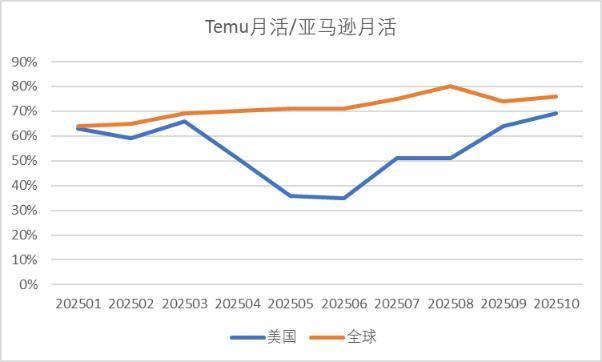
Source: SensorTower
While global e-commerce penetration continues to rise, regional market growth characteristics diverge:
In developed markets like the U.S. and Europe, e-commerce penetration rates are 16.2% and 13.4%, respectively, with growth mainly driven by the shift of existing consumption online and the online penetration of high-ticket categories;
In emerging markets like Southeast Asia and Latin America, e-commerce penetration is only 5%-12% and 10%-20%, respectively, with demographic dividends and economic growth jointly driving incremental demand. In 2024, their e-commerce growth rates reached 18.9% and 17.0%, offering high-growth opportunities.
The market landscape remains relatively fragmented, leaving room for new players:
In North America, Amazon's share is about 31%, but platforms like CVS and Walmart are clearly diverting traffic;
In Europe, Amazon's share is only 15.2%, with local platforms like Otto and Media Markt showing strong competitiveness;
In Latin America, MercadoLibre holds about 27% share, though logistics barriers limit its monopoly;
Southeast Asia presents a diverse competitive landscape with Shopee, Lazada, and local platforms.
Against this backdrop, Temu's global layout is becoming more balanced: while consolidating its position in developed markets like North America and Europe, it is increasing investments in emerging markets like Southeast Asia and Latin America. From a GMV perspective, the U.S. share has dropped to less than 30%; MAU distribution is more even, with shares in high-growth regions like Asia and South America continuing to expand.
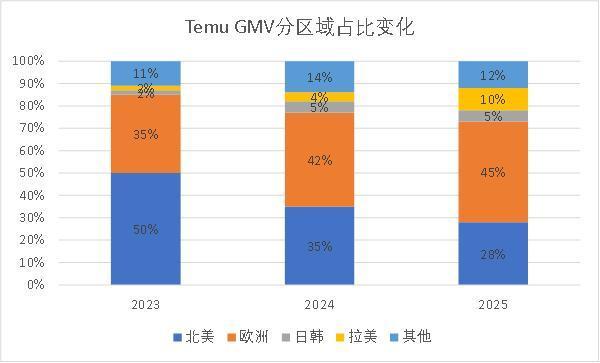
Source: CICC

Source: Sensor Tower
02 The Hidden Path: Deep Confidence Rooted in China's Supply Chain
Chinese e-commerce companies can gain market share overseas not only by operational efficiency but also by relying on the powerful Chinese supply chain behind them. As platforms that facilitate transactions, the scaled development of e-commerce always depends on the solid foundation of the supply chain.
The initial success of platforms like Temu is the result of combining the "goods circulation" capability of China's supply chain with online traffic. To achieve sustainable share expansion and value growth, it is necessary to move from simple "goods output" to complex "supply chain capability output." The quality upgrade of China's supply chain will be the key to winning in the global market.
1. Home Advantage of Chinese Manufacturing
China has the world's most complete industrial system, covering all categories in the United Nations industrial classification, with comprehensive manufacturing support. Especially in categories like small appliances, home goods, apparel, and footwear, industrial clusters show significant agglomeration effects, enabling rapid response from R&D to production and shipping.
This advantage manifests as differentiated competitiveness in different markets:
In developed markets, Chinese products often serve as affordable alternatives to high-end brands, emphasizing cost-performance;
In emerging markets, they become choices for local consumers' "consumption upgrades," highlighting quality-price ratio.
Having weathered tests like the pandemic, the resilience of China's supply chain has gained global recognition. Against the backdrop of tariff frictions in 2025, China's supply chain has instead become a "hard currency" in a high-inflation environment. Marketplace Pulse data shows that the proportion of Chinese sellers among Amazon's top sellers has risen, exceeding 50%, confirming the global competitiveness of Chinese manufacturing.
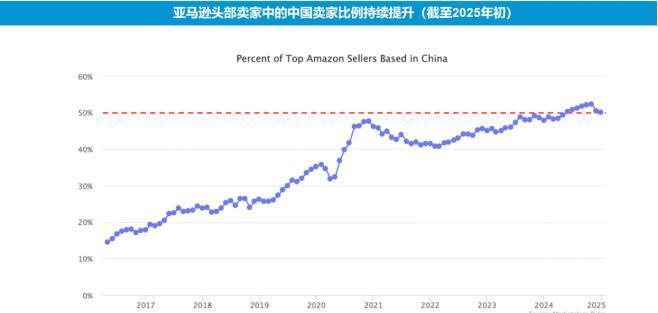
Source: Marketplace Pulse, Soochow Securities
Cross-border e-commerce platforms closest to the supply chain thus gain unique home advantages. Leading platforms go further by actively investing in supply chain optimization. Pinduoduo's early experience in supply chain transformation through initiatives like Duoduomaicai (group buying for groceries) and "Billion Subsidies" has provided critical support for Temu, making it one of the cross-border e-commerce players adept at the C2M model. Through fully hosted and semi-hosted models, Temu has simplified cross-border processes and lowered the threshold for foreign trade, enabling more small and medium-sized factories to reach global consumers directly.
Temu has also deeply integrated with industrial clusters to optimize costs and efficiency: the platform connects directly with factories, keeping raw material markups within 10%, and combined with the scale effect of hit products, further reduces costs. For example, products like electric air fryers and portable washing machines are 20%-30% cheaper than traditional foreign trade channels through bulk purchasing and simplified packaging.
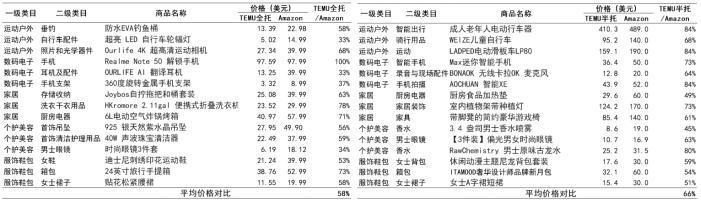
Chart: Temu product prices compared to Amazon U.S. Source: Guosen Securities
2. Supply-Demand Balance: Temu's "Heavy Bet" on China's Supply Chain
However, to gain greater global market share, resting on existing advantages is insufficient. From the four dimensions of e-commerce competition—"variety, speed, quality, and cost"—China's current model excels in "speed" and "cost" but still has room for improvement in "variety" and "quality."
Compared to traditional foreign trade, cross-border e-commerce has fewer circulation links and higher efficiency, especially the B2C model, which allows products to reach overseas consumers directly, saving costs. To further achieve "variety" and "quality"—that is, to provide richer and better-quality products—a viable path is to replicate the mature domestic C2M model in the cross-border field.
At the shareholders' meeting, Zhao Jiazhen made it clear that Pinduoduo would bet on this: after repeated discussions, the company has anchored China's supply chain as the core of its next phase of development; it will continue to pursue high-quality development, fully investing in the high-quality and brand-oriented upgrade of China's supply chain, thereby driving platform and ecosystem value leaps.
Against the backdrop of intensifying mismatches between personalized demand and homogenized supply, shortening the distance between consumers and producers is key to improving efficiency. Pinduoduo's domestic C2M model has transformed from a concept into a practical efficiency advantage. Since last year, the platform has successively launched measures like "Billion Subsidies," "E-commerce Westward Expansion," "New Quality Supply," and "Trillion Support" to further strengthen the supply chain.
Take the "Trillion Support" plan launched in April 2025 as an example: Pinduoduo plans to invest over RMB 100 billion in funds and traffic resources over the next three years, focusing on supporting industrial cluster merchants in transformation and upgrading, encouraging them to shift from OEM thinking to user-centric and brand-oriented thinking. Dedicated teams have 深入農產區、產業帶,提供研發、生產、供應鏈等環節定制方案,目前已帶動平台農產品上半年銷量同比增長 47%,工業品供給豐富度提升 35%。
The number of active merchants is a direct reflection of supply chain capability: Pinduoduo's platform now has over 14 million active merchants. From "Billion Subsidies" to "Trillion Support," the core logic has always been "supply-demand balance"—feeding growth results back to consumers and merchants, driving the supply chain toward high quality and brand evolution.
03 Feasibility Analysis: Three Calculation Paths
The overseas market space (clear path) and supply chain upgrade (hidden path) form the realistic logic for "rebuilding a Pinduoduo." We further deduce the feasibility of this goal from a data perspective.
Method 1: Global Share Estimation
Current global e-commerce GMV is about $6.3 trillion, and Pinduoduo's global GMV is about $780 billion, corresponding to a 12% market share. Referring to the steady-state e-commerce landscape in China, leading companies typically hold 20%-30% shares.
Assuming global e-commerce penetration increases by 1 percentage point annually, global GMV could reach $8.5 trillion in three years. If Pinduoduo's overseas market share reaches domestic leading levels (20%), the corresponding GMV would be $1.7 trillion, 2.2 times the current scale, essentially achieving the goal.
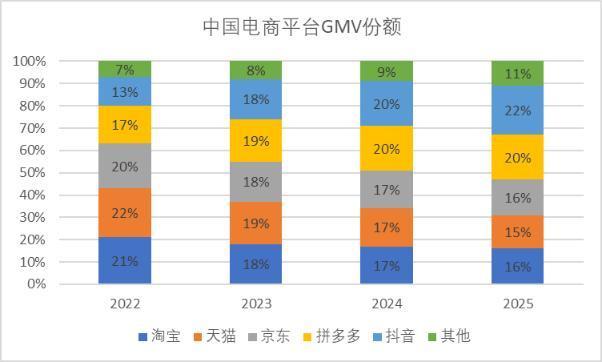
Source: Bloomberg
Method 2: Benchmarking Amazon's Growth Trajectory
Amazon doubled its revenue between 2019 and 2022. Pinduoduo's 2025 revenue is estimated at about $61 billion, equivalent to Amazon's 2019-2020 level. Referencing Amazon's 3P business growth trajectory and factoring in stronger support from China's supply chain, Pinduoduo doubling its revenue to $120 billion in three years is a realistic target.
From user data, Temu's MAU has exceeded 520 million, over 70% of Amazon's, providing a foundation for benchmarking.
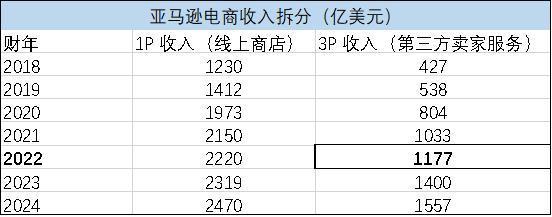
Source: Amazon financial reports, Jinduan estimates
Method 3: Bottom-Up Calculation
Using 2025 as the base year, core indicators for 2026-2028 are assumed as follows:
Domestic business compound growth rate: 10%, slightly higher than the industry, driven by increased user purchase frequency; monetization rate remains stable.
Overseas business compound growth rate: 40%, about 15% higher than the industry, driven by market expansion and increased user purchase frequency; monetization rate remains stable.
Calculations show that Pinduoduo's total GMV in 2028 will reach RMB 8.2 trillion, 1.5 times that of 2025; due to higher overseas monetization rates, total revenue will be about RMB 850 billion, 2.07 times that of 2025, essentially achieving the "rebuild a Pinduoduo" goal, with core drivers coming from Temu's rapid growth.
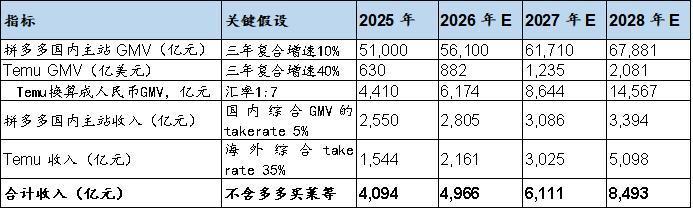
Source: Jinduan Research Institute calculations
04 The Essence: From "Goods to the World" to "Chain to the World"
Over the past three years, Temu's rapid development has marked the initial mission of Chinese e-commerce going global—"goods to the world"—achieved through 极致性价比 and efficient traffic operations, delivering massive amounts of Chinese goods to global consumers. But this is only the prologue. Pinduoduo's strategic ambition to "rebuild a Pinduoduo" points to a deeper, more challenging phase: "chain to the world."
"Chain to the world" means Pinduoduo's role will evolve from a platform for cross-border goods circulation to a key participant in the quality upgrade of China's supply chain. It must not only continue selling goods but also deeply 介入 and reshape the entire chain from product R&D, smart manufacturing, and brand 孵化 to cross-border logistics and localized services. This requires the company to heavily invest resources in the "high-quality development" and "brand upgrade" of China's supply chain, as emphasized by Zhao Jiazhen—this is the core of future development.
The essence of this shift is a fundamental evolution in the 出海 model of Chinese manufacturing. The early "goods to the world" relied on existing 产能 and cost advantages, while "chain to the world" requires exporting organizational capabilities, data capabilities, and 协同 capabilities, helping Chinese factories shift from 被动接单 to actively 洞察 global demand, transforming from "OEMs" in the manufacturing 环节 to "market players" with pricing power and brand strength.
Thus, the goal of "rebuilding a Pinduoduo" is far more than a numbers game around GMV. Its true 内涵 is whether Pinduoduo, leveraging the 平台's 海量 data and market 触角, can successfully 牵引 China's supply chain through a qualitative change from "goods to the world" to "chain to the world."
This qualitative change is the ultimate answer for Pinduoduo to achieve sustainable growth and 穿越 cycles. How many "Pinduoduos" Pinduoduo can ultimately "rebuild" precisely depends on the depth and effectiveness of its "heavy bet" on China's supply chain and 助力其升级. Only by continuously driving and empowering through data, helping Chinese manufacturing complete the evolution from "cost advantage" to "quality and brand advantage," and moving from "Made in China" to "Branded in China," can Pinduoduo's globalization blueprint truly gain an inexhaustible source of momentum.
This is not only a strategic choice for one company but also more than just a business—it is a profound journey of 共同成长 with China's real economy.
This article is based on publicly available information and is for informational purposes only, not constituting any investment advice$PDD(PDD.US) $Amazon(AMZN.US)
The copyright of this article belongs to the original author/organization.
The views expressed herein are solely those of the author and do not reflect the stance of the platform. The content is intended for investment reference purposes only and shall not be considered as investment advice. Please contact us if you have any questions or suggestions regarding the content services provided by the platform.
