


Validating value through commercialization, integrating resources via platforms: Everest Medicines reshapes the commercial logic of innovative drugs


Chinese innovative pharmaceutical companies are facing a core question: As the industry's development logic shifts from "imitation and follow-up" to "original innovation," how can companies break through the barriers of homogeneous competition and achieve high-quality breakthroughs?
In response to this question, Everest Medicines recently unveiled its "2030 Development Strategy," with a dual-engine approach of "BD collaboration + independent R&D" as the core pathway, clearly outlining a growth blueprint to transition from a leading Asian biotech to a global integrated biopharmaceutical company. This strategy not only reflects the company's deep analysis of domestic pharmaceutical industry trends but also provides a practical model for the transformation and upgrading of China's innovative drug industry.
As China's innovative drug industry gradually gains global acceptance, Everest Medicines has also demonstrated its blockbuster product incubation capabilities through the explosive performance of its core product Nefecon®. The implementation of the "2030 Strategy" further marks Everest's strategic evolution from "single-point blockbuster incubation" to "global diversified creation," propelling its innovation layout into a new phase driven by globalization and multi-technology platforms.
01 Dual-Engine System to Build a Value Growth Loop, Commercialization Capability as the Cornerstone
The core logic of Everest Medicines' "2030 Strategy" lies in building a dual-engine system of "commercialization creating certain value and R&D business creating growth value," with the commercialization segment serving as the "certainty engine" for strategy execution. Backed by market-validated end-to-end core capabilities, it has become an irreplaceable cornerstone for the company's future development.
After years of refinement, Everest has developed an integrated commercialization platform (A2MS) driven by scientific and commercial insights, covering access, medical affairs, marketing, and sales. The synergy across these functions significantly outperforms industry averages, as evidenced by the explosive growth of its core product Nefecon®.
As the world's first and only fully approved targeted therapy for IgA nephropathy, Nefecon® has set a benchmark in commercialization: its first prescription was issued at Shanghai Ruijin Hospital in May 2024, and by November, it was successfully included in the National Reimbursement Drug List (NRDL), achieving the milestone of "market access upon launch." In 2025, its first full commercial year, sales exceeded RMB 1 billion in just the first three quarters, making it the first chronic disease treatment in China's pharmaceutical industry to hit the RMB 1 billion mark in its debut year.
Notably, this stellar performance was achieved by a sales team of fewer than 200 people—eschewing the industry's traditional "mass manpower" approach. Through precise disease treatment positioning, robust real-world studies, efficient NRDL access, and strategic hospital coverage, Everest achieved rapid product adoption with exceptional efficiency, solidifying the industry-leading status of its A2MS integrated commercialization platform.
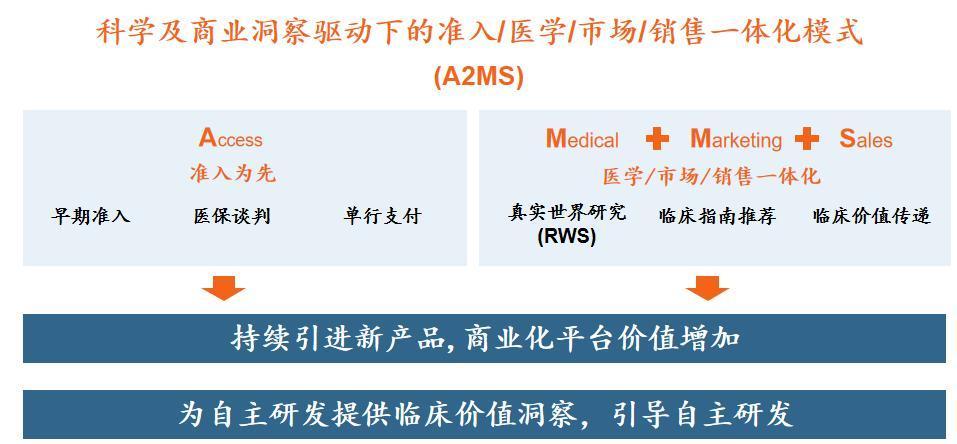
Figure: Everest Medicines Commercialization Platform (A2MS)
From precise disease treatment positioning to building a clinical evidence base through extensive real-world studies, and then efficiently advancing NRDL access and hospital coverage, the closed-loop operation of each step ensures rapid product adoption. It is precisely because of this "certainty engine" in commercialization that Everest's R&D "growth engine" is highly anticipated by the market.
In R&D, Everest is sharply focused on disruptive mRNA technology platforms, prioritizing breakthroughs in mRNA in vivo CAR-T and mRNA cancer vaccine platforms. Significant progress has already been made: its personalized therapeutic cancer vaccine EVM16 has initiated first-in-human (FIH) trials with patient dosing completed; its off-the-shelf therapeutic cancer vaccine EVM14 has dosed the first patient in a global multicenter Phase I trial in the U.S.; and its autologous CAR-T program EVM18 has completed multiple non-human primate (monkey) studies, with clinical candidate molecules identified. The company holds full intellectual property and global rights to these products.
The "2030 Strategy" explicitly states that the company will fully initiate global expansion, accelerate the development of global registration and clinical capabilities, and gradually establish commercialization systems in Europe, the U.S., and emerging markets, aiming to achieve a dual-engine growth model of "overseas licensing + commercialization."
Building this "dual-engine" model is no easy feat—it must be grounded in the core capabilities accumulated over years of development.
Looking back, Everest's growth can be divided into three key phases: The first phase, in the initial five years after its founding, saw the company build its core framework and successfully complete an IPO on the Hong Kong Stock Exchange. The second phase, from 2023 to 2025, marked the initial formation of the "dual-engine" platform, with the successful launch and commercialization of two core products, Etrasimod and Nefecon®, alongside the establishment of an mRNA-based in vivo CAR-T platform and a cancer vaccine R&D platform.
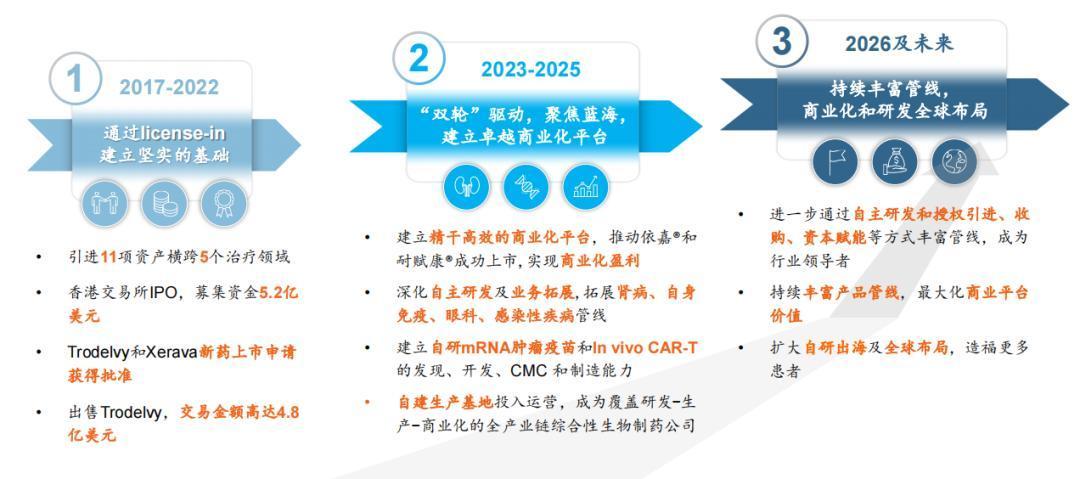
Figure: Everest Medicines' Three Development Phases
Today, Everest Medicines is entering its third phase of full-scale expansion. During this stage, the company will continue to enrich its pipeline through independent R&D, licensed introductions, and capital M&A, gradually building a high-value product portfolio and steadily advancing toward its goal of becoming a globally leading integrated biopharmaceutical company.
02 Becoming a Blockbuster Incubator, Unleashing the Potential of the Commercialization Platform
If the dual-engine system provides Everest with the core momentum to move forward, the blockbuster incubation potential of its commercialization platform is the key to propelling the company to new heights.
One of Everest's core tasks in the future is to replicate this mature commercialization capability across more product areas. Under the "2030 Strategy," the company plans to add 3-5 late-stage assets annually through BD partnerships; by 2030, it aims to achieve total revenue exceeding RMB 15 billion, with existing pipelines contributing ~RMB 9 billion and newly introduced pipelines ~RMB 6 billion, while exploring potential licensing-out (License-out) revenue. The CAGR is expected to exceed 50% from 2025 to 2030 and remain above 15% post-2030.
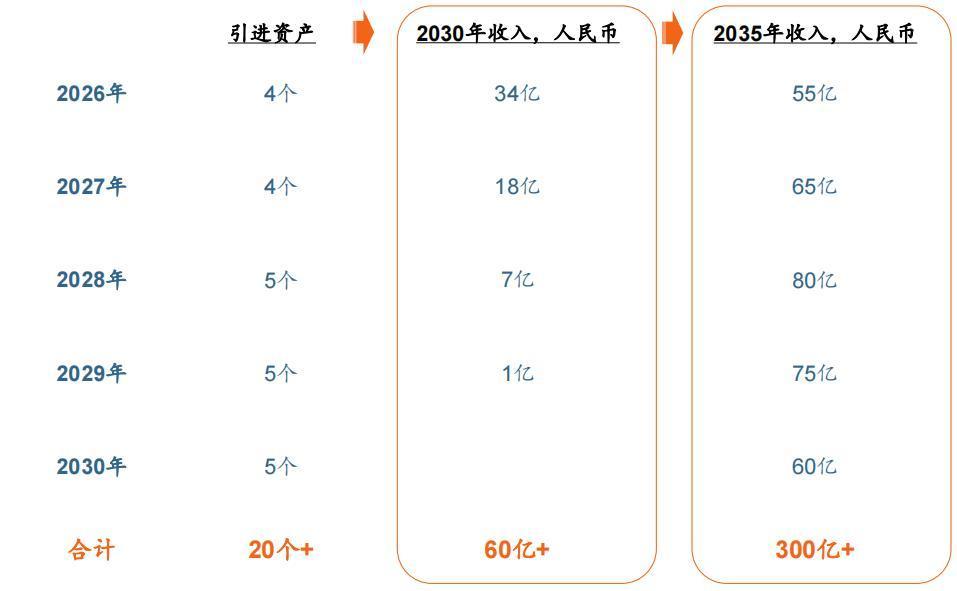
Figure: Everest Medicines' Asset Introduction Plan
To achieve this goal, Everest has outlined a clear commercialization path: On one hand, it will continue to deepen its focus on existing core products, driving further adoption of Nefecon® with the core concept of "targeted treatment, early intervention, and long-term management," with sales expected to reach RMB 2.4-2.6 billion in 2026. On the other hand, it will accelerate the commercialization of new products, prioritizing preparations for the launch of its autoimmune blockbuster Velsipity® (etrasimod), while executing a heavyweight collaboration with Haisco, including providing commercialization services for six of Haisco's mature products and advancing the commercialization of the cardiovascular disease treatment PCSK9 inhibitor Lerodalcibep in Greater China.
Notably, Lerodalcibep, exclusively licensed in, boasts core advantages such as a smaller molecular weight and longer half-life, enabling convenient monthly subcutaneous injections without the need for cold-chain storage—greatly expanding patient accessibility for use at home or while traveling.
In terms of efficacy, Lerodalcibep has also demonstrated excellence. Across multiple global Phase III trials involving over 2,900 patients, results showed that Lerodalcibep can sustainably reduce LDL-C (low-density lipoprotein cholesterol) by ≥60% in CVD patients or those at very high/high risk, and by 59% in HeFH (heterozygous familial hypercholesterolemia) patients with more severe LDL-C elevation. Based on these strong clinical data, Lerodalcibep's Biologics License Application (BLA) was approved by the FDA on December 17, 2025, for lowering LDL-C in adults with hypercholesterolemia (including HeFH); the product has also been filed with the EMA and is expected to submit a BLA in Greater China in the first half of 2026, with potential approval and launch as early as 2027.
Through this strategic collaboration with Haisco, Everest has quickly filled pipeline gaps in high-potential therapeutic areas (e.g., cardiovascular/metabolic), building a competitive matrix. This move underscores Everest's long-term strategic vision in commercialization platform development.
Leveraging scientific and commercial insights, the "2030 Strategy" introduces an "N+X" product portfolio strategy, centered on key therapeutic areas like nephrology, autoimmune, critical care, cardiovascular/metabolic, and ophthalmology, to build a pipeline system of "N core blue-ocean blockbusters + X synergistic value-added products." Through continuous product introductions and strategic positioning, the company aims to establish a clear product hierarchy across segments—some focused on volume-driven stable revenue, others on differentiated indications to address unmet needs. Ultimately, this hierarchical approach will help Everest build an ecosystem moat with long-term competitive barriers.
03 Spillover Effects: Becoming a Consolidator of China's Innovative Drug Assets
The advancement of the "2030 Strategy" is not only about Everest's own growth but will also have far-reaching spillover effects on the transformation of China's innovative drug industry.
Currently, China's innovative drug sector faces structural challenges of "severe product homogeneity and insufficient commercialization capabilities," with most biotech companies constrained by single-product pipelines and struggling to realize long-term commercial value. Recognizing this pain point, Everest is determined to act as a consolidator of China's innovative drug assets, empowering high-quality products through its commercialization capabilities to achieve synergistic value creation.
By generating stable cash flow through its commercialization platform to support cutting-edge R&D with "non-dilutive financing," Everest has effectively addressed the industry's core dilemma of "continuous burn" versus "commercial profitability," providing a replicable path for domestic biotechs transitioning into biopharmas.
Everest's ability to become a consolidator stems from two key factors: first, the full ecosystem empowerment from CBC Group, and second, its proven core competencies.
As the central integration platform within CBC Group's ecosystem, Everest benefits from continuous resource empowerment: beyond pipeline imports from CBC's NewBridge Pharmaceuticals, more high-value products and strategic opportunities from ecosystem partners will be directed its way, ensuring stable BD resources. Thus, understanding Everest's core value requires a deep grasp of CBC Group's ecosystem.
At the same time, Everest's commercialization capabilities have been market-tested. In the innovative drug space, developing and launching products may not be the hardest part—achieving commercial success is far rarer. Everest's validated commercialization prowess not only enhances its own products but also serves as a key advantage in attracting external biotech collaborations. Amid a fragmented and low-concentration industry, Everest is steadily emerging as a central force in innovative drug commercialization.
Concurrent with the long-term strategy release, the collective share purchases by core management and major shareholders further demonstrate unwavering confidence in strategy execution and long-term growth. Major shareholder CBC Group has also pledged continued share purchases over the next six months.
Looking ahead, as its commercial product matrix expands, R&D pipelines deliver, and global operations strengthen, Everest is poised to achieve its 2030 revenue target of RMB 15 billion and cross the RMB 100 billion market cap threshold. From the birth of blockbuster Nefecon® to the imminent approval of "next surefire blockbuster" Velsipity®, from mRNA platform breakthroughs to the Haisco collaboration, Everest has taken solid steps toward strategic execution.
Amid the waves of the innovative drug industry, Everest is writing a new chapter in China's global pharmaceutical journey with clear strategic focus and strong execution.
This article is based on publicly available information and is for informational purposes only, not investment advice.$EVEREST MED(01952.HK)
The copyright of this article belongs to the original author/organization.
The views expressed herein are solely those of the author and do not reflect the stance of the platform. The content is intended for investment reference purposes only and shall not be considered as investment advice. Please contact us if you have any questions or suggestions regarding the content services provided by the platform.
